Chapter 10: Rising of the Automobile Age
1901 - 1929
The average resident, if there ever is such a person, awoke on January 1, 1901, with little thought as to the changes a new century would bring. Much later, historians concluded that the passing of the frontier in America had already taken place in 1893, and some significant forces of change were at work in the nation.
The center of population had moved west to southern Indiana and would continue to move toward the Pacific coast as each successive U.S. Census in the new century was recorded. Migration, nourished by mobility, was under way.
A manner of some importance to the Pennsylvania Railroad at this time was assuring a sufficient water supply for existing and future needs of its steam locomotives.The company had perfected the technique of picking up water from troughs alongside the tracks on the fly and installed this equipment along its main line at St. David’s and Glen Loch. The railroad retained American Pipe Manufacturing Company of Philadelphia to develop a distribution network for the sites, utilizing the Pickering creek water supply.
On July 23,1895, officials of the American Pipe incorporated the water companies: Easttown Water Company; Tredyffrin Water Company; Villanova Water Company, serving Radnor township; Willistown Water Company; and East Whiteland Water Company. One week later, Easttown Water was renamed Berwyn Water Company and it acquired the other four companies.
During its four years of existence, Berwyn Water developed the Pickering creek pumping station near Phoenixville and built the Diamond Rock reservoir at the highest point on the line into the Valley. It had also laid pipes along Lancaster turnpike from Bryn Mawr to Glen Loch, providing public water to our local area. In 1899, North Springfield Water Company acquired Berwyn Water. The growing water industry, shared by many companies, was consolidated in 1925, when the community suppliers were acquired by Philadelphia Suburban Water Company.
Ice played an important role in the early days of the twentieth century, a time when fresh and perishable foods from other parts of the world became available, but electric refrigeration for homes was still in the future. Few homes in Berwyn had springhouses for cooling and storing food. The swinging shelves, usually found hanging from basement rafters, were at best unsatis-factory. The icebox was welcomed into the kitchen despite its drawbacks of emptying the drip pan or running out of ice at a crucial time.
The Berwyn Ice Company began operation October 7, 1901 on Lancaster pike at Woodside avenue. It advertised its product as “pure ice manufactured from pure spring water” at the source of Darby creek, old Springhouse tavern. The plant was managed for about two years by Charles Z. Jones of Kromer avenue. Jones was succeeded by George Turner who took up residence at the south east corner of Berwyn and Woodside avenues, a block from the plant.
Cash flow was a problem. The plant was mortgaged in 1906. When the company defaulted in 1913, Bryn Mawr Ice Company became the owner. Shortly after this the tall red-brick building used for ice storage was erected. It had the capacity to store two thousand tons of ice. The sign atop the building read, “Ice Never Fails,” and remained a Berwyn landmark for many years. But ice manufacturing finally did fail and its operations ceased around 1950. In 1971 the tall brick building and its sign came down. The long, low building which once housed horses, delivery wagons, and later trucks is today Yang’s Market.
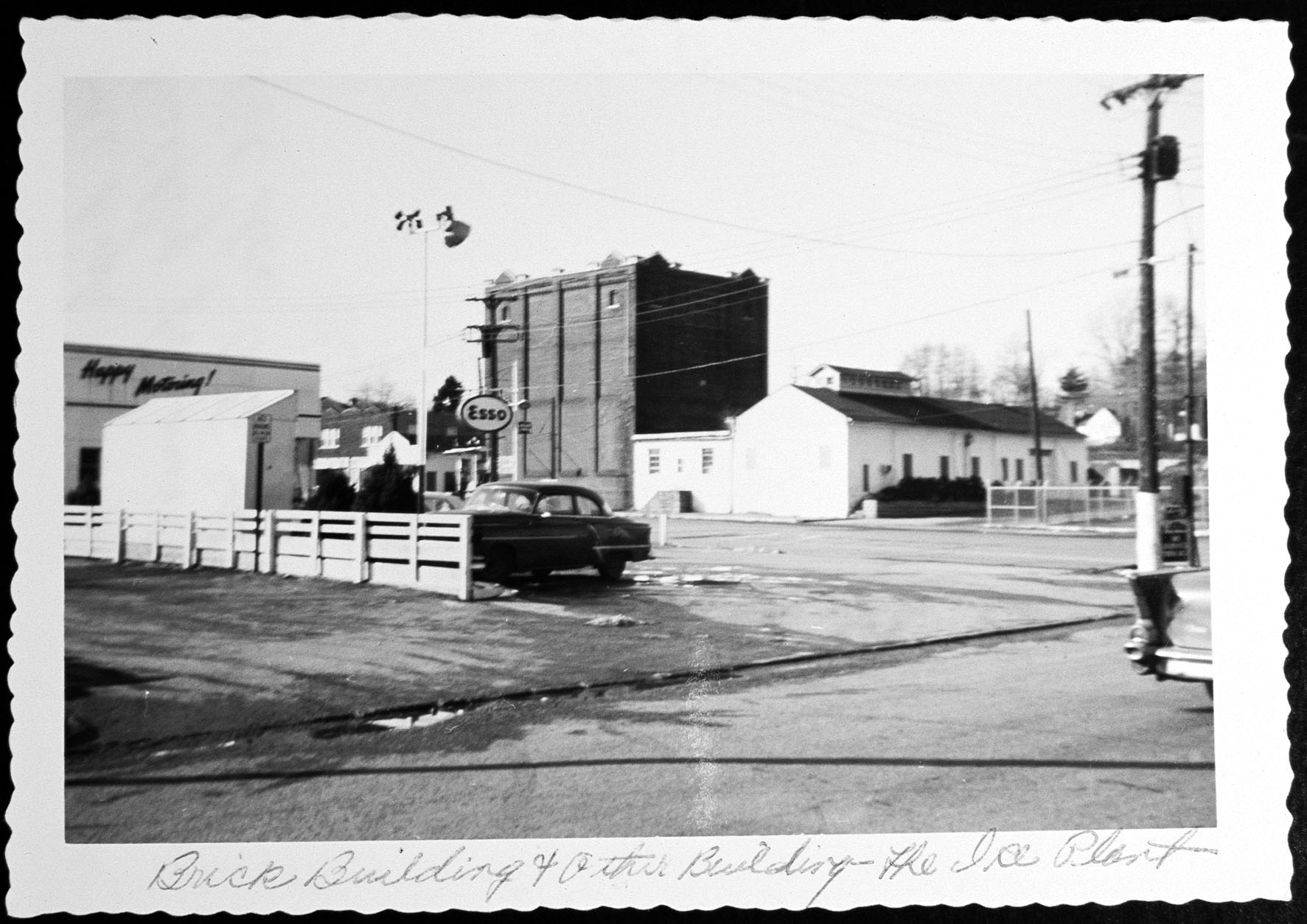
Berwyn Ice Company on Lancaster avenue, opened in 1901
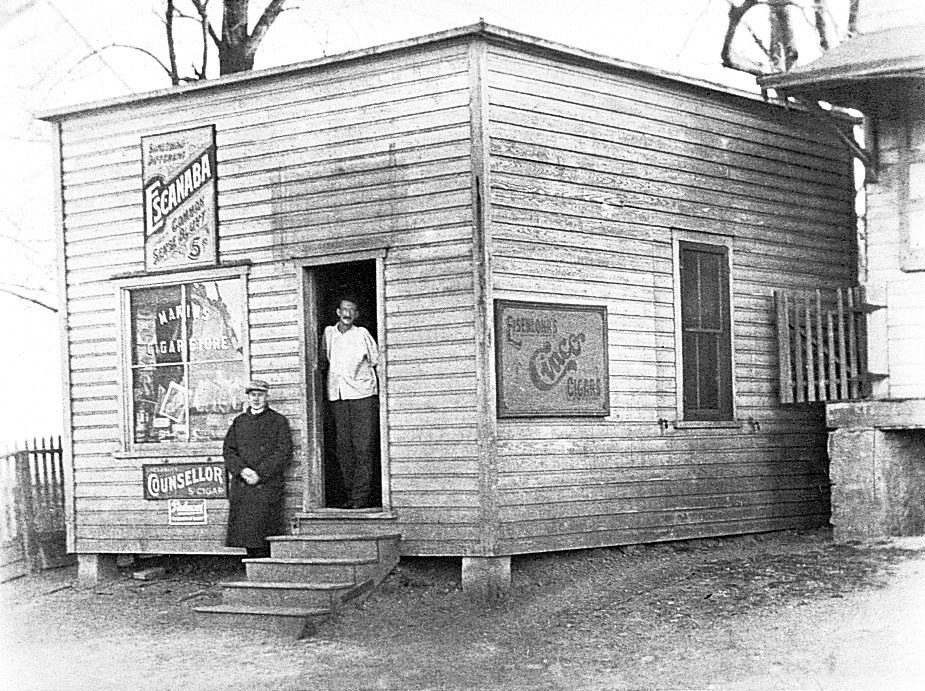
Makin’s tobacco, newspaper and candy store two blocks further west from the Ice Plant
A “Town Meeting” was held in the Odd Fellows Hall on October 3, 1905, at which about 125 “citizens and ladies” were present, to discuss and offer suggestions “for the improvement of Berwyn.”
A number of suggestions were made, and, as reported in the Minutes of the meeting, “These suggestions took a tangible form in a motion ... that a Committee of 3 (later changed to 5) be appointed... to secure all information possible relative to improvements and to draw up a constitution and by-laws to form an Improvement Society whose object shall be to improve conditions in Berwyn.” The motion was passed by the meeting, and Henry 0. Garber, William Fritz, George Maxton, the Rev. R.N. Powers, and AM. Snider were appointed to constitute the committee.
Two weeks later the committee presented its report, and “after carefully considering and amending the same” it was accepted and adopted. It was then moved “that a permanent organization called the Berwyn Town Meeting be formed under the Constitution and By-Laws” that had just been approved. This too was approved, with 24 persons enrolled as charter members. (In the following March the name was changed from the Berwyn Town Meeting to the Berwyn Citizens’ Association.)
From the beginning, the establishment of a reading room and library was the major project of the organization. At the same time, the extension of street lights and sidewalks in Berwyn and the disposal of garbage were also areas of improvement to which attention was given.
At the meeting of October 3, 1905, a committee of five was appointed to inquire further into conditions, sites, etc., for a new library. This committee reported the following at the second Town Meeting: All attempts must be on a modest basis; other near-by libraries had reported very small beginnings and meager interest; at least $500 would be needed a year, and they suggested means of obtaining this money.
At the November 16 meeting the Reading Room Committee was instructed to secure a room for six months with the privilege of extending the time to one year. By January 1906 the minutes show the Reading Room in operation on the upper floor of what was then “The Bakery” on Waterloo avenue and a Special Committee was appointed to purchase tables and games, these in addition to magazines and papers already subscribed for.
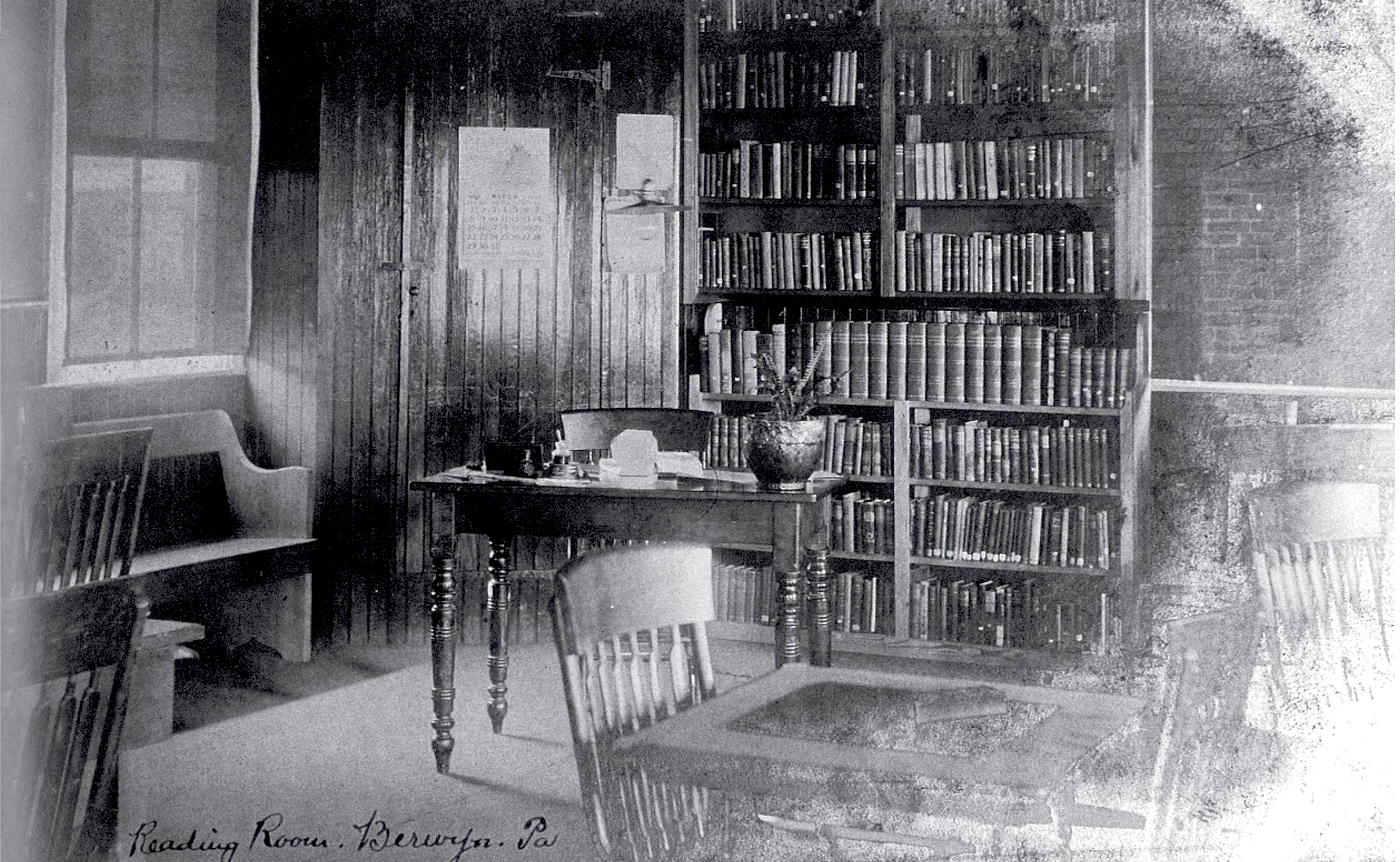
Berwyn Reading Room
About this time evidently the Committee was greatly enlarged. The additional names were 16 in number. Mr. William Fritz and Mr. George Hutton were largely responsible for financial support. Members of the Committee shared the work of a Librarian. A Special Committee headed by Mr. Coates examined all books offered or secured for the Library. By March 1906 the Committee requested that its quorum be lowered to but eight members.
An invitation was extended to the Women’s Auxiliary of the Chester County Hospital to use the room for its monthly meetings. Minutes likewise report that a loan of 50 books had been made by the Friends Library of Philadelphia. Books had also been loaned by the State Library at Harrisburg.
There was need for a Librarian. Mrs. Elsie Jardine was appointed in November of 1906. In 1910 the Library moved to the Yerkes Building on Lancaster Pike. Here the first book stacks were built. Money was raised by “candy made and sold by the members.” The shelves were built by Mr. J.P. Lamborn. A standard system of cataloging was also installed and the Committee spent many long hours in cataloging all the books. Townspeople worked unceasingly that the Library might succeed, and it today is the result of the untiring efforts of many citizens. (The Reading Room/Library then established, incidentally, later became what we know as the present-day Easttown Library and Information Center.)
Berwyn’s largest manufacturing enterprise, the American Bronze Company (later reorganized under various names, the last of which was American Non-Gran Bronze Company) operated between 1907 and 1959 in the building known today as the Bronze Building. It produced castings of a special bronze alloy which were machined into bushings and bearings used in automobile and aviation engines. The technology employed was contributed by Englishman Alfred Hodgson Smith, a metallurgist who had worked out and brought to this country with him an idea for a special type of alloy. (Smith, by the way, was over 65-years of age when he came here to pioneer the new company. He died at his home in Berwyn in 1919.) Jack Watson, of Wayne, handled administrative matters and was the financial backer.
The new company grew rapidly. Within two years the original foundry building was enlarged, the number of furnaces and employees was increased and more lathes were added to the production line. By 1912 the quarters were outgrown again, and a new modern foundry with a “saw-toothed” roof for maximum lighting and ventilation was erected. This was the period of immigration to America from southern and eastern Europe. Brothers Henry and Fernando Toroni came from Italy to Berwyn and worked at the “Bronze.” Both made their homes here and held important supervisory posts in the plant. In the beginning the products were used by automobile and truck manufacturers. During the first World War, every truck sent overseas was equipped with a kit of bronze bushing material for emergency field repairs.
Later the company began to work in the aviation field, providing bushings for Pratt & Whitney engines. Bushings from the Berwyn plant were said to be in the Wright engine that powered Charles Lindbergh’s “Spirit of St. Louis” on its historic non-stop trans-Atlantic flight in 1927, one of the great achievements of the twentieth century.
The picture post card craze in the United States was at its peak during the period 1905-1912. Especially appealing were real photo post cards showing images made by a local photographer. Berwyn had such a photographer. She was Miss Lucy Sampson who lived on Francis avenue with her sister, Sarah, and her sister’s husband.
Lucy Sampson took numerous photographs of Berwyn and the adjacent Main Line area and had a most extensive collection of picturesque rural and sylvan scenes, historic buildings, interiors of stately homes, and group and individual portraits. Some of her work can still be found at post card shows, auction sales, and flea markets.
The following photos are all by Lucy Sampson
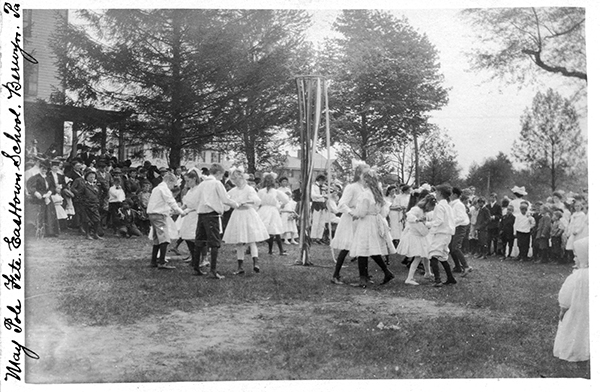
May Day
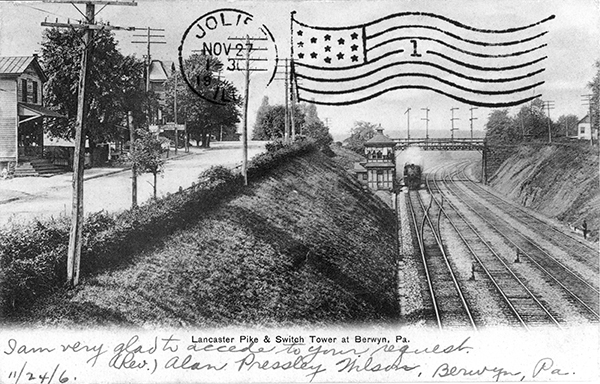
Lancaster Pike and Berwyn switch tower
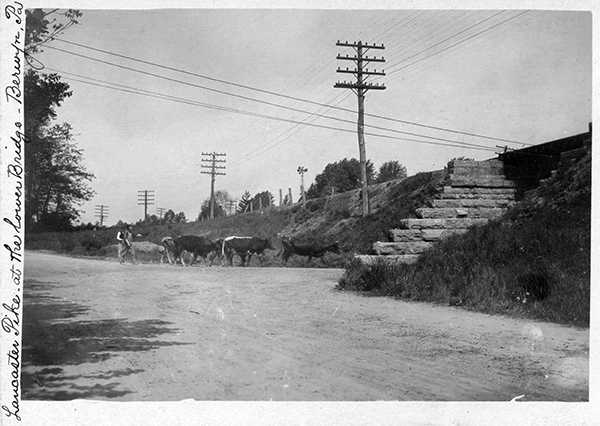
Route 30 at underpass east of Berwyn
During the first decade of the century the deaths of three of Easttown’s most respected citizens were recorded. They were: Joseph W Sharp (1828-1908), who established his country estate, “Hawthorne,” near Leopard upon the death of his father in 1856 and was instrumental in organizing the Berwyn bank; Preston W. Lobb (1844-1903), who managed the Fritz lumber yard for many years and had an important role in the founding of the First Baptist Church of Berwyn; and William H. Burns (1856-1910), the proprietor of the Berwyn Planing Mill and builder of homes and many larger public buildings such as schools, churches, railroad stations, and business houses.
In 1907, the Pennsylvania General Assembly passed a supplement to its earlier acts governing high schools, which gave two or more adjoining townships the right to erect and keep joint high schools. On May 23, 1907, a joint meeting of the school boards representing Easttown and Tredyffrin townships was held in the Easttown High School building on Bridge avenue “to consider the advisability of uniting the two townships in high school work.”
Members of the Devon Citizens’ Association attending the meeting asked for time to hold a meeting of their own to discuss having a joint high school as they were not sure that this was the thing to do.
George Hutton was elected temporary chairman of this first Joint School Board in the state of Pennsylvania. A joint committee (J.H. Dingee, J.P. Lamborn, H.R. Wilson, and George Johnson) was appointed to investigate and confer in the matter of grounds and building.
On June 6, 1907, the report of the committee was received and the committee continued. On June 26, D. Knickerbacker Boyd was selected as the architect and a town meeting called to present the proposal to the taxpayers at the Easttown High School building. On July 11 the meeting was held but no test vote was taken. The sentiment of the meeting was favorable. A total of 26 attended. A Devon Citizens’ Association member asked for a meeting where they could hear more from the Easttown Board.
On August 3, the Boards voted to buy John Beadle’s ground (on the southwest corner of Conestoga and Howellville roads, across the street from the North Berwyn school) and moved that the Committee get an option for 60 days at $4500. The Committee reported on August 16 that they could secure 3-1/4 acres of the Beadle ground of $5000. All Directors except Thomas voted yes. William H. Burns was the successful bidder at $27,835 to build the school, with an additional cost of $3590 for heating. On December 19, 1908, the building was deemed completed. Formal dedication took place on February 9, 1909, in a snowstorm, with 300 persons present.
The 1909 enrollment of the school was 72 students; this grew to 107 by 1920, and 330 by 1930. The school closed its doors on June 15, 1955 (it was demolished in 1970), superceded by the construction of Conestoga High School, with an enrollment of 479 in the three High School classes. The first principal of the joint Tredyffrin-Easttown High School was Hayes C. Taylor, of Kennett Square.
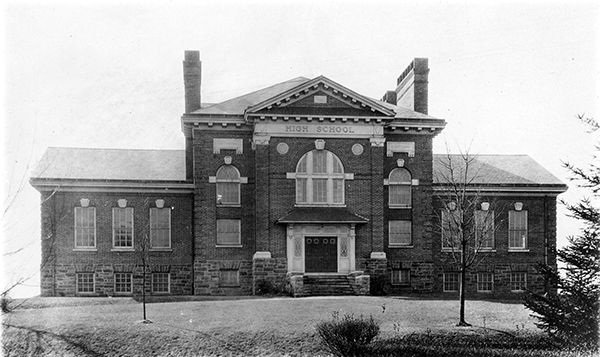
T-E High School. 1908 - 1955; image Id TEH16
New homes continued to be constructed in Easttown. One of Devon’s most exquisite country houses, “Grey Craig,” was built in 1902 for James W. Patterson along Waterloo road about a mile and a quarter from Devon station. Designed by architect William Price, the English Tudor house was erected at the crest of the hill (450 feet elevation) overlooking 76 acres.
Another new estate was Philadelphia attorney William C. Bullitt's 15-acre “Oxmoor” (named after the ancestral home near Louisville), south of Exeter road and west of Waterloo. One of his sons, William jr., was the first ambassador to the Soviet after it was recognized in 1933, while the other, Orville, was one of the founders of the local Blue Cross and chairman of the board of the Philadelphia Orchestra. Oxmoor today is known as “Rosedon” but is still a landmark Devon address.
George Wharton Pepper, Philadelphia lawyer, threw in his lot with Easttown when he decided to become a resident. He tells the story in his autobiography, “The choice lay between a small tract of high-priced land near a railroad station and a large tract in the more remote farming area. We decided in favor of a farm, and in August of 1907 bought ... a beautiful tract of farmland and woodland. The tract comprised 177 acres. The property had once belonged to the sisters of General Anthony Wayne, and we were glad to find his signature as an attesting witness to one of the old deeds.” Pepper continued, “Upon the land there stood a stone farmhouse somewhat more than a hundred years old. There was a stream running though the property; and as foxes - as well as other small game -were plentiful, we named the stream Fox Creek and to the place itself we gave the name Fox Creek Farm.”
An elaborate country house named “Kelso” after a family ancestor, constructed about 1907 off Berwyn-Paoli road was the summer home of Philadelphia investment banker, J. Gardner Cassatt. As early as 1860 the 124-acres had been the Jonathan T. Morris farm. Yes, it is likely that artist sister Mary Cassatt on a visit to Philadelphia at Christmas 1908 did get to see the new house. It is now the Upper Main Line YMCA.
The Devon Horse Show resumed in 1910, after a nine-year hiatus. The president of the Association then was John T. Windrim, architect, who had built an exquisite home in Devon at the corner of Sugartown and Fairfield roads, with J. Gardner Cassatt, of Kelso Farm in Daylesford, the vice president. Much of the credit for the success of the revival of the Devon Horse Show, however, is usually given to the untiring efforts of William T. Hunter, who owned a small farm near the grounds and was treasurer of the Association.
When the show resumed in 1910 it was, as one writer described it, “already large” and “veering from rusticity to brilliance." (This is reflected in the composition of the Board of Governors and their selection of honorary vice presidents of the Association. Among the honorary vice presidents, for example, were Philander C. Knox, Charles Custis Harrison, Charles Lea, Dr. Charles B. Penrose, George Wharton Pepper, and Edward T. Stotesbury, while William C. Bullitt, Victor Charles Mather, A. J. Drexel Paul, M.A. Rosengarten, Welsh Strawbridge, and William Wayne were among the 32 members of the Board of Governors. Only D.B. Sharp, E.W. Twaddell, and Henry M. Warren were holdovers from the group that originally formed the Devon Horse Show Association in 1896). For the first time, the show was held over the Decoration Day (or Memorial Day) week end, a now three-day event on May 30th, and 31st and June 1st.
In 1913 William T. Hunter became chairman of the show, and in the following year it attracted more than 1000 entries and was described as “the largest outdoor show in the United States, and very probably in the world.” Its success has continued to build over the years. It is without doubt Easttown township’s preeminent sporting event.
The automobile had established itself as an economic force to be reckoned with. Automobile production in the United States since 1900 surpassed an aggregate of 1 million cars (statistics show 450,000 registered automobiles in 1912), but there were only 2.5 million miles of roads, most of them in towns and cities. Paving, if any, ended at the town line.
At this point Carl Fisher got involved. (He had already made a fortune by building the Indianapolis Motor Speedway and heading a company that made improved auto headlights.) Fisher went to a map and drew a straight line from New York to San Francisco, and declared that he would spearhead the construction of America’s first transcontinental highway. Fisher, an idea man who left details to others, was fortunate to attract as contributors two men influential in the world of car manufacturing: Frank A. Seiberling, president of Goodyear and Henry B. Joy, president of the Packard Motor Car Company.
On July 1, 1913, the road was officially named the Lincoln highway, and the Lincoln Highway Association was born. Joy was elected president of the association while Fisher, already elected vice president, was on a cross-country survey tour. In August, Henry Joy sketched out the chosen route for the Lincoln highway. In the East, a number of existing turnpikes were folded into the route, including the 63-mile stretch of the Philadelphia and Lancaster turnpike passing through Devon and Berwyn. Thus did the name “Lincoln Highway” come to be associated with our main street. (It was not until 1917 that the turnpike tolls were removed, and in 1925 Federal and state lawmakers voted to institute a new highway numbering system that meant the end of named highways. U.S. Route 30 came into being, but the name Lincoln highway did not easily go away.)
Henry Oscar Garber, a Schuylkill county native born in 1862, learned telegraphy and as a young man worked for the Pennsylvania Railroad a brief time in Berwyn. After marriage and starting a family, he returned to Berwyn in 1893. There he opened a newsstand and general store on the Lancaster turnpike just west of Waterloo avenue. He added an eastern section to it, so that the two-room storeroom had an upper and lower level. The store was a neighborhood meeting place where men sat around the stove and spun their yarns.
An ardent sportsman, Henry Garber had a keen interest in hunting and fishing. He kept a horse for fox-hunting and seldom turned down a hunting trip to Camp Lamoka, near Monroeton, for deer. Anyone who got a deer would hang it from the rafters in front of the store, and in the fall there might be several deer hanging there. His son-in-law was a local butcher.
During the years of the bicycle, Garber made runs to Atlantic City and was considered one of the finest amateur riders on the Main Line. He also took an active interest in the local baseball teams during the early days of the Main Line League.
Ever active in community affairs, he was a charter member of the Berwyn Fire Company, a Republican county committeeman for a number of years, a school director in Easttown township, and postmaster in Berwyn for ten years, from 1904 to 1913. Theodore Roosevelt signed the documents commissioning him postmaster. He tended his store to the very end and died on September 14, 1943.
Many stories exist as to who owned the earliest automobiles used in our area. Henry Garber was identified by his grandson Henry Pyle some years ago as having the first automobile in Berwyn, date not specified, a Cadillac. A newspaper reported in 1910 Garber had purchased a new Mitchell touring car. Mr. Pepper, in his book, says his place was more than four miles from Devon and in 1907 an automobile became a necessity. Charles Z. Jones, owner of the Berwyn Plumbing & Heating Company has been named by George Roberts as having had one of the first Model T’s (they came out in 1908), and C.C. Wilson’s first car was a 1905 Maxwell, according to his son Dave.
In later days, probably the 1920s, Berwyn had two garages - Fell’s, across from the Fritz lumber yard, a Buick agency, and Bill Trowill’s, at the other end of town, across from the primary school. (Who could have predicted then today’s strip of auto dealerships stretching from Devon to Berwyn: BMW, Mercedes, Jeep, Saturn, Toyota, Nissan, and Volvo.)
Although the automobile was making great strides, it was still in its infancy. The Pennsylvania Railroad continued to enhance its service and earn public good will. From the time the railroad rebuilt its line in 1877, it was said, four tracks came into Berwyn, and only three went on to Paoli. With the growth of the suburban commuters and commuter trains in the early 1900s ( there were 60 trains daily on the Main Line alone), the problem of handling the passenger traffic in and out of Broad Street station in Philadelphia became acute.
Following a study, in March 1913 the railroad announced plans to electrify the Main Line service for suburban traffic between Philadelphia and Paoli. The project included the construction of overhead wires and cables called a catenary. A by-product of electrification was the installation of light-position signals to replace the semaphore arms formerly used for signaling. Electrified operation was begun on September 11, 1915. The suburban terminus and yards of the railroad then gravitated to Paoli, and Berwyn was left, more or less, behind.
The European war which had commenced in August of 1914 grew ever more ominous. President Woodrow Wilson and the United States maintained a posture of strict neutrality. The announcement in January 1917 that the German navy would engage in unrestricted submarine warfare against all shipping to Great Britain prompted Wilson to break off diplomatic relations. The sinking of American ships led to a U.S. declaration of war early in April 1917. A Selective Service Act followed which made all men between the ages of 21 and 31 eligible for the draft. More than four million U.S. men were under arms when the conflict ended in 1918; U.S. deaths from all causes, including flu, totaled 112,000.
The names of local residents who served are preserved on the stone memorial put in place by the community next to the 16th milestone on Lancaster avenue (opposite the intersection of Waterloo road) on the second anniversary of the Armistice, November 11, 1920. The bronze plaque reads, “World War, 1917-1918, in honor of the men of Easttown and Tredyffrin Townships who answered their country’s call.” Inscribed are the names of 304 men (including four overseas workers). The names of nine men killed in action or who died of disease are marked with a star. They made the supreme sacrifice:
| Thos. Levering Bolster | Chas. J. Kramer |
| Carmiene Capuzza | Lewis G. Smith |
| LeRoy Dalton | Walter H. Walker |
| Everett Henry | Christian Wanzel |
| Edgar Weaver |
The memorial, moved several times over the years, now stands on Lancaster avenue at the southern entrance to the new pedestrian way bridging the railroad tracks at the train station, called by some the new Berwyn town center.
Franklin Lorenzo Burns, known locally in Easttown township as “Frank Burns”, was a well known and highly respected ornithologist and local historian. He authored “The Ornithology of Chester County, Pennsylvania,” a book published in 1919, and later in his career was a charter member (1936), president, and publication editor of the Tredyffrin Easttown History Club.
According to his own written record, Frank Burns was born at Sharp’s Corner in Easttown in 1868. His father built a house in North Berwyn for the family on the Old (Conestoga) road in 1876, and thereafter it would be Frank Burns' home until his death February 7, 1946. He chose painting as his career (an older brother, W.H. Burns, was an important building contractor), and for many years he was one of the prominent house and construction painters of the Main Line, having many men in his employ and accepting large contracts.
As a boy, his father instilled in him his own interest in nature and in local history, and from his youth Frank Burns began to collect data and specimens and to make notes on both these subjects. He was a great student of the birds of Chester county and of bird migrations. His ornithological records began in 1884 and his record of seasonal bird migrations began the following year. Later he often remarked that he had the longest record of bird migration reports being made to the Smithsonian Institution; this report record extended over sixty years. He had a little square house by his residence, near the street, where children curiously peeked in to see his collection of mounted birds and trays of eggs.
As he aged, his interests turned more toward local history, although through his life he had collected all available data on the subject, both from published books, local records, and informants' statements. Everything that he heard he wrote down. This information formed the basis for his many articles published in the Quarterly of the local history club and in the Picket Post, the publication of the Valley Forge Historical Society. He bequeathed a rich legacy of local history to us, indeed.
Frank Burns was also involved in the Berwyn Fire Company which took a long step forward when it dedicated a new fire house and community hall on May 8, 1929, at 23 Bridge avenue. Newspaper accounts of the dedication state that it was a “red letter day” in the history of Berwyn. William Fritz presented the key to Frank Burns and Frank F. Walker. Edward J. Redmond, Commander of Dalton-Wanzel Post of the American Legion, presented and dedicated a flag and flagpole. It is said the ladies of the auxiliary earned and gave the sum of $14,000 toward the building of the fire house.
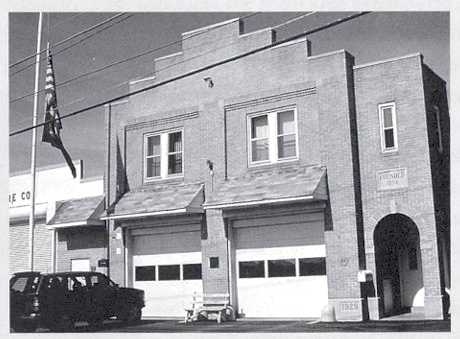
Berwyn Fire house
The old fire house had been located around the corner on Berwyn avenue in a small structure erected soon after the company organized. Dr. James Aiken was president and Temple Gregg, secretary, when the first motorized equipment was acquired in 1917. That was the year the Ladies Auxiliary organized, to help raise funds for that first American La France engine.
Berwyn churches also moved forward when, encouraged by pastor Rev. Thomas J. Aiken, Trinity Presbyterian Church sponsored a mission Sabbath School in Paoli. The first exercises were held on July 2, 1892 in a building rented from Henry Schofield on the north side of Lancaster pike west of what is now Route 252. In time, a site on Darby road was secured, a Chapel was erected by Ottmer Palmer, a local contractor, and numbers grew sufficient to organize a church on October 26, 1899. Twenty-three founding members signed the charter; sixteen of them had been members in Berwyn given letters of transfer by Trinity Church.
On April 1, 1901, Rev. Aiken, twenty-two years pastor at Trinity, was called to the newly organized Paoli church, having been released with regret by the congregation in Berwyn. The Rev. Robert N. Powers accepted a call to Trinity. He was installed on December 10, 1901 and stayed until 1908. During the Powers pastorate the mortgage debt on the newly constructed Berwyn church building was completely repaid.
The tenure of the young Rev Dr. W. Potter Van Tries spanned the years 1908 to 1911. He resigned his pastorate, married Daisy Aiken, a niece of former pastor T.J. Aiken, on December 28, 1911, and accepted a call to a Presbyterian church in Altoona. Near the end of his career, he retired to Berwyn and preached on occasion at Trinity. On June 30, 1957, he preached his 50th anniversary sermon and died shortly thereafter.
Long pastorates were in vogue during the early years of the twentieth century. The Rev. Dr. J. Charles Levengood preached at Trinity Church in Berwyn from 1912 to September 30, 1940. The son of a Honey Brook doctor, he was dearly loved by the congregation. In 1929 he arranged to move the church cemetery to free up space for future building and obtained the necessary decree of Chester County court. Building plans and the cemetery move were delayed, however, by the depression and World War II.
Baptist Church in the Great Valley: The church continued in a quiet way during the long pastorate of the Rev. Dr. Joseph Evans Sagebeer, 1904-1926. He had a Ph.D. in psychology and was the son of the Rev. William Sagebeer who served at the Newtown Baptist church for many years.
The old church with a great past celebrated its bicentennial June 1, 1911. It was then the abode of the dead. One speaker, Dr. George Morris Phillips, of West Chester State Normal School (now West Chester University) stated that he had walked through the churchyard and observed the tombs of his grandparents, two great-grand-parents, two great-great-grandparents, and four great-great-great-grandparents. Letters were read from descendants of some of the former pastors and reference was made to ever faithful elders, deacons, and missionaries, whose bones had long since mouldered away in the, at this period, best kept cemetery in the two townships.
The First Baptist Church: Rev. Fryer resigned November 30, 1904, and the Rev. Escol S. Sellers, estimator for an engraving firm in Philadelphia, supplied until he was ordained as pastor on June 29, 1905. During Pastor Sellers’ leadership, the church debt was liquidated. He remained until March 1917 and was followed by the Rev. Herbert Hargrave, 1917-1921; the Rev. John G. Booker, former pastor of the Baptist Church in the Great Valley, 1922-1925; the Rev. George O. Read, 1925-1927; and the Rev. Franklyn W Wiley, a student from Eastern Baptist Theological Seminary, 1927-1935.
During Sellers’ pastorate the membership increased to 150 members, but later there seemed to be a distinct trend toward the mother church, the Chapel gaining ground. Wiley’s personality, however, consolidated those remaining into a compact and distinct organization holding much to themselves. Up until Rev. Read’s pastorate the congregation had sponsored numerous benefits, suppers, and festivals, but in January, 1925, it was decided that all money should come through direct sacrifice of the donor.
Berwyn Methodist Church: The Rev. Alden W Quimby, 1896-1922, has been characterized by a history writer as a “gentle and kindly” pastor. His commitment to his ministry was deep, and he always gave it his first priority. He was, however, an exceptional individual. He enjoyed taking long walks in the surrounding countryside, and was well known to residents for miles around Berwyn because of his frequent expeditions on foot. His interest in history eventually led him to write an historical novel about Valley Forge. As an amateur astronomer, he was an active observer of the sun for over thirty-two years, and he willingly shared his love of astronomy with others. Rev. Quimby died on September 23, 1922 at age 66. The next year the church's pipe organ was dedicated as a memorial to him.
In conformity with Methodist custom, local pastors were changed by the Conference every few years. Following Quimby, the Rev. J.C. Tenant served as supply May 1922 to January 1923; then the Rev. Paul W. Poley, 1923-1925; the Rev. J. Carpenter Zook, 1925-1927; and the Rev. Frank Mack, 1927-1929.
St. Monica Roman Catholic Church: Father John Carey was assigned to the parish in 1906. During his tenure, the parish built a school, purchased a house to remodel as a convent, and stuccoed the wooden church exterior. The old horse sheds were taken down about 1917. Chester County Historical Society preserves to this day a bill receipted in Father Carey’s hand for “$6.00 rent of horse stable to Mr. W. W. Hoopes” dated April 16, 1911.
On September 8, 1916, the parish school was formally opened with three nuns who traveled each day from Immaculata College (now University) and taught in the church basement until the school was completed, March 19, 1917. Nine years later a house adjacent to the church property was purchased from the Armstrong family, and on March 19, 1926 nuns took up residence for the first time in the parish.
Father Carey died on November 6, 1939, a few days after his seventy-fifth birthday, having been pastor of St. Monica parish for thirty-three years.
St. David’s Episcopal Church: During the latter year of Rev. Keller's term he had been assisted by the Rev. James Hart Lamb, D.D., and at the Easter meeting of the congregation following Mr. Keller's death, Dr. Lamb was unanimously chosen as rector of the church. He began his ministry on Sunday, April 6, 1902.
Dr. Lamb presided over the commemorative exercises celebrating the Bicentenary of St. David's Church held on September 4-5, 1915. He was succeeded by the Rev. Crosswell McBee, 1922-1945.
The automobile, no doubt, brought an end to the days of the glorious Devon Inn. In April 1914 owners John W and Ellen Simmons Patten sold the Inn and about 14 acres of ground. For a while the building was occupied by the Devon Manor School for Girls. In 1926 it reopened as the Devon Park Hotel for two years, and after remodeling, it became the Valley Forge Military Academy with Captain Milton Baker as the superintendent, a staff of thirteen, and 117 cadets. A few months later, on January 18, 1929, a disastrous fire swept through the old building and totally destroyed it. The famous and well-known landmark, the old Devon Inn, was no more.
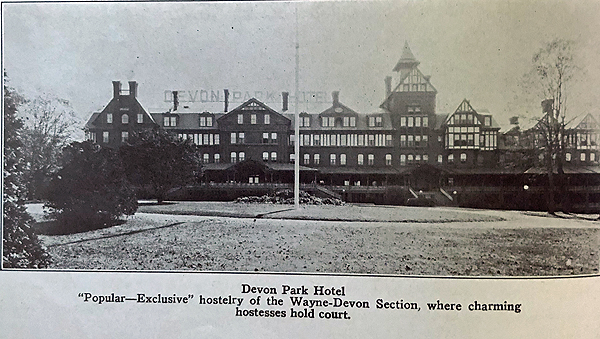
Devon Park Hotel; image Id DEI42
At The Same Time
First successful powered, man-carrying airplane flight made by Wright Brothers at Kitty Hawk, North Carolina
British suffragettes demonstrate for women’s right to vote outside Buckingham Palace
HMS Dreadnought, first modern battleship, launched in Britain
Panama Canal opened to traffic
Swiss physicist Albert Einstein publishes General Theory of Relativity
League of Nations formed following World War I
Sir Alexander Fleming, British bacteriologist, discovers penicillin