Chapter 9: Beginning of the Suburban era
1886 - 1900
Coffin & Altemus, developers of the so called “Devon estate,” had to overcome adversity very early in the course of their undertaking. The Inn at Devon, opened in August of 1882, was destroyed by fire a year later in the middle of the 1883 season. The blaze was apparently caused by a defective flue over the kitchen. Fortunately none of the guests were injured.
Work to replace the Inn with a new one began immediately. A grand reopening took place on June 7, 1884, and, if anything, the new Inn was even more grand than its predecessor. Larger than the original hotel, it was 334 feet long and 58 feet wide - longer than a football field - more spacious and better arranged with accommodations for fifty more guests. It was built in the same Queen Anne style, but it had four, rather than three, stories plus an elevator and an emphasis of fire protection. Incidentally, all of the rooms were equipped with electric lights a few years later in 1891, probalby the first use of electricity for lighting in Easttown. The current was provided by the new Wayne Electric Light Company.
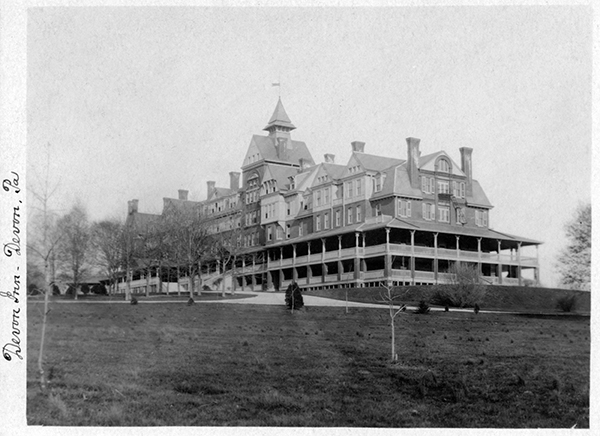
Devon Inn, photo by Lucy Sampson; image Id DEI07
The Inn was usually fully booked, and the remainder of the visitors to Devon choosing to build residences adjacent to the Inn continued to increase.
The Coffin & Altemus tract had originally been laid out into 140 some lots of two-and-one-half to five acres each. Some purchasers along Waterloo road opted to buy multiple lots that aggregated as much as 15 acres. William B. Mann purchased 6 lots on the west side of Waterloo road opposite the Inn, as did Dr. John H. Packard further south on Waterloo. He named his estate “Tregarick.” Dr. Amos R. Thomas and his son Charles took a 17-acre parcel along the north side of Arlington road (Lancaster avenue today) which they called “Llangollen.” Other early purchasers were Henry Mather Warren, “Fairfield,” and Theodore Kitchen, “Brendon.”
Some lots, perhaps bought on speculation, also began to turn over. One such transaction involved the William B. Mann tract which was soon purchased by George H. Earle jr. Mr. Earle’s son, also named George Earle, was born in Devon on December 5, 1890. He served one term, 1935 - 1939, as govenor of Pennsylvania and consequently can be claimed by Easttown as a native son.
In April of 1892 ten men from the Devon area met at the home of J. Lewis Twaddell on Valley Forge road. Their purpose was to start a Sunday School in Devon; it was soon known as the Devon Chapel. Hoping eventually to become a Presbyterian Church, they applied to the Chester County Court of Common Pleas for a charter which was granted on June 14th, 1893. Named as subscribers were the leaders: J.H. Jefferies, of Wayne, and F.E. Hastings, J. Lewis Twaddell, Louis Warner, and S.D. Walton, all of Devon.
Coffin & Altemus, donated a piece of ground on Berkeley road for the chapel. During the summer of 1893 a frame building was erected on the site. It was dedicated on August 20th. Among those taking part in the service were: The Rev. William H. Gill D.D. of Philadelphia, Rev. William Patton of Wayne, Rev. John G. Booker, Rev. Thomas J. Aiken, Rev. Charles Straw of Berwyn. (An early map shows that apparently Coffin & Altemus gave a like-size piece of ground for Devon School next to the chapel site).
The membership of the Chapel increased as the town of Devon grew, and in 1897 a full-time minister, the Rev. Joel Swartz D.D., was called in anticipation of becoming a full-fledged Presbyterian Church. Early in 1903 a petition presented to the Presbytery of Chester was approved, and the congregation adopted the name St. John’s Presbyterian Church.
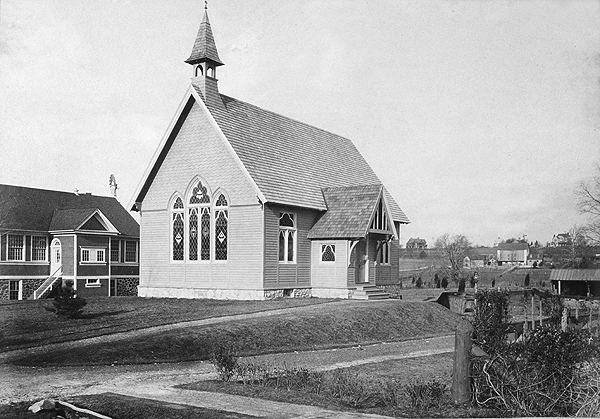
The Devon Chapel, now St. John’s Presbyterian Church; image Id SJP06
The future of Devon was dealt a severe blow on January 4, 1895 with the death of Lemuel Coffin, one of the principals in the firm of Coffin, Altemus & Company. Apparently Mr. Coffin died intestate with dependent minor children, and it was not until March of 1898 that a decree of the Orphans Court of Philadelphia permitted dismantling the real estate venture. In the aftermath of settling the estate, Edward T. Stotesbury and James W. Paul jr., partners at the Drexel investment firm, purchased the unsold lands at Devon later in 1898.
The location of the little town growing up at Devon began to attract the attention of Philadelphia’s wealthy who were seeking a retreat, perhaps a summer place, but not necessarily a working farm. They could afford larger tracts than those available around the Inn. Besides, land further away from the railroad stations was more reasonably priced yet close enough for easy commuting to the city.
Charles Custis Harrison was one of the first to usher in the era of large landowners. In 1891 he purchased several hundred acres along the Darby Creek watershed which he named Happy Creek Farm. Over 100 acres were located in the southeast corner of Easttown, with an even larger tract and newly constructed residence in adjacent Newtown. Harrison had been president of the Franklin Sugar Refining Company and a member of the brokerage firm of Harrison, Frazier and Company. He was also a Trustee of the University of Pennsylvania and later served as its Provost.
Another Philadelphia businessman, William Nelson Wilbur, bought a house and forty-three acres just south of Devon in 1894. He later increased his land holdings to 100 acres and called the estate ldlewood Farm (we know it today as Hilltop, location of Easttown township offices and park). Wilbur presided over a chocolate manufacturing enterprise which made the famous Wilbur Buds.
Apparently the Wilburs fitted right into the Devon community as their children, Lawrence and Willie, took part in a performance of The Devon Dramatic Association just after Christmas 1896.
The horse was still the primary means of transportation. Good harness horses were a necessity to Devon folks as well as an attractive pastime, as many of the splendid homes were far removed from the station. Recognizing the need to develop good horses for their carriages and wagons and other vehicles, a dozen local horsemen and farmers met on the lawn of the Devon Inn, the side toward Waterloo road, in 1896 to form the Devon Horse Show Association.
The group elected Henry T. Coates (who was in the book business) the president; Lemuel C. Altemus and Henry Mather Warren, the vice-presidents; E.W. Twaddell, the secretary; and David B. Sharp (who lived at “Hawthorne,"” Leopard, where he operated a stock farm), the treasurer. Also included on the executive committee were C.Davis English, John W. Patten, A.B. Coxe, and R. Penn Smith.
In early May the Association sent an invitation to friends and neighbors, inviting them to a meeting at the Devon Inn. “Dear Sir,” the invitation read, “In order to effect an organization for the purpose of holding a Horse Show at Devon, a meeting of gentlemen, interested in the breeding, showing and ownership of horses, is called for Friday evening, May 22, 1896, eight o’clock, at Devon Inn. Please attend and invite others who may be interested.”
Their efforts met with success. The first horse show, a one-day affair, was held on July 2, 1896 (the date was selected to avoid conflict with the Philadelphia Horse Show usually held on Decoration Day), with entries closed June 27th. It took place on the field of the Devon Polo Club (the present site of the show) diagonally across from the famous and fashionable Devon Inn.
There were 26 classes altogether in this first horse show. The number of entries in each class ranged from two to ten, the latter number entered in the class for the best roadster owned by a farmer. In addition to ribbons, prizes of $10 for first place and $5 for second place were awarded for entries “owned by farmers.”
“It was seen early in the morning of July 2nd,” it was reported, “that a beautiful day was in prospect,” and the crowd “arrived early.” The judges for the show were Barclay Warburton, Dr. Thomas E. Parkes, and M. Peach, and it was noted that they “did their work well and promptly, and their awards evidently gave entire satisfaction to the spectators if not in all cases the exhibitors.”
The outstanding horse in this first show was J.C. Young’s brown geding Governor Brown who won the blue ribbon in three classes and shared first place in another class with its stablemate Senator Quay, in the class for the best pair of harness horses.
The 1897 show was also held at the polo field, but in 1898 it was moved to the “spacious” lawn of the Devon Inn, where it was also held in the next two years. In 1898 the show became a two-day affair, held on June 7th and 8th. By that year there were entries from places as distant as Lionville, Northbrook, Ercildoun, and West Chester. But, unfortunately, after the show in 1900, for reasons not known, it was not held again until 1910.
Meanwhile, in Berwyn the pace of development continued to be brisk. About 20 dwellings, the Berwyn National Bank, two stores, a real estate office, and the Methodist church took shape within the village in 1888, while other building under way included St Monica Roman Catholic church, a graded school (cost $7000), and six more dwellings, which were completed shortly after. The village then had 500-600 residents and four churches. Real estate that sold eight years before at $35 an acre now went for $1175.
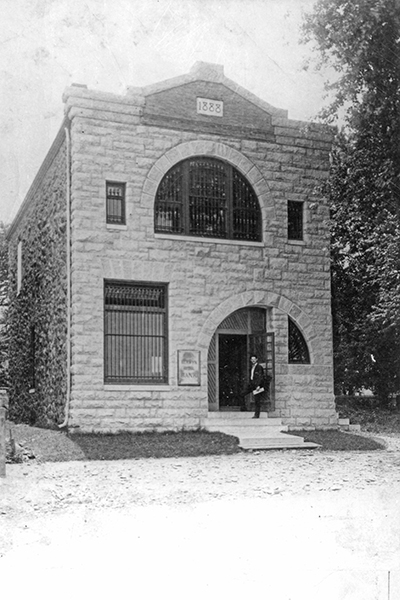
Berwyn National Bank
William Henry Fritz turned age 21 on December 21, 1885 and claimed his inheritance, the coal, feed, and lumber business started by his father Henry before his death. Uncle Preston Lobb, steered him through a period of apprenticeship and left him in full charge. The timing could not have been better as demand for building supplies was at an all-time high.
In 1885 a part of the Joseph C. Smith and Davis Taylor farms was purchased by Charles N. Thorpe, president of the Keystone Watch Case Company, then of Philadelphia, and his wife, Mary Warren Thorpe. They immediately developed that part lying west of the Glassley Commons in the limits of Berwyn by opening Warren avenue (the name perpetuates the family name of Mrs. Thorpe), dividing the tract into lots numbered 16 to 28, and erecting five dwellings which were sold and occupied immediately.
That portion of land acquired within Glassley town, lots numbered from 1 to 15, contained no buildings save the bare walls of the old Smith barn and a shed (the Smith farmhouse was west of the line), but the substantial walls of the barn were utilized in the construction of a large building, with frame annex, which in all contained 60 rooms; upon it was bestowed the name of Wynburne Inn (Berwyn turned around).
This building was erected by W.H. Burns for the Thorpes, and it became a summer boarding house of varying fortune and changes in management. Completed in time for the summer 1887 season, it was said to be rented to a lady who was keeping a fashionable boarding house on Spruce street, Philadelphia. Later, William W. Downing and wife, who managed it for ten or more years, were perhaps the most successful in catering to the city business man who wished to be with his family and still have them in the country. Under another management and under the name of the Lincoln Inn, the building later burned down.
A “Village Improvement Society” took form in June of 1885. It devoted its efforts chiefly with the placing of some hundreds of feet of boardwalk from the pike to the Presbyterian church and to Cleaver’s store, and the erection of a dozen coal-oil street lamps. William Nuzum, caretaker at the Town Hall, was the lamplighter. This association ultimately died of malnutrition, for in July 1889 the local paper stated that it had expended a grand total of $1440, the boardwalk was badly in need of repair, and the streets were in darkness.
About this time James F. Kromer of Lehigh county, near Allentown, bought a property on the pike opposite the Fritz establishment, and started a livery stable and hotel business. His home was on the north side of Berwyn avenue behind his place of business. Kromer’s younger brothers, Samuel and Alfred, also lived in Berwyn. With increasing travel between the city and the local area, there was a great need for a place where visitors could rent a horse and a rig to get about in the country.

Kromer Livery Stables. Photo by Julius Sachse.
Julius Friedrich Sachse, born in Philadelphia, lived at the Leopard during this period. He was a manufacturer of fine shirts for many years. He gave the name “Sachsenstein” to his place of sixty acres, after an old castle said to have been the ancient family seat near Erfurt, Germany. At first it was a summer retreat, but it later hecame his permanent residence.
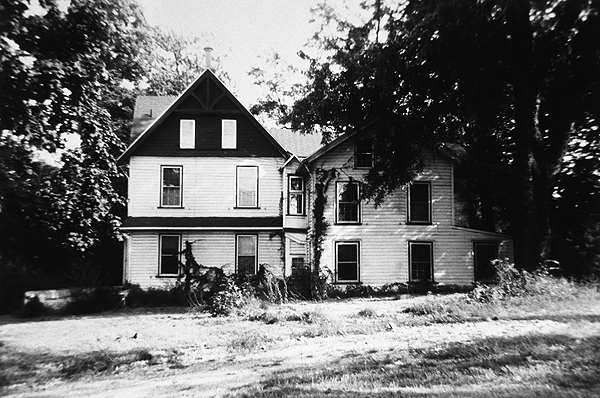
Sachse house
He had business reverses, after which he conducted an office in Berwyn. He was Justice of the Peace of Easttown and Deputy Coroner of Chester County. He had one-half of the small box-like shop near the station, the other half was occupied by David Preston, shoemaker. There you could get your shoes half-soled and listen, at the same time, to testimony in a law suit.
Squire Sachse was also a journalist, historian, and photographer, who wrote with such vivacity that trifling civil suits, petty criminal cases, and sudden deaths became of interest to every one. Often his items were given front display column space. He collected from the oldest inhabitants many local traditions and wrote in 1892 a piece, “Devon and its Historic Surroundings,” primarily for the advertisement of the fashionable Devon Inn. Later, he published the material he had collected about the old inns along the Lancaster turnpike. In this way Julius Sachse was successful in preserving much information about the history of the area which would otherwise have been lost.
An examination was held in West Chester in the spring of 1888 for the admission of cadets to the Naval Academy at Annapolis. Two students at Glassley school, Howard W. Huffington and Harry E. Pennell passed successfully, Howard as first and Harry as third, over competitors from private and high schools. They both went to Annapolis and successfully passed the entrance exams, but as Chester county was entitled to only one cadet, only Howard Huffington was appointed.
The Glassley one-room school house became overcrowded and unable to accommodate all its pupils. The school seated sixty pupils and then had eighty-six on the roll. Commencement exercises for its last graduating class were held in the Baptist Chapel on June 5, 1888. It was decided to construct a new, larger school in Berwyn. The School Directors bought for $775 the tract of land on Bridge avenue across from the present Fire Company building. In April, 1888, W.H. Burns contracted to build the one story stone school building for $5175. It was dedicated August 28, 1888, with Board president Captain William Wayne presiding. Known as Easttown Grammar School, it opened on Monday (no Labor Day holiday then) September 3, 1888, with Hannah Epright in charge of the Grammar Department and Mary A Pyle of the Primary Department.
Manual Training was introduced in 1890. The fifth grade boys had class one hour a week in a part of the basement partitioned off and fitted up with work benches. In 1893 a second floor was added to the building containing three rooms, of which two were immediately put to use. A new principal, J. Alexander Clarke, took over. Mr. Clarke later taught in Philadelphia, but lived in Berwyn until his death many years later.
On September 10, 1894, Easttown opened a two-year high school on the second floor of the Bridge avenue building. Stenography and typing were added to the curriculum. The new school held no commencement until June 2, 1896, when a class of five graduated in a ceremony held in Trinity Presbyterian Church. Members of this first graduating class were: Bertha Rogers, salutatorian; Mary E. Gordon and H. Oscar Broadbelt, who read essays; Laura Beaumont, who read the class history; and William G. Armstrong, valedictorian. In 1904 the first four-year high school course was begun at the school. At about the same time, the high school students began to become involved in organized sports with other schools. In 1912 the Berwyn Primary School, across Central avenue, was built to care for increased enrollment. In 1920 the Leopard School was closed and in 1922 the Ogden School, last one-room school, closed. All school facilities for Easttown were now located in Berwyn.
Local residents and businessmen had to travel almost nine miles round trip to Malvern if they wanted to access banking services. There was an obvious need for a village bank. On June 5, 1888, a group met at the home of Isaac Cleaver to take the first steps toward forming Berwyn National Bank. In addition to Cleaver, those attending the organization meeting were William Coates, Joseph Sharp, William H. Fritz, Preston Lobb, and about a dozen others. William H. Burns, local builder, received the contract to erect the building, located across from the railroad station. It was completed at year end and opened for business on June 1, 1889. Joseph Sharp served as first president.
When U.S. Census figures for 1890 were tabulated they showed what a powerful growth had taken place in Easttown in the decade of the 1880s. The population had doubled to 1682 citizens from 845 ten years earlier. The railroad produced the growth stimulus. It was the employer of choice and, in addition, actively promoted the advantages of suburban living to stimulate traffic into our area.
Before the phonograph, motion pictures, radio, and television, there was the “lodge.” A report in a local newspaper observed, “There are about a dozen lodges in Berwyn, all with good membership, and in looking over the meeting nights one wonders whether the men of this pretty village ever stay home o’night.” A lengthy list
of lodges and meeting nights followed:
In Odd Fellows Hall -
-Monday night, Order of Independent Americans, No. 362;
- Tuesday night, Berwyn Lodge, No. 998, I.O.O.F.;
-Wednesday night, Carpenters’ and Joiners’ Union;
- 1st and 3rd Thursday night,
Ladies of the Golden Eagle, No. 84;
-2nd and 4th Thursday night, Berwyn Castle, No. 142, Knights of the Golden Eagle;
-Friday night, Wyomissing Lodge, No 231, I.O.O.F.;
-Saturday night, Daughters of Liberty, No. 21...
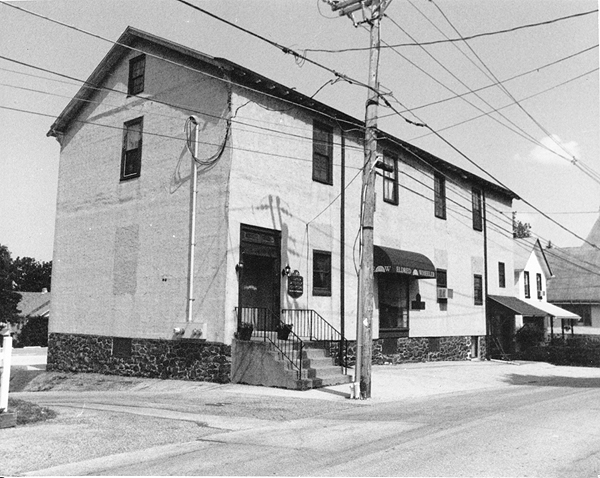
Odd Fellows Hall
Meeting Elsewhere -
-Berwyn Division, Ancient Order of Hibernians;
- Thomson Lodge, No. 340, Free and Accepted Masons.
In addition to all these were the meetings of the Fire Company, the Building and Loan Association, and the Berwyn Social Club, and “yet the women of Berwyn seem to be a happy and contented lot.”
Berwyn Lodge, No. 998, I.O.O.F. (Independent Order of Odd Fellows), had been instituted on May 28, 1884. It first met in Old Hall behind the Presbyterian Church but then moved to Steen's Hall (believed to be in Howellville). In 1890 the lodge bought from Frank Stauffer a lot on the east side of Waterloo avenue as the site for its new hall. Built in 1892, the two story structure housed the lodge on the upper floor while the first floor was used for public meetings, political rallies, benefit entertainment performances, musical recitals, and concerts.
The fire company also traces its origins to the last decade of the nineteenth century. A destructive fire in 1891 which consumed the shop of the blacksmith George Krider and the carriage builder and wheelwright Frank Krider, prompted the men of Berwyn to organize a fire protection effort.
A book containing the Constitution and By-Laws adopted July 23, 1894 contains the following: “Danger from Fire Prompts us to United Action.” The preamble reads: “We citizens of Berwyn and vicinity, for the better protection of property from destruction by fire, do hereby associate ourselves under the name and title of ‘The Berwyn Fire Company’ ....” The organization was completed with receipt of the charter, dated November 20, 1894. Each volunteer fireman provided his own equipment - a leather bucket and a section of ladder. These were kept in their own home and carried to the fire where the ladder sections were joined.
Henry T. Coates, was the last of the Coates brothers to take up residence in Berwyn. Although he had begun assembling acreage for a “country seat” off Leopard road in 1880, his mother’s death had intervened, and he remained in Philadelphia to care for his father. After his father died in 1893, Henry Coates and his wife (they had no children) moved into their new estate. He named it “Langdale,” in deference to his ancestor, Mary Langdale.
Under the provisions of his father’s will, Henry Coates was left in control of the book business, and the name of the firm was changed to Henry T. Coates & Company. Coates was a bookish man who accomplished much work in a few years, a man of quick and generous impulses, sociable, excitable, loveable, active, though somewhat impractible in home affairs. He had been on more or less intimate terms whith many of the most prominent men in social life, and in the business and professional life of the East.
The organizers of the Devon Horse Show Association met to organize the first show, they elected Henry Coates president. He apparently was very fond of horses. In 1901 he wrote a “Short History of the American Trotting and Pacing Horse.” Coates cared for old thoroughbred horses at his farm, but never raced them. It would appear that, to spare them from the “glue factory,” he bought them up and looked after them at Langdale. When age claimed them, they were interred at a private cemetery back of the house. There were nicely rounded head-boards, painted white and lettered carefully in black, with each horse’s name and dates of birth and death.
During the McKinley presidential campaign of 1896, with the gold standard an issue, Coates acted as chairman of some interesting Republican meetings, in which Berwyn attained prominence through the high quality of the speakers on the local platform. Ex-senator Edmonds of Vermont, then stopping at the Devon Inn, made the speech of the campaign in the stuffy little Odd Fellows Hall, a speech that was extensively copied and circulated by the Republican Nationa Committee.
Apparently Henry Coates took the village to his heart during the sixteen or so years he resided here, His name appears on an early list of members of the Berwyn Fire Company, and he was a patron of a series of four lectures held in the Easttown School for which the School Board granted permission in 1900.
The boom of the 1880s, as is often the case, soon came face to face with the reality of the 1890s. The financial “Panic of 1893” brought with it a period of ecomonic uncertainty, including bank failures and business bankruptcies, the first of which in this area was the Philadelphia & Reading Railroad. The publishing business declined without corresponding cuts in expenditures. Coates was heard to say that many of his employees had grown old in his service and that he could not turn them off. The firm continued until 1904, and was then acquired by John C. Winston Co. Its former efficient head died at his beautiful home in Berwyn, almost unattended. His widow, a sister of his brother William’s wife, lived out her life there also. The property was sold on April 1, 1920 to Helena T. Devereux, and today is known as the Whitlock Center of the Devereux Schools.
The retail store owned and operated by Isaac Cleaver was known as the “Beehive.” In April of 1895, when electric light wires were at last extended to Berwyn from the plant at Wayne, the first and only electric light in town beamed forth brightly from the pole in front of Cleaver’s store. For nearly 30 years the store supplied the inhabitants of the growing town of Berwyn with many of its material needs. Its inventory included general merchandise, grocery products, flour, vegetables, fruit, fish, dry goods and notions, horse blankets, clothing, boots and shoes, drugs and medicines, coal oil, and a wide selection of farm and garden needs, even pianos, organs and sewing machines.
The store was extensively patronized and it was widely known that Mr. Cleaver sought but reasonable profits on legitimate transactions. Unfortunately, the business did not continue to prosper. It has been suggested that perhaps Cleaver’s many and diverse community activities may have interfered with his business, that it may have been in part due to competition from newer stores, or that his liberal credit policies were at fault. (It was reported that he had about $36,000 in uncollectible accounts on his books.) Whatever the cause, as a result, in 1896 the business was sold for $500 at a Sheriff’s sale.
Trinity Presbyterian Church: A meeting of the congregation was called for February 6, 1889 to consider building a new church sanctuary. The first church building had been dedicated in 1862 when Reeseville, its name then, numbered only about ten houses. Although some of the older members had an especially strong attachment to that “little brown church,” now a larger church was needed and a grander church was a possibility.
The pastor at the time was the Rev. Thomas Jefferson Aiken who, as a young man, had served the church from 1868 to 1874 and who had returned again as pastor in 1885. The congregation agreed to build, and over the next two years plans were put in place. The architect was John Fraser, of Philadelphia, just returned from Washington, D.C., where he had supervised construction of the U.S. Treasury buildings. Local builder William H. Burns won the contract to construct the church.
The plan was to first erect the Sunday School Annex against the old church. The last service was held in the old church on September 6, 1891, and it was demolished soon after. The cornerstone for the new church was laid on October 22, 1891, precisely thirty years after the cornerstone was placed for the first church.
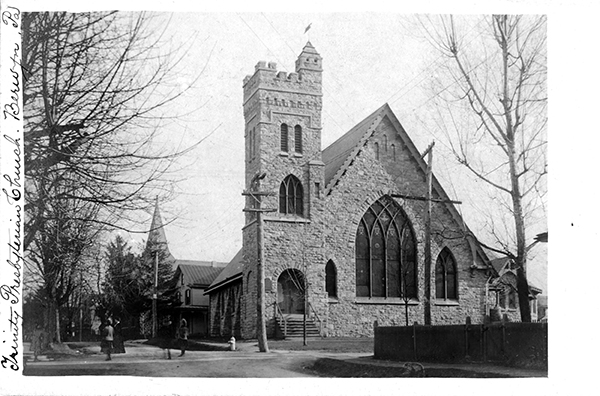
Trinity Presbyterian Church, dedicated in 1892. Photo by Lucy Sampson.
Baptist Church in the Great Valley: The Berwyn Baptist Chapel was built on Cassatt avenue, near the railroad station, in 1886 by Morgan Ruth of Malvern, at a cost of $6822 according to the church account. The exterior is part frame and part Easttown stone in rubble work, being of the “Up John” period. The cornerstone was laid with ceremony on September 14, and on November 28, the first services were held, when the Sunday School celebrated their anniversary.
For a time they seemed to prosper. An itinerant evangelist, one George Williams, conducted a “union” revival service in the Chapel during the winter of 1891-92, with marked success in respect to the number of converts, most of whom joined the Baptist Church through the activity of “Brother” Cleaver. It had been agreed among the church leaders that inasmuch as it was to be a union service, that the converts should not be influenced to unite with this or that church.
On July 26, 1895, the Chapel was damaged by fire supposed to have been of incendiary nature; the interior was remodeled by W.H. Burns, and the building reoccupied in December of the same year. Many were pleased that some of the clashing color effects produced by an exorable taste in the “fighting” windows, were replaced by more artistic leaded glass. The renovation was largely at the expense of the insurance company, of which Deacon Cleaver was the local agent.
Perhaps there is no more distasteful task than that of recording church dissentions. Early in the pastorate of the Rev. John G. Booker, 1893-1895, a native of England, personalities between a few leading members spiraled into a most bitter feud until nearly all were involved on one side or another, resulting in the withdrawal of the greater part of the congregation, many of whom were recent converts, but taking with them several whose traditions ran back to the very foundations of the Baptist Church in the Great Valley. The bone of contention was not disclosed save that it was understood to be of a sordid nature.
The First Baptist Church: Claiming to have been locked out of the Chapel, a number of Baptists met in the old band hall over the plumber shop on the corner of Waterloo avenue and the Pike, September 23, 1896. On the evening of the 30th an organization was effected, at first called People’s Baptist Church, later First Baptist Church of Berwyn, with James J. Dewees, Abraham S. Latch, Theodore L. Wiggins, and Pusey Pennock as deacons. This church was recognized March 2, 1897, by the Baptist Council of the Philadelphia District, a body independent of the regular organization.
Berwyn Methodist Church: After being forced to find new quarters when the roof of their frame chapel at Devon collapsed in a heavy snow and rain storm in the winter of 1883, the embryonic Methodist congregation met for a time in the Berwyn Town Hall. The adjoining sheds of the Presbyterian church were used for horses and carriages. The Sunday School opened May 4,1884, after a preaching service. The church was connected with the Salem Charge, and the Rev. Edward Townsend of Salem was pastor. Later that year they purchased a lot on the west side of Church avenue (now Main) extending through to Waterloo. At the Conference of 1885 Berwyn was set off from Salem, as a separate charge, and the Rev. Daniel Hartman became the first pastor.
St. Monica Roman Catholic Church: St. Monica is named, as are most Catholic churches, for a saint - in this instance for the mother of St. Augustine, which is appropriate since the church owes it beginnings in Berwyn to the Augustinian fathers in Villanova. The Town Hall erected in 1877 on Church avenue, served as the religious center for Catholics of the Berwyn area until December 24, 1889 when Mass was celebrated in the basement of their still uncomplete church.
Prior to 1873 they had to make an eight-mile trip to the chapel of Villanova College. In 1876 the Rev. John Fedigan O.S.A., pastor of Villanova, was asked by a boyhood friend, James Kelley, to attend a meeting to discuss the needs of his fellow Catholics in Reeseville (name soon changed to Berwyn). As a result of this meeting, the first Mass in Berwyn was celebrated on January 12, 1879 in Mr. Kelley’s home, at the corner of Lancaster pike and Waterloo avenue, which was to serve as the area’s Catholic religious center until the Town Hall rented shortly afterward.
George and Cornelia V, Tobler, who owned a 1.4 acre tract on the south side of Berwyn avenue, transferred half of it to the Augustinian fathers on June 2, 1888 for a consideration of $2800. By Christmas eve 1889 work had progressed far enough to permit holding the first Mass in the basement of the structure, but it was not completed until three years later. The church was dedicated on May 28, 1893. In June the Augustinians turned over the new church to the Archdiocese of Philadelphia, ending their association with the parish. For a while St. Monica operated as a mission church served by Father Hand and Farther Ward of St. Katherine parish in Wayne. On January 11, 1897 St. Monica received its first resident pastor, the Rev. Hugh J. Dugan, and thus was accorded full parish status by the Archdiocese.
St. David’s Episcopal Church: Upon the death of Rev. William F. Halsey, October 15, 1882, the Rev. George A. Keller, then assistant rector of Christ Church, New York City, was called to the vacant charge and began his ministry there early in 1883. Rev. Keller died March 4, 1902, after a ministry of nearly twenty years.
The deaths of there men, Frank H. Stauffer, 1895, Thomas Aiken, 1897, and John F. Kauffman, 1898 was participated importantly in guiding the small village of Reeseville to its maturity as Berwyn, were recorded in the waning years of the nineteenth century. Stauffer, was a leader in many local organizations, including the Presbyterian church; Aiken sub-divided his farm and it became the core of Berwyn and Kauffman surveyed the land and laid out the town of Devon. New names and faces would be needed in the new century.
At The Same Time
Gold discovered in South Africa
Brazil becomes a republic
Italian Guglielmo Marconi, inventor of “wireless telegraph” or radio
Hague Peace Conference held; aims to settle international disputes