Chapter 11: Depression, Defense, and Development
1930 - 1964
Our local history writers have recorded little of their recollections of the “great depression” which afflicted the decade of the 1930s. Perhaps the memories are still too vivid, too painful, or too distressing to describe.
Writers on a broader scale have left some facts to ponder. Gifford Pinchot entered into his second term as Pennsylvania's governor in 1931 and was faced by hard times and an increase of unemployment to alarming proportions. The state had only eight per cent of the population of the United States but had ten per cent of the unemployed. Agriculture was similarly affected. Farm prices, over the decade from 1919 to 1929, had dropped more than 50%, and then from 1929 to 1932, sixty per cent more. The farms of Easttown would never again meaningfully supply crops and foodstuffs for the marketplace.
Franklin Roosevelt, newly elected president of the United States, quickly acted to shore up the banking system. Two days after his inauguration, he issued a proclamation on March 6, 1933, closing all banks until Congress could meet in special session. (Berwyn National Bank just three years earlier had embarked on a building program to enlarge and renovate its facilities on Lancaster avenue in accordance with plans and specifications prepared by Ritter and Shay, Architects. The project was completed in October of 1930). The bank was closed from March 10, 1933 until February 8, 1934, but no money was lost by depositors. In October of 1934 the death of William H. Doyle, a director, was noted by the bank Directors in a tribute in appreciation for his services both to the bank and the community, especially during the period of suspended banking services.
Any employment opportunity was greatly esteemed. A highway project which will resonate clearly with today’s Easttown residents, widening of Lancaster avenue through Berwyn, commenced about 1930. Pavement was extended from Grove avenue in Strafford, south of the railroad, to connect with Lancaster avenue in Berwyn (prior to this time the street we know as “Old Lancaster” north of the railroad was the only thorofare available). Then in April of 1931 the newspaper reported, “Berwyn property owners, as well as the Chester County Commissioners, are anxiously awaiting word from the State Highway Department as to the latest decision on plans for the widening of [Lancaster avenue] through town. The original plan would have resulted in the razing and altering of many business properties and would have caused thousand of dollars in damages which the county would have to pay...”
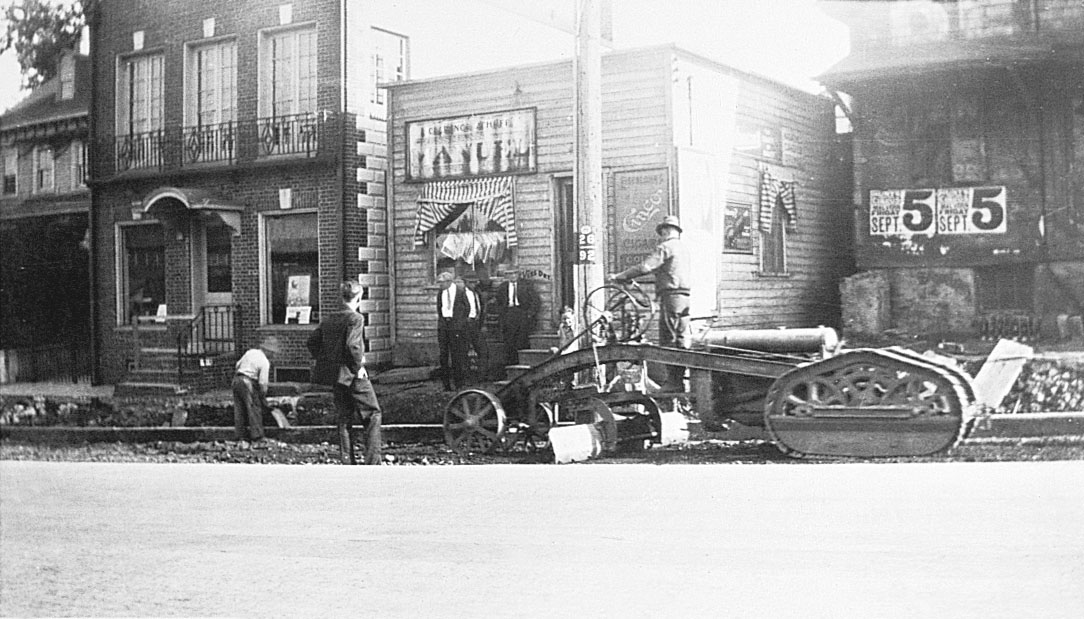
Stores on Lancaster avenue in Berwyn during street construction 1932. Photo by Charles Siner
As it turned out, the construction greatly altered the grade of the highway as can be noted from references by local writers in the Quarterly. The Walker twins, Merle (Lee) and Mildred Jones), writing about the Berwyn Pharmacy say, “In early days, before Lancaster avenue was improved in the 1930s, the drug store sat high on the street. Five steps led up to the door, wider steps at the bottom and a second set of narrower steps at the entrance to the store.” Also, Sara B. Nuzum writing about Cook's store (later Beadle’s, still later Williams’) at Lancaster and Bridge avenues says, “In 1930 the Turnpike was changed to four lanes. They took the porch off the store, and at that time Harry Williams remodeled and stayed in business until his death in 1941.”
The school authorities in Easttown decided to upgrade the elementary school facilities early in 1930. They acquired a tract of land on the south side of First avenue, east of Bridge avenue, in Berwyn, from the Coates family, hired architects, and let bids for the construction of a new Easttown Elementary School. The new school was first occupied in the fall of 1932.
In 1933, the old Grammar School, previously closed in 1926, was razed. The south room of the annex, Building No.2, became, for the next eight years, the site of the Berwyn Library. It was also used for many years as a meeting place for Easttown township supervisors until the new Township Building was built in 1958 on Berwyn avenue on the east side of town.
In 1932 the Paoii Branch of the American Red Cross relocated to the other room of the former schoolhouse. The outbreak of war in Europe in 1939 brought a great increase in Red Cross volunteer activities. Negotiations commenced with the Easttown School Board to purchase the building The transaction was completed in April of 1943, the library having moved out some months earlier to the Aiken building (old Berwyn Pharmacy) on Lancaster avenue. From the Red Cross and others, the building descended to become headquarters for Surrey Services for Seniors today.

Surrey Services building, formerly the Red Cross.
Storm clouds of war were again building on the horizon in Europe. Then came the surprise Japanese attack on the U.S. Naval base at Pearl Harbor on December 7, 1941.
“The regimentation of the physical, mental, and spiritual entities of a people to the will of a single mind, however efficient to accomplish a set and determined purpose, cannot result in the lasting good or happiness of the world.” So stated the editor of our local history journal in the first edition published after the attack. The response on the home front was immediate.
On December 9th, orders came through for full time observation of the overflight of all aircraft. (The U.S. Army had conducted a series of tests for observation of planes in this area in October of 1941.) At 6 p.m. the Berwyn Observation Post started on twenty-four-hour duty. With no protection against the weather, and having to go down a long ladder to telephone messages, Clarence Reifsneider, who had established the Post on the High School roof for the earlier tests, looked for a more desirable location. The Road Supervisors of Tredyffrin township were approached and they agreed to build a place on the roof of the township building on Old Lancaster road, about half a mile southwest of the High School.
The Army was agreeable, and Walter Eaves, Mr. Leighton, and Mr. Waterworth, the Road Supervisors, started work for the new observation post. They had a doorway cut through the south wall of the building, and a stairway with a railing and a platform constructed on the roof. A former traffic watch-box with windows on three sides and a door with glass was placed on the platform. A telephone and electric line were put in place and on December 16th the Post officially opened on the roof of the township building. Orientation marks which could be seen while telephoning were painted on the upper and lower roofs.
On December 19th, Mr. Reifsneider had to resign due to his connection with Bell Telephone Company. F. Alfred Patton was approached about taking over the duties of Chief Observer, which he agreed to do and resigned as an Observer on the Sugartown Post.
The first week on the job was to complete the roster so that an observer would serve only once a week. With two people on a two-hour tour that would require 168 people. Several persons were on more than one tour, and Mrs. Franklin Wandless was on three times a week. Two Assistant Chief Observers were appointed: Mrs. Edith Reifsneider, who took care of the daytime observers, and William Armstrong, who handled the nighttime tours. In placing people on a tour, friends, spare time, and type of work or business were considered, which in the end paid dividends, because at the time of deactivation 90 of the original people were still included among the 157 people on a week’s duty. The Post was never without at least one observer on duty. The only difficulty encountered with manning it was during February when colds kept people away.
A flag pole was erected by Berwyn Plumbing and Heating Company and a flag bought by the observers. Franklin Wandless made an appropriate weathervane, depicting two observers, following a plane, and placed it on the roof.
A red flash message was reported just before 3 p.m. on May 26, 1943, when a plane crashed during a heavy rain storm on the Percy Wilson estate at Devon, two miles east of the Post.
When the Army distributed Aircraft Warning Service arm bands, the observers wore them while on duty. Later, when the Wings, in the form of a pin, were issued, the observers felt that they really were a part of the Army Air Force. The Post was deactivated in October of 1943.
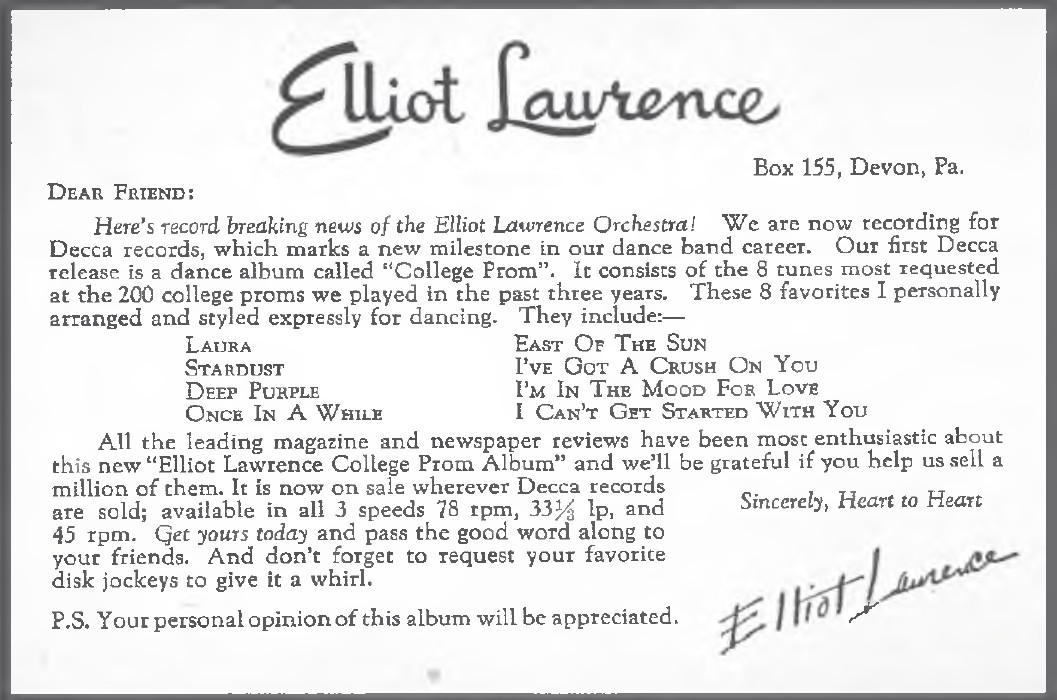
Easttown was not without other talents. A young man with great musical ability graduated from Tredyffrin-Easttown High School in the wartime Class of 1942. He was Elliot Lawrence Broza, later known professionally simply as Elliot Lawrence. His family moved in 1936 to a house on the north east corner of Fairfield and Sugartown roads in Devon, and he grew up there.
His father was general manager and program director for radio station WCAU in Philadelphia and also producer and director of its popular Children’s Hour program, broadcast on Sunday mornings. Music was a normal accompaniment of Elliot Broza’s everyday life. From the age of two, he was fascinated by the piano, but as he grew older he also played the saxophone.
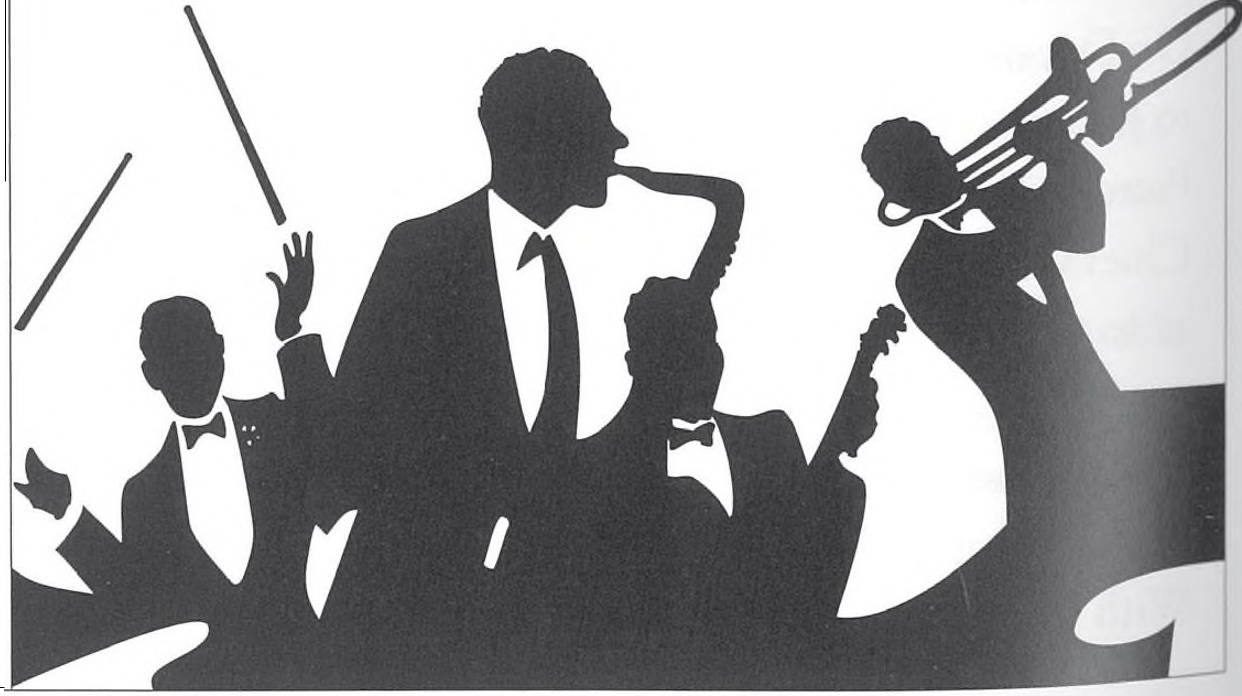
After the family moved to Devon, he took piano lessons from Stanley Gray, the music director for the Tredyffrin-Easttown school system, also doubling on the clarinet. This was about the time that the “Band Busters” was organized. An eleven piece dance band, made up of children between eleven and fifteen years old, the band used the third floor of the Broza home in Devon as a rehearsal hall. The group not only played on the Children’s Hour program, but also at private parties, for which the young musicians were paid from a dollar and a half to three dollars each. In addition to playing piano, saxophone, and clarinet in the band, Elliot Broza was its business manager, arranging bookings and handling all the band’s correspondence.
With this background it was inevitable that as a student at Tredyffrin-Easttown High School, Elliot Broza would be involved in just about everything pertaining to music, both instrumental and vocal. And he was.
After graduating from T-E, Broza entered the University of Pennsylvania, completing his course in a war-accelerated program in three years. He immediately took over as musical director of station WCAU, where he put together what George T. Simon, music critic and editor of Metronome magazine, later described as “the greatest studio band in the country.” The band featured vocals by Rosalind Patton and Jack Hunter, played sweet music, and achieved great popularity with the Philadelphia listening audience.
By the early part of 1946, Lawrence (as he was by then known) took the band on the road, with dates at prestigious venues, radio remotes, and recording contracts. Unfortunately, in the 1950s musical tastes changed and the days of the big bands were numbered. “Elliot Lawrence, his Piano and his Orchestra” will always be remembered fondly. If he had been born ten years sooner, there is no telling what he would have achieved.
Even though he had been bedridden in his mother’s home on Central avenue in Berwyn for several years, during World War II Bob Goebel wanted to be a part of the war effort. The result was “a monthly newspaper, published by Berwyn men and women on the Home Front for the Berwyn men and women on the Fighting Fronts.” The first issue appeared in April 1943, and its publication continued on a monthly basis until May of 1946, by which time nearly all those who had served through the war had returned home again.
Robert F. Goebel was seriously crippled when a disease, generally termed as arthritis, set in about a year after he graduated from Tredyffrin-Easttown High School in 1933. After an unsuccessful operation he was confined to his room. He conceived the idea of a home town newspaper, to be sent to service personnel during the war. Since there was no such paper, he volunteered to head the task as editor; the communications were to come to him.
A great volunteer effort ensued (there were 24 names on the masthead for the final issue) and the product was well received. Contributions of equipment, supplies and cash flowed in. The paper metamorphosed from four mimeo-graphed pages to a new and larger, printed format. In fact, so well did the Berwyn Post become a hometown newspaper that many of the local residents wanted it delivered to them too. A special December 1944 Christmas issue reached fourteen pages. From an initial circulation of 130 the numbers climbed to 2500 copies by the end of the war, including a large number of copies circulated locally.
A special thank you was given to Bob Goebel on September 22, 1944 when he received the American Legion Citation. The award was made in recognition of his work as editor of the Post, and was presented by William H. Kohlmeyer, service officer, and Clarence L. Reifsneider, adjutant, on behalf of Dalton-Wanzel Post No. 646 of Paoli.
Less than nine months later Robert F. Goebel was dead, at the age of 30. In early June he went to the hospital for an operation, and two days later, on June 13, 1945, he passed away. To the very end he displayed the same cheerfulness and faith that helped him meet and rise above the physical handicap under which he had labored, since a football accident twelve years before.
The war in Europe had ended, but in the Pacific hostilities continued. There was never any question about the future of the newspaper. The staff closed ranks and kept on producing the Post “in tribute to his memory.” Not until its 38th issue, May of 1946, did publication cease.
Fittingly, on the front page of the final issue was reproduced the program for the annual Memorial Day Service in Berwyn, to be held at 11 o’clock in the morning on May 30th at the Easttown Grammar School. A highlight of the service was the dedication, by Bill Pyott, assisted by members of Berwyn Girls’ Club, of a memorial plaque to honor Robert F. Goebel, to be placed in the Easttown Library.
Also, at the service, Dan Redman paid tribute to the Gold Star Veterans of World War II. A page in the last issue of the Post recognized twelve of them:
| Thomas Armstrong | John Bartosh |
| Anthony Borzillo | Stephen Brooks |
| Daniel Connor jr. | Maurice S. Houston |
| Thomas E. Parlaman | Warren Phelps |
| Curtis K. Ritter | Alvin Stauffer |
| James D. Sweeney | John Carl Wright |
No complete list is known to exist. A local committee for the erection of the Berwyn Veterans’ Monument is currently working on this. Likely the list eventually determined will be larger than that shown above.
For four days in June of 1952 the village, and most of adjoining Easttown and Tredyffrin with it, took time off to celebrate the 75th anniversary of the town named Berwyn. World War II had scattered close to 400 of its sons and daughters to the ends of the earth. With peace achieved, they returned with renewed pride in their home town to pick up the lose ends and seek a career. Many opted first for college and after four years, at graduation, found themselves faced with renewed armed conflict in Korea only weeks after receiving their degree. The feeling of patriotism, pride in nation and its accomplish-ments was at a high level, and everyone loved a parade.
Fourteen local organizations formed the sponsoring committee for the event. Paul L. Good was chosen general chairman, and veteran residents belonging to the community’s several organizations took up duties as committee chairmen and working members.
At noon on June 26 the fire whistle sounded the official opening of the celebration. All the buildings in town were decorated with flags and red, white, and blue bunting. Residents dressed up in old time costumes and special black derbies and top hats decorated with red bands. There was a hobby show open daily in the former Acme Markets building at the south west corner of Lancaster and Main avenues.
At 2 p.m. a memorial service at the monument on Lancaster avenue remembered deceased members of the community. In the evening at 6:30 p.m. there was a Little League baseball game between Berwyn and Devon-Strafford on the high school turf. The team uniforms were freshly washed and ironed for the occasion. A community church service and choir sing was held at the field following the game.
The next day, Friday, June 27, the Berwyn businessmen’s gala parade stepped off at 7 p.m. There were also ceremonies at the fire house following the parade to house the new 1000 gallon a minute Autocar pumper and burn the note on the new Cadillac ambulance.
Saturday, June 28 was set aside as Fireman’s Day. At 10:30 a.m. the annual meeting of the Chester County Firemen's Association convened in the fire house auditorium. After lunch, at 2 p.m. the firemen’s parade got under way featuring hundreds of thousands of dollars worth of equipment, with bands from far and near competing for prizes. It was a long parade on a hot day.
The celebration closed on June 29, with special worship services in the individual churches of Berwyn. On Sunday afternoon the results of the judging of vintage clothes worn during the week were announced. Charles Gibb took winning honors in the men’s division; Mrs. William Rambo in the women’s division; and Mr. and Mrs. Walter Brown were chosen the best dressed old-fashioned couple. It was, in short, a celebration not soon forgotten.
By 1952 even the youngest World War II veterans had completed their college courses. They were getting married, starting their careers, and the great “baby boom” had begun. Young families spent their weekends visiting sample houses.
Easttown Woods was Berwyn’s first post war housing development. Advertised as “surrounded by trees,” it offered homes at affordable prices just fifty years ago. The houses were appealing to new families. The location, of course, was superior, with the closeness of the Pennsylvania Railroad and the anticipation of the Schuylkill Expressway. And once on site, the young couple could appreciate the pains the architect and the builder, the Easttown Company, had taken to make an affordable home a truly fine place to live.
First, instead of following the usual method of clearing the land of all obstructions and laying out streets in grids, the builder left standing the large, medium-sized, and even small trees. Many of the homes were shaded by trees already fifty and seventy-five feet tall. On the southwestern side of Midland avenue Doyle & McDonnell once had their dogwood nursery. Homes there featured several full-grown dogwoods in their back yards.
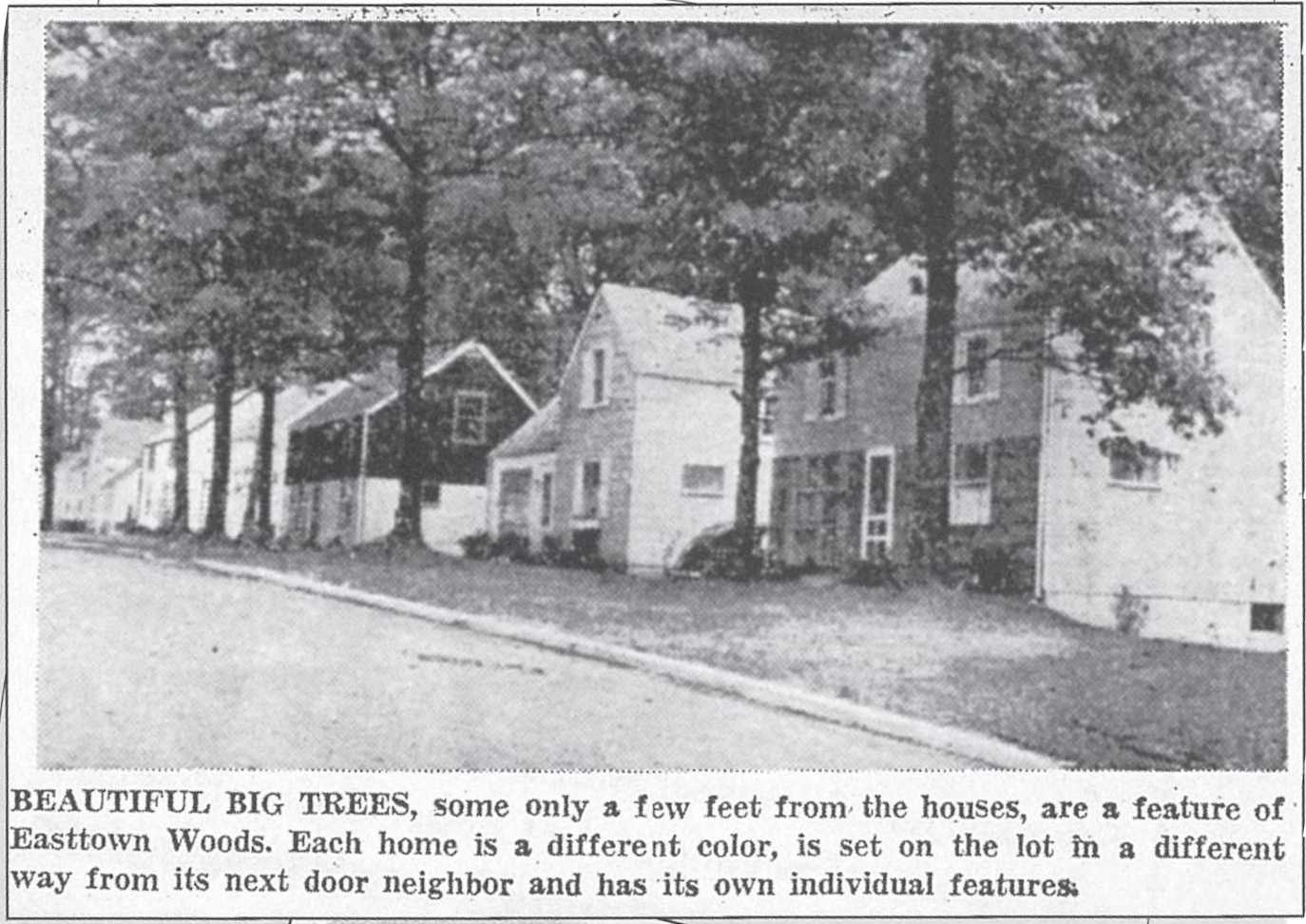

The streets of the development curved and straightened in a pleasing way. Houses along the little branch of Darby creek sat low, while houses on the western side of Midland avenue sat high. The houses were also turned in different directions to avoid a “cracker box” look, and colors were in variety and selected by the architect. The salt box type was not a typical choice in Philadelphia’s suburban housing; more common at this time was the ranch house, and soon the rage would be the split-level.
Most Easttown Woods houses were built with only the first floor finished. On the first floor were the living room, dining room, efficiency kitchen, two bedrooms and bath. Utilities were in the basement. The living room featured a picture window. The dining room adjoined it with no separating wall, and the kitchen opened without doors or walls to the dining room. The effect was a brightness and spaciousness uncommon in a small house.
Walter K. Durham, the architect, had considered the family who would be living in the home when he designed it. He gave remarkable attention to even small details. The open kitchen was equipped with an exhaust fan; the bathroom mirror was angled so that small members of the family could see themselves in it.
While the second floor was unfinished, it was ready for expansion. Most families set about immediately to complete it. The men worked together or alone; wives helped. Some families hired contractors to raise the back roof and put in a dormer and an upstairs bath. Those with houses with a garage also found that they could, after all, put a door from the garage into the basement, greatly improving accessibility to the house. Building a house is hard work, and few were experienced at it, but they learned from one another as they went along.
Most of the buyers were veterans and their families. The men were about 27 to 32 years old. Many were beginning professionals, teachers, accountants, an architect, and, the greatest in number, engineers. Most of them had one or two children when they moved in, and would have more; four children in the family would be common ten years hence.
It was a time of changing life style for the American family. Before the war a lifetime in the same community, with the extended family near by, was the common pattern. Now young couples set off on their own to distant places where there were no family ties. In Easttown Woods a number of people came from Michigan to work at the new Paoli center of the Burroughs Corporation; others came from western Pennsylvania and New York, in addition to those from other suburban Philadelphia areas.
The local residents, whose quiet little village these 75 new families also inhabited, were gracious and welcoming. It was a happy, supportive place to come to. Many of these newcomers had moved from city apartments where they had been met with indifference. The warmth of the village was immediately evident. Several widowed women, living with their families in the older part of town, became loving, capable baby-sitters.
Most of all, the newcomers supported each other. They were sharing a very happy time of their lives together; common interests bound them closely.
Home delivery men came regularly through the streets; breadmen, milkmen, an elderly gentleman who peddled his wife’s sticky buns on Tuesday and Saturdays, and eventually, the mailman. (During the first years of the development, when mail had to be called for at the post office, mothers trekked uptown with their strollers and walking toddlers. They “did the town” as they went along, and by the time the mail was home-delivered, the mothers and the town were well acquainted.)
The sidewalks on the west side of Midland avenue and the east side of Eastwood road at first saw heavy traffic in strollers, soon to be accompanied by tricycles and scooters. Back yards sprouted sand boxes and gym sets. Mothers gathered where the children were, to supervise.
The Easttown Board of Supervisors, in those early years, met at the Red Cross building behind the Acme, at Bridge and Lancaster avenues. The residents of Easttown Woods were well treated by the Supervisors; they did not always have their needs met, but they were always heard with courtesy. One of the gains they accomplished was to have a school crossing guard placed at the intersection of Waterloo and First avenues. When more of the children were in school, the township, the school district, and St. Monica Church cooperated in making safer paths, out of the roadway, for the children.
The shopping district was along Lancaster avenue, and the stores on the highway closed on Wednesday afternoons. They were managed primarily by long-time local residents. Mr. Day had a small drug store near the corner of Lancaster and Main avenues; when he retired in September of 1954 William Connor, of Kennett Square, moved in and became Berwyn’s pharmacist, soon expanding his store to the corner, buying the property from Josephine Latch. (Connor served the community 44 years until retirement in 1998.)
The Bridge Shop was just above the post office, and had a succession of owners; here were sold sodas, ice cream, snacks, and some groceries. Espenshade’s was a larger grocery store on the highway down near Midland avenue; they made deliveries back then. Across Main avenue from Connor’s was Harolds Department Store, managed for many years by the town’s most prominent Democrat, Lou Lieberman; his merchandise was fresh, of high quality, and well displayed, and included items in great demand by the families living in Easttown Woods, name brand women’s blouses, snow suits, polo shirts, and underwear for small children. A new hardware store opened, and soon had to expand.
These first few years were in many ways charmed ones for these new residents. Careers were moving ahead, and the growing mob of children was happy and healthy. In 1957 came the first recession, and with it a cutback at Burroughs that broke into the tranquil world of Easttown Woods. Over the next few years Burroughs was to lay off or transfer a number of employees.
New housing developments were springing up everywhere, yet the schools were remarkably adept at keeping ahead of the enrollment. In 1955 a wing with two kindergarten rooms and a cafeteria was added to the Easttown school. In 1957 the Devon school was ready and the Devon children were assigned there, and the Easttown school became known as the Berwyn school. In 1961 the new Hillside school took children from Berwyn who lived in the Bair road, Margo lane, Conestoga road area. In 1965 another group went off to the new Beaumont school.
New churches and church facilities also appeared. In October 1951, Trinity Presbyterian Church removed its cemetery from the corner of Berwyn and Waterloo avenues into the Great Valley Presbyterian churchyard in the Valley. On the Berwyn site it built an addition to the church including an auditorium seating 250, separate class rooms, a church kitchen and a pastor’s study, all completed in 1954. A new two-story education wing was dedicated in 1973.
First Church of Christ, Scientist, Berwyn, joined our community when it purchased the Chapel on Cassatt avenue near the railroad station from the Baptist Church in the Great Valley. The new congregation held its first service in the building on October 4, 1953.
Berwyn Methodist Church: The Rev. Stacy Myers began a twelve-year pastorate in May of 1953. During his tenure a 7-1/2 acre property was purchased from the Coates family, and the first buildings on the present church campus were consecrated in 1958. Three years later the original 1888 building on Main avenue was sold to Trinity Presbyterian church, leaving behind seventy years of fond memories. Rev. Myers was succeeded by the Rev. Harold Schieck in May of 1965.
St. Luke’s Evangelical Lutheran Church: After meeting for about a year in the old dance hall (Isabel E. Rogers Hall, Stone and Gables, Devereux School) in Devon, the Lutherans organized as a church on December 5, 1954. The Rev. Theodore Schlack was called as the first pastor. Land straddling the Easttown township line in Devon was purchased in 1955. The church met in the Red Cross Building in Berwyn while the church was being built. The first service in the newly constructed edifice in Devon took place on December 7, 1958.
Evangelical United Brethren: A church of Methodistic German background occupied a new building in 1962 on Darby Paoli road at Buttonwood. Not long after, in 1968, the denomination merged with the Methodist church to form the United Methodist church. The larger Berwyn church was the survivor locally. Today Congregation Or Shalom, a Jewish synagogue, occupies the location.
St. Norbert Roman Catholic Church: In 1956 a new parish began in Paoli, carved for the most part out of St. Monica in Berwyn, to relieve crowded conditions. The Norbertine fathers then resident at Daylesford Abbey were involved in opening the new location. The children of St. Norbert continued to use the school facilities of St. Monica until their own school building on Darby Paoli road was completed in early 1958. The first mass of St. Norbert parish was celebrated on June 18, 1956 in the Paoli Fire House.
St. Monica Roman Catholic Church: The Rev. John Driscoll was appointed pastor in January of 1957. He twice enlarged the school, the first expansion being in 1958, and built, the same year, a new convent, the old one having been torn down to enlarge the school. Father Driscoll died on September 6, 1968, at age 63.
Main Line Unitarian Church: Founded in 1958 by about twenty families in the area, the church found a permanent home in 1961 when it purchased the old Emory McMichael mansion on Valley Forge road near Maplewood, close to Old St. David’s church, in Devon. The Rev. Mason McGinness became the first pastor in 1963.
Work to organize a local YMCA began in 1962 and reached fruition when the Upper Main Line YMCA purchased the 54-acre Daylesford property of the Norbertine fathers on December 31, 1964. Originally part of the estate of J. Gardner Cassatt, the property includes a large brick mansion house and surrounding grounds which have been developed into a first-class YMCA.
The new Easttown Township building and adjoining Library, at the southwest corner of Lancaster and Midland avenues, opened in 1958. It was the first permanent home the township had. By then a number of the children in Easttown Woods were in school, and the library was a great convenience for them. A true dedication to educational excellence was apparent in the schools, and in the community at large.
At the end of five years, the first home owners in Easttown Woods began, in small numbers, to move out. By five years after that a good number had moved on, some transferred or promoted to another, distant city, others to larger homes nearby for their growing children. As a result, the community became more diverse. For some newcomers, it was a place to retire. But those who were early owners in Easttown Woods look back at those years and remember what a great place it was to start a family.
Issues of the Daily Local News published on March 20, 21, and 22, 1958 confirm what was doubtless a record snowfall for the area. The snow started during the day on the nineteenth. By early evening, traffic, even on the Lincoln highway, was virtually at a standstill. Police reported major tie-ups on both Route 30 and 202 (now Bear Hill road and the Paoli pike). The hill at Devon on the Lincoln highway, for many years a bottleneck when snow came, was completely blocked by stalled and abandoned cars and trucks. Emergency shelters had to be set up along Route 30 to provide food and sleeping accommodations for snowbound travelers, truck drivers, and marooned families.
By half past nine the following morning, the snow on the ground in West Chester was officially measured at 25 inches! Unofficial measurements in Paoli showed depths of as much as three feet. The unexpected storm surpassed all previously recorded snows, including the former all-time record storm of Christmas Day in 1909, officially measured at 21 inches, and the well-known Blizzard of 1888.
The snow was an extremely wet and heavy one, sticking to everything it fell on. Its weight coupled with high winds, resulted in many broken branches and fallen trees, causing thousands of families to be without electric power or telephone service and hampering road clearing and repair operations. Some were without service for three or four days, and in a few instances in the Great Valley for an even longer period of time. At the Philadelphia airport there were only four inches of snow recorded, but even that somehow seemed scarcely appropriate for the day before the first day of Spring.
That same year, Easttown lost its largest, and likely almost its last industry, when the American Non-Gran Bronze Company closed. During World War II the company employed close to 1000 workers on war production, operating on a three-shift, seven-day a week basis in several locations. After the war, the contracts were canceled and reorganization took place. New management modernized the plant and operated successfully until November of 1958, when a dispute over wages caused a costly strike lasting into the following year. Two months after the strike ended, the business was sold and its assets and operations transferred to Chicago. Twenty-four trailer loads of equipment were moved from Berwyn.
The experiences of the homeowners in Easttown Woods were replicated countless times in countless developments in the following 50 years, in neighborhoods named Berwyn Downs, Country Estates, Dogwood Lane, Leopard Lakes, Lenape Farms, Beaumont, Devon Downs, and what seems to be an endless litany. In the twenty years from 1950 to 1970, the population of Easttown township grew from 3784 to 9565 bringing a huge need for support infrastructure of streets, sewers, trash (and leaf) removal, schools, library facilities, parks, and public safety. Incredibly, fire protection is still provided by our volunteer Berwyn Fire Company.
At The Same Time
Norwegian statesman, Trygve Lie, elected secretary-general of newly formed United Nations
J. Presper Eckart and John W. Mauchley unveil ENIAC, world’s first computer, at U of P’s Moore School of Engineering
U. S. Supreme Court rules in Brown v. Board of Education that racial segregation in public schools violates constitution
Polio vaccine developed by American medical researcher Jonas Salk released to pubic
Soviet Union launches Sputnik, first artifcial earth satellite
East Germany tightens borders; Berlin Wall built
Soviet cosmonaut Yury Gagarin orbits Earth in first manned space flight