Chapter 8: The Centennial Period
1876 - 1885
During the Centennial period the little village of Reeseville was considered one of the most quaint and charming places along the Main Line.
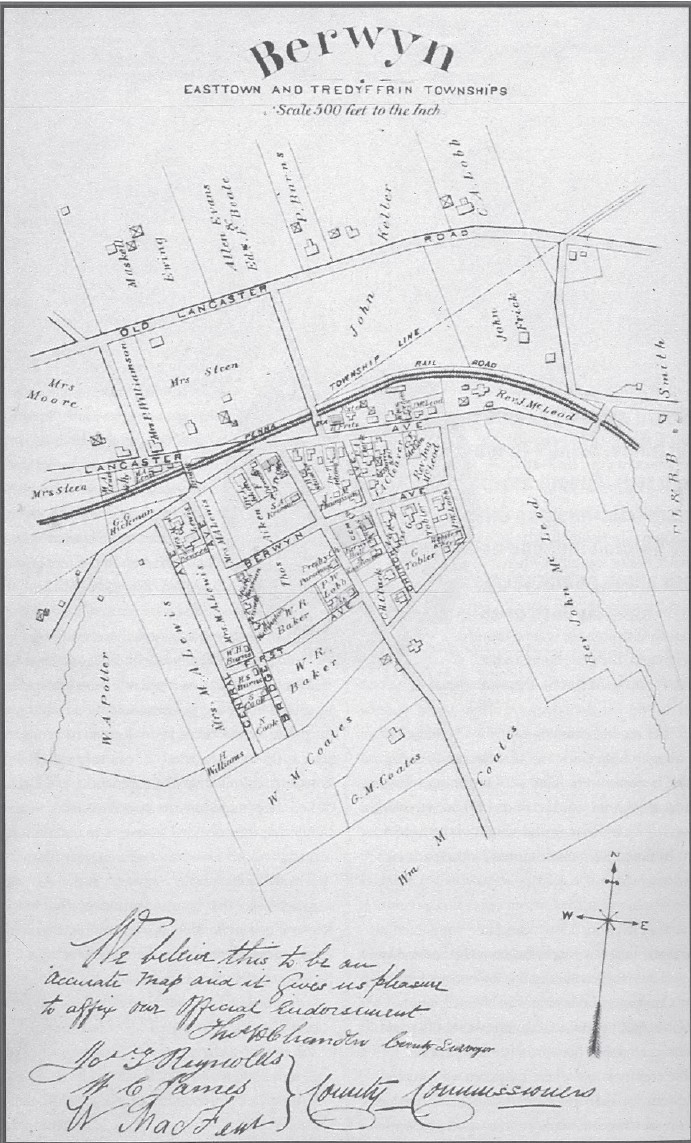
Map of Berwyn from Breou’s Official Series of Farm Maps of Chester County, published by W. H. Krik in 1883
Altogether it contained about forty dwellings, a Presbyterian church, Cleaver’s general store, Fritz’s coal, lumber and feed yard (operated by Preston Lobb, widow Fritz’s brother), James Kelley’s tin shop (real Welsh tin), Morris Lewis’ carpenter shop, Thomas Aiken’s carpet weaving shop, Egbert Bloom’s harness shop, and McLeod’s blacksmith and wheelwright shop (occupied about this time by William Epright). Altogether there was a population of about two hundred.
Some of the inhabitants were not at all pleased with the lovely name of Reeseville and determined to make a change without offense to their Welsh neighbors. At length it was proposed to name the village after the Berwyn hills overlooking the beautiful valley by the river Dee, Merionethshire, Wales. The village looked over the beautiful pastoral valley of Chester from a commanding height, and its position was popularly thought to be the highest point topographically along the Pennsylvania railroad between Philadelphia and Columbia. As a citizen stated in 1878, “the name gives universal satisfaction because it is short, significant, and euphonious and because it is the only name of the kind in the Western Hemisphere.”
Berwyn received the official recognition from the United States Post Office Department in 1877, and the same name has since been adopted by towns in New York, Maryland, Illinois, Nebraska, and Oklahoma. There were no new roads or avenues except Church avenue from the station to the Presbyterian church and Berwyn avenue from Waterloo to the same edifice and a little beyond, to provide egress for the newly built dwellings of Harriet Davis and William Clark, the latter an imposing mansion. As near as can be ascertained, Church avenue was renamed about the beginning of the year 1886. Miss Sara Nuzum has said that there was a note in the paper dated January 6, 1886, “Wanted a good reason for naming Church avenue ‘Main’.”
The village from east to west included the McLeod farm which originally extended to between Church and Waterloo avenues; Aiken farm from Waterloo to near Bridge avenue; and the Dr. Henry Yates Carter farm to the Potter line. A southern tier included the Coates, Leamy, and Potter farms. North of the railroad were the Smith, Mathews, Fritz, Williamson, and Moore farms of no considerable extent; with a northern tier mainly on the Old Lancaster road of the Jones, Williams, Lobb, Reese, Burns, Neeley, and Morrison tracts
Old “Cockletown” or “Cream Ridge”, revolutionized into North Berwyn, had lost half a dozen houses demolished mainly by the ravages of a century of time, and gained only half as many, for local building without the facilities of supply meant a great deal of labor. The shingles for the roof of John Neeley’s house built by Isaac Burn, in 1846, had been wheeled by Parsons the carpenter all the way from Spread Eagle in a wheelbarrow! Reeseville had no station and was only a flag stop as late as 1871.
The Centennial Exhibition at Philadelphia in 1876 to celebrate the one hundredth anniversary of the Declaration of Independence had stimulated amazing economic growth for the city, already boosted by the post Civil war industrial revolution. Slightly more than eight million tickets were sold for the 159-day event (the population of Philadelphia was then only 750,000) and the Pennsylvania railroad expanded facilities to allow it to carry close to five million passengers.
The railroad was in the midst of replacing iron rail with steel, and in 1877 it rebuilt the roadbed through Berwyn to reduce grades and eliminate the numerous short curves previously deemed necessary. David Ryan was awarded the grading contract between Glassley and Mt. Airy, and purchased the Abel Reese farm for the stabling of his horses and the housing of his employees. They were all Irish and like the contractor were devout Roman Catholics. The warm-hearted Ryans became a part of the social and business life of the community.
The Carter farm house and barn and the old Newtown and Howellville road bridge were demolished, the Aiken houses and the Fritz warehouse moved back by an expert mover, much to the astonishment of the inhabitants, without disturbing the tenants, and two dangerous grade crossings at either end of the village eliminated.
It was a stirring sight at quitting time to see the horses and dump carts come in, each wild Irish cart boy lashing his horse into a gallop to see which arrived first from the dump, for at supper “first come, first served.” The horses were stabled in the long, low, log barn of the old Reese farm where the stable boys probably slept on the straw In the rear, one field back, at the edge of the woods a shanty of hemlock boards housed the magazine of 300 kegs of blasting powder, quite enough to blow up the place, yet the reckless fellows often entered with pipes lit. Powder was plentiful for Fourth of July or for shooting rabbits. When Friday came the water boy complained of sore arms for that was the day when the salt cod fish appeared on the supper table and every one was thirsty.
Work was not begun by the railroad on a new depot in Berwyn until early April of 1881. The brick building was designed to be 54 feet long by 20 feet wide, with first story 15 feet high and the second story 10 feet. Construction was near complete and grading around the new station started by mid-December of 1881. All was finished by early January the next year.
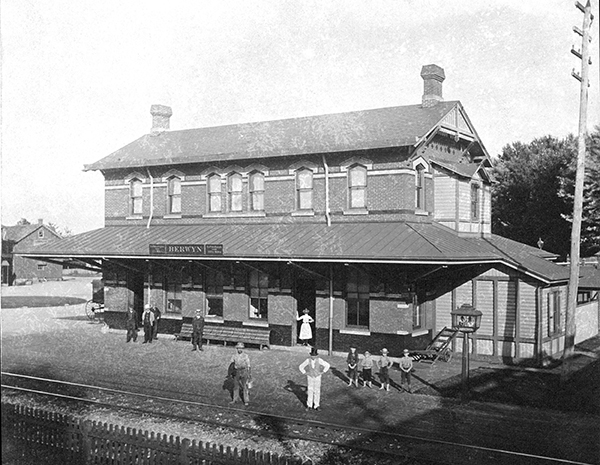
Berwyn Railroad depot ; image Id RBE12
Enos Reese Lewis, a contracting painter had made some money on the painting of the Girard avenue bridge over the Schuylkill, married a wife with some more money. He bought the Carter farm and laid it out into building lots in 1878. The new avenues, Bridge and Central, were designated by posts a long way apart and strung with a strand of telegraph wire.
Little or no attempt was made to grade or gutter, and during the greater part of the year there was literally no place to plant a booted foot, yet the lots of this tract and those of the Aiken farm on Waterloo, Berwyn and Knox avenues sold rapidly. A waggish correspondent of a Philadelphia newspaper wrote, “This old town, after sleeping for over a half a century, is taking a second growth.” The first buildings on the Lewis development were his own mansion, later the site of a school, and those of Huffington, Mrs. Barnett, and William Hayman. Lamentably, Mr. Lewis met an untimely demise at a railroad crossing on March 4, 1879.
The building boom was largely due to the incorporation of the Berwyn Building and Loan Association the previous year. Almost anyone possessing a lot could borrow the money on easy terms to build a home.
In building there was a regrettable lack of restrictions as to grade, alignment, quality, architecture, etc. Lumber of the best grade and skilled labor were cheap; carpenters received $1.75 for a day of ten hours. The result collectively left everything to be desired artistically, though many secured comfortable homes, stove-heated and cistern-watered to be sure.
Later when bathrooms became within reach of many, wells were drilled by Frank Leamy and everywhere the windmill erected its whirling, squeaking head. There were so many windmills that the prediction was freely made that the village would eventually be pulled up root and branch during some big wind and whirled to parts unknown.
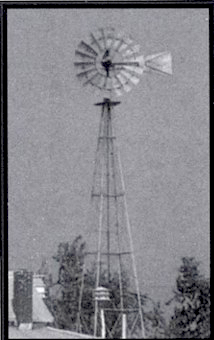
The windmills, from a bare derrick of rough skeleton timbers, evolutionized into weather boarded, painted structures with elevated tank lofts, and then degenerated into the Charles Quimby-built single heavy uprights with heavy guy wires insecurely attached to buried stones, none of which survived the first heavy gale.
The laying of water pipes by Springfield Water Company and the forcing of Pickering creek water from Diamond Rock reservoir eliminated the windmill annoyance, but Berwyn continued, in comparison with rival rural towns, to suffer from the lack of competent supervision and cooperation in building.
The incorporation of a Hall and Library Association in 1878 with shares at $20, in which I. A. Cleaver and J. W. Sharp were active, led to the construction of a town hall on Church avenue behind the Presbyterian church and the organization of a Lyceum in the new Hall in which local talent was discovered. Also, lectures by professionals, elocution, musicales, magic, etc., enlivened the winter season, and a whole week’s dissipation in the Local School Institute, in which Enoch Wells’ poorly disciplined Mt. Airy pupils carried away three first prizes to two for Miss Eyre’s Glassley pupils, much to the latters’ surprise.
Henry Troth Coates presented the library with many standard works, and the reading room, with chess, checkers, and backgammon became quite popular. A former resident whose late son was a Naval Surgeon, presented the library with a large collection of minerals gathered from all parts of the world, but it was not exhibited. The library was open Saturday afternoon and evening.
The Coates brothers of Philadelphia bought parts of the Wetherby, Carter and Leamy estates on the southern border of the village and in the 1880s remodeled or built themselves country seats. Henry T. Coates, the eldest of the brothers, was a partner in the publishing firm of Porter and Coates. The firm had built up a profitable trade by republishing the standard works of the best and most popular English and American authors unprotected by copyright, Scott, Dickens, Thackery, Cooper, Simms, and a host of others. While this may have been piratical since there were little or no illustrations, no translations, nor artists or authors to be paid, only a matter of printing and a cheap binding, yet these cheap volumes and sets were a distinct benefit to the general public.
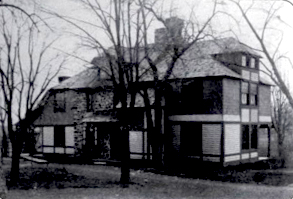
Philadelphian William M. Coates bought a farm with an old Welsh farmhouse at the corner of First and Waterloo avenues in Berwyn. This photo was taken by his brother in 1882 just after it had been remodeled into a local showplace.
In 1878, Mrs. Martha (Freeman) Doran, wife of James T. Doran, the lame Secretary of the Corn Exchange, with her maiden sister, Miss Sara Freeman, opened the Spring Cottage Seminary at their residence on Church avenue. The large shaded grounds then extended to the pike, and the school was filled to its limited capacity for some years by the youths and maidens of the neighborhood, eager for a higher education than the public schools could afford. The ladies taught French, Latin, and mathematics superficially, and English and vocal and instrumental music rather competently. Later James Doran, who was a perfect genius mathematically, took over the school and a new building was erected for the purpose. When Mr. Doran moved his private school from Berwyn to Malvern April 1, 1888, he was described as a “popular educator” who would provide a “proper education.”
Isaac Abraham Cleaver, the enterprising merchant of Berwyn, was the son of Hiram and Jane Abraham Cleaver who resided on a farm near Leopard. At age 18, Isaac Cleaver enlisted in the 97th Pennsylvania Volunteers and served throughout the Civil War. Wounded in the left foot at Green Plains, Virginia, May 20, 1864, upon recovery he received his discharge. In January the next year he married Mary, daughter of Henry and Sarah Kaufman, farmed for three years, then opened a general store in Berwyn. He became not only the leading merchant, but a citizen of great value to the community. He was a deacon in the Baptist Church, Sunday school superintendent and Bible teacher. He was a school director and was prominent in Masonic circles. Although he held the township of Easttown “in the pocket of his vest,” politically he never realized his ambition to be sent to the State Legislature.
The Rev. Thomas Jefferson Aiken was an eloquent preacher, and his brother, Dr. James Aiken, practiced all his life in and about Berwyn, a kindly, charitable man, especially skillful with the illnesses of children. Dr. Aiken broke down under the strain of the influenza epidemic at the time of World War I and died soon after.
Francis Henry Stauffer, known locally as “Frank,” a newspaper writer and reporter, moved to Berwyn in 1874 from Mt. Joy, Lancaster county, where he had edited the Mt. Joy Herald. He bought the former Thompson house on the turnpike which had been remodeled and replas-tered on the exterior to resemble cut stone work, a triumph in the plasterer's art. This well kept property extended back on Waterloo avenue and was one of the show places of Berwyn.
He had also been Assistant Assessor of Internal Revenue of Lancaster county during Lincoln’s administration. As a writer he contributed to various magazines including Good Housekeeping. In 1876 his collected poems were published by Lippincott in book form, entitled “Toward Sunset, and Other Poems.” Later, in 1882, he published a compilation of prose called “The Queer, The Quaint and The Quizzical.” In the language of a prominent critic, his poems possess unusual purity and healthfulness.
Later he accepted a position on the editorial staff of the Daily Evening Call. He edited the juvenile columns under the pen name of “Uncle John.” This paper was deservedly popular as a family newspaper but failed in time. He then opened a real estate office in Berwyn, became Justice of Peace of Easttown, and built up quite a comfortable local business.
There were many other Easttown residents who may not be entered here because of lack of data and there were many who lived nearby and took part in the village life. John Campbell, traveling salesman, who devoted his leisure to elocution; Hannah Epright, the self-styled “grandmother of the local graded schools;” Elijah H. Wilds, with his wonderfully clear memory of past events, and others.
Captain William Wayne was a frequent visitor to Berwyn, and his son opened the first real estate office in the building later occupied by Mr. Sachse. William Wayne Evans was born 1828 and died in 1901. His line of descent from General Anthony Wayne was on the “distaff” side, there being no survivors in the male line. Evans, who received the rank of Captain in the Civil War as a company commander, was authorized by court proceedings in 1854 to drop the name Evans.
The Captain took great delight in showing the historic room at Waynesborough with furnishings of the Revolutionary period. General Wayne’s sword and pistol were there and his portrait and any barefoot country boy might see them, but the Devon inn proprietors had to remove the Wayne homestead from their list of local attractions. Society folk who rode out to view the interior of the house sometimes tried to pilfer a souvenir and ascend the stairs for a more intimate survey of the home. “Madam,” the courtly owner would admonish, “This is a private house!”
An ice cold streamlet flowed past the back porch of the Wayne home, and winter and summer the Captain bathed his feet in its clear water every morning. He did it and never suffered from cold feet. In later life he became very methodical, his program included a daily walk to the Paoli post office and a visit to the freight office where he sat and conversed for a time. He always returned home by the Darby road until he came to a path in his own meadows bordered by the little stream.
William Wayne represented the Eastern District in the Pennsylvania State Legislature and was keen in repartee, as James T. Doran once remarked after a banquet in West Chester, “Monaghan always prides himself on repartee, but Wayne went him one better.” He was also a most charming conversationalist. He was put to the acid test on one occasion. Picture to yourself a lot of mechanics drawn from scattered homes from Berwyn to Sugartown after working ten hours without heat in extremely cold weather. The work day ended and dusk was falling into night and Captain Wayne was seated in the harness room when the men congregated to get their lunch pails and overcoats preparatory to a long walk home. They were held there by the conversation of one man, the very workmen who an hour before were so eager to be on their way. The spell of his voice attracted them. The subject of the conversation was the rise and fall of Henry Askin of Wayne.
To return to village matters, John F. Kauffman organized and conducted a singing school each winter. A “string band” or orchestra, was also formed with a German teacher. This met in practice at various homes before an audience of admiring friends. It consisted of violins, violincello, cornets, and piccolo. They gave one or two concerts. This was the forerunner of the Berwyn Cornet Band organized in 1884 with Peter Trego, George Taylor, William H. Fritz, Ernest Shank, and others.
The neighborhood had heretofore enjoyed a reputation for sober, law-abiding citizens, but in the later 1870s it awoke to the fact that it had some suspiciously idle and dissolute persons about, mostly “black sheep” of honest Scots-Irish parentage.
Many public and private buildings within a radius of half a dozen miles were entered and robbed. The Presbyterian church was even stripped of its carpet! The leading citizens secretly formed the “Berwyn Protective Association” and employed Detective Johnson. It was the midnight conversation of a group of half-intoxicated men and the discovery of a lounge in a cabin, covered with a piece of carpet stolen from the house of Hiram Cleaver near the Leopard, that led to the discovery of the “Hammer Hollow Gang” as the criminals. Later the remainder of the carpet was found buried in the yard of Pete Mullen, Hammer Hollow and he was induced to turn state’s evidence.
Joseph Smith conducted a public sale east of Berwyn, and it was the scene of sensational arrests while the cattle were being sold. Singularly enough the detective was unfamiliar with the faces of the men against whom he had secured evidence. He knew their names and recognized their voices, so a member of the Protective Association pointed them out to him as the persons wanted strolled about the grounds.
Four men and one woman were tried and convicted, including the young woman “hired out” to leave a door or window open for the easy entry of her confederates. The supposed leader, an Englishman, known by an alias, disappeared, and the criminal gang was broken up. There had heen possibly twenty persons, including the Norristown “fences,” who received the stolen property.
The village of Berwyn was strategically situated as a rural vicinity of Howellville, Valley Forge, and New Centreville, on the south lay Waterloo Mills and “Pinchtown.” The Darby creek paper mills, the rich country about “Wyola,” Newtown, Leopard, and White Horse were near. There was Glassley to the east and Mt. Airy west. The farmers came here to buy and sell, to engage workmen, and to attend meetings of a sacred or secular nature.
It was the era of high tide in the local production of foodstuffs. Dairy farmers supplied milk daily from large herds of cattle to the Philadelphia depots. The milk train stopped regularly at Berwyn to load the numerous rattling milk cans.
There were other prosperous farmers from the southern borders of Berwyn and out Leopard way. Some of them marketed their produce personally twice a week at the farmers’ market houses in Philadelphia. Beef, veal, mutton, lamb, poultry, eggs, butter, and cheese were sold. There was a limited supply of fruits and vegetables in season, and pork, scrapple, lard, and sausage were sold during the colder months.
Always on Tuesdays and more and more on Friday afternoons, the heavily laden farm wagons plentifully besplattered with mud, rattled down the streets of Berwyn. The study teams of farm horses were driven by farm boys. There would be a final burst of speed as they entered the village. On every wagon, seated beside the driver, was the farmer himself “dressed in his Sunday best” for it was his pleasure to“stand” in the market stall. He would be there bright and early in the morning and dispose of his produce to his regular customers. In winter when the roads were covered with snow, the farmers arrived in great sleds and it was glorious fun for the school children to “steal a ride.”
The Berwyn market railroad car was often insufficient to hold all the dressed meat, butter tubs, and egg boxes. It was a matter of pride to have sausage, scrapple, etc., of surpassing excellence and consequently in great demand. Most of the farmers were men of character and substance who established an intimate clientage. Family teamwork was essential, but the returns were immediate and satisfactory. The decline of the market followed the refrigeration of produce from the cheap western lands, increased city rentals, and the abandonment by city cooks and housekeepers of their personal marketing.
Under the leadership of Henry Kauffman jr. a flourishing afternoon Union Sunday School was organized. This was held in the hall over the Leopard School in 1871 and continued every winter until about 1883. The “Union” was of the Great Valley and the Newtown Baptist churches, therefore demoninational. Under the magnetic Superintendent, with Lucy Morris at the organ, with John Kauffman’s mellow tenor and Clara Stanley’s clear soprano to lead in the golden hymns, this was a great success. A visiting enthusiast, a Mr. Eldridge, in 1874, offered to bestow a silver medal on every pupil who was present every session. At the “Jubilee” at the Great Valley Baptist Church there were seventeen medals awarded at a cost of $85. Later at Berwyn Mr. Eldridge made a similar offer, a gold medal. Provision was made that if Mr. Eldridge should die his promise should be carried out, This promise was not kept because the estate would not permit it. No explanation was ever made to the scholars.
The little town hall of Berwyn was the cradle of four of its village churches: Baptist Chapel, 1878 - 1882; St. Monica Roman Catholic, 1878 - 1889; Methodist Episcopal, 1883 - 1888, and the First Baptist (originally called Peoples’ Baptist), 1893 - 1903.
Samuel J. Randall was a familiar figure in Berwyn for many summers. He was the able Democratic leader in the lower house of Congress from the Fourth Ward of Philadelphia, whic he represented from 1863 until his death in 1890. There is a story that postmaster Isaac Cleaver had advertised the rental of the furnished farmhouse of his father near Leopard. In response to this the brother-in-law of Randall asked for a Sunday afternoon appointment to look over the farm. He was too busy to spare the time any other day. Cleaver, with the thought that his prospective renter was a roughneck from the toughest ward in the city was inclined to refuse. Finally he consented to meet him at the station and drive him to the farm. He discovered that Mr. Randall was an unassuming gentleman and that he was well pleased with the place.
Randall’s summer home became the Mecca of hordes of office seekers after the first election of President Grover Cleveland. The first applicant for office was a sturdy old fellow who had trudged out to the farm and as he mopped the sweat from his face, he said, “Mr. Randall, I want to get in the Mint right away!”
Frederick Engle, Mr. Randall’s coachman, was a German-American, well educated and a member of our Library. He had aspirations. Randall’s private secretary before the election, said, “Fred, you are a Republican and aspire to the position of doorkeeper to the House of Representatives; if you vote the Democratic ticket it is possible that Mr. Randall might recommend you.” The statesman, having heard the matter from his Secretary, called his coachman in and asserted gravely that this seemed too much like bribery, and that he should not consider changing his politics for a position.
Isaac Cleaver expressed his entire willingness to turn over the office of postmaster to his successor, whomever he might be, and begged Randall to allow no consideration of friendship to interfere. “Mr. Cleaver,” said Randall, “you are a man after my own heart and there shall be no change in the Berwyn Post Office as long as I can prevent it.” Because Speaker Randall was a protectionist and fought the efforts of the administration to lower the tariff, he lost his influence, and after a time Samuel Kromer became postmaster of the place.
The local military spirit sought an outlet in the Washington Troop, organized December 11, 1873 at the Union Hall. This was a fine body of men who participated in the occupation of Pittsburgh during the “Railroad Riots” of 1878. They erected barracks at the Paoli parade grounds with stables below and a room above.
On September 20, 1877, Washington Troop Captain Wilson M. Matlack led the military parade at the 100th Anniversary of the Paoli Massacre and the dedication of the new monument. The 22 acres were literally packed with citizens of the surrounding countryside. Easttown brought up the rear with a banner on which was inscribed, “Easttown, the home of General Wayne.” Dr. J.B. Wood was chairman of the monument committee; Washington Townsend delivered the historical address, and Wayne MacVeagh the oration. Governor John F. Hartranft was present with his staff.
At Waterloo Mills the mill was purchased in 1877 by Allison Alexander who refitted it with improved rollers in an effort to compete with western flour milling. Alexander operated the mill into the early 20th century and also used the millpond for an ice-harvesting business, a winter time activity at many mills.
The Lancaster Avenue Improvement Association, an investment syndicate in which Alexander J. Cassatt, a vice president of the Pennsylvania Railroad, was a prime mover, bought in 1880 a section of the Lancaster Turnpike from the owners for $20,000. This section of the road began at Overbrook and ended 14 miles west in Paoli. It was said the strategy was to prevent competing trolley lines from acquiring the property. The turnpike had been very much out of repair and the new company put it into excellent condition. The bicycle fad filled the pike on a Sunday with “century” runs of City Clubs, scared the horses and made the wheelmen liable to damages. The League of American Wheelmen defended their members and, after a time, induced the toll roads to make a charge for bicycles.
The 1880s brought rapid growth along the railroad corridor west of Philadelphia in Easttown township. City residents, encouraged by railroad promotion, looked for accommodations in the country where they could spend time away from the workaday world. They built elegant summer homes, near the train stations, where they lived a gentlemanly country life of farming and sport and, as well, escaped the heat of the City.
There were only a few widely scattered farms in the eastern part of Easttown in the summer of 1881 when two Philadelphia merchants, Lemuel Coffin and Joseph B. Altemus, purchased over 600 acres of land and hired John Kauffman, Esq., surveyor of Berwyn to lay out building lots along the railroad in Easttown. They named their model community Devon. In the summer of 1882 they erected a large hotel similar in its appointments to the hotels built earlier at Bryn Mawr and Wayne and began the development of a fine summer resort “in the English manner,” in pleasing surroundings.
A new railroad station was added to serve the development. William Reed Lewis, the station-master, was also named the postmaster when a post office opened on May 25, 1883. Lewis lived with his family in the upper floor of the building. He later served as Consul to Tripoli during Cleveland’s first administration.
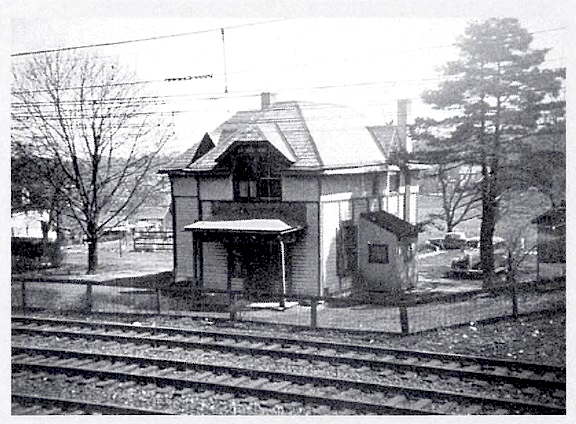
Devon Station
The east-west streets, from north to south, as laid out by Coffin & Altemus, were Arlington, Berkeley, Chester, Devon (but it was an old road and continued to be known as Sugartown), and Exeter. They ran from Valley Forge road, on the east, west to a swampy area drained by the many small streams that are tributaries to Darby creek, in the area west of Fairfield road.
The north-south streets, from east to west, were the aforementioned Valley Forge road, Dorset, an unnamed boulevard running from the railroad station to the Devon inn (the inn occupied the block bounded by Berkeley, Dorset, Chester, and Waterloo roads), Waterloo (another old road), Fairfield, West Arlington, and Lakeside (now considered the eastern border of Berwyn).
The names of these streets all project a strong English flavor, and were selected to be compatible with the name Devon selected by the railroad for its new station. The east-west streets, with Fairfield, also provide an alphabetical sequence to the street names.
At The Same Time
Battle of Little Big Horn; Sioux Indians lead by Chief Sitting Bull kill General George Custer and his men; last major North American Indian victory
“Impressionist” artists exhibit paintings in Paris
Berlin Conference; European powers decide on “spheres of influence” in Africa
French Chemist Louis Pasteur gives first inoculation against rabies