Chapter 7: Civil War and Reconstruction
1860 - 1875
When Reeseville was so named there were only a log house and a store between the Springhouse and the Drove. In 1860 the village was a widely scattered community of about thirty houses and no local industries beyond farming and small trades.
There were on the Lancaster pike, beginning at Glassley, the homes of J. Root, Robert Gamble, Joseph C. Smith farm (later Wynburne), Thomas Mathews (later Francis), John Kugler, Charles Thompson (later Matson), S.D. Hunter store occupied by Milton Fussel, single and double dwellings of Robert White, J. Brooke (Fritz), Mrs. Williamson (Drove), and Mrs. Jonathan Moore, nearly all with small farms attached. Leopard road: Mrs. Carter, Mrs. W.A. Potter and Stephen M. Leamy farms,- Waterloo avenue (Newtown road): Benjamin Wetherby farm.
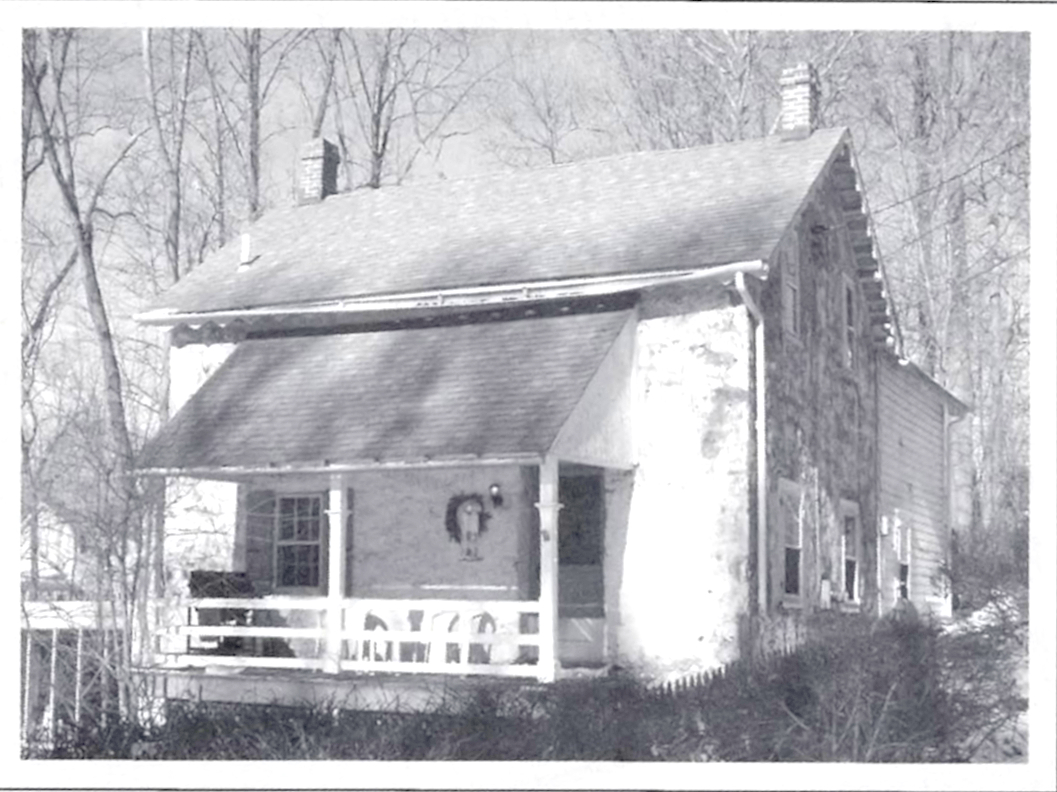
Known as the Walley tenant house, the stone cottage on Leopard road south of Sugartown probably dates to 1830 or before. Joseph Sharp bought this farm from Samuel and Henry Walley in 1838.
On the Old Lancaster road there were the small houses of J. Gowdy, George White, T. Williamson, Peggy Dane, Abel Reese, Peter Burns farm, J. Brooke (Old Drove), and Mrs. Reese (later Bentz). Howellville road: John Neeley, Robert Neeley, and Richard Evans farm,- Contention lane: B. Suplee and George Lewis small farms, with some other small parcels of land not considered of sufficient importance to map. A family of Whites in which there were several grown daughters, lived in the little house of logs (Dr. Okie gateway) and during the Civil War made flags for the government.
The frame store and dwelling on the southeast corner of Lancaster pike and Waterloo avenue had a variety of tenants, few of whom made ends meet in a community able to supply most of its own necessities. William Sloanaker, Van Leer and Channel, Clarence, Hunter, Fussel, et al., have already been named as former merchants, and there had been another, one John Law, who married Eliza Bell, daughter of the proprietor of the little store in the old Fox tavern on the Old road. He had been a sober industrious young man when he moved into this building and stocked up with the usual line of liquors in addition to general merchandise.
Milton Fussel, father of the well known physician of a later period, was here 1859-1861, at least, during which time the property was in the name of S.D. Hunter. Fussel was the first postmaster when Reeseville received official sanction in 1861. George W Downing succeeded him in 1867.
Isaac A. Cleaver occupied the store in 1868 and a year later was named postmaster. In 1870, Cleaver built a large frame store and dwelling a square east of the old store and of course moved the post office.
Henry Fritz of the Gulph road near Carr school, an enterprising carpenter and builder who had made a stake in the Askin’s operations at Wayne, married local girl Mary Lobb on December 24, 1863 and settled here soon after. He built himself a mansion, the coal, lumber, and feed warehouses, and the four tenant houses (west of Howellville road on the Turnpike) known as the Brown row or “Scienceville.” He was deservedly popular, took great interest in the welfare of the church and the building of the parsonage, but unfortunately his life was cut short by an accident at the Eagle railroad grade crossing in 1870.
Rev. McLeod built the blacksmith, wheelwright and saddler shops, the cottage in which Sammy Buley village sexton lived, and a triple dwelling known as the “Beehive.” Joseph Ernst farmed for the McLeods and John Mains, popular young man, was the village blacksmith.
Charles L. Thompson, president of a street car line in Philadelphia, built the double house where “Jake’s” store (Lichtenfeld’s) later stood. His family was a live one: Charles, Joseph, William, Morton, Hetty, perhaps others, and they were fond of sport and horses. A married daughter and her family, the Parks, occupied one side.
Strange though it seems, Reeseville did not appear on the schedule of the Pennsylvania railroad as late as 1871. The neighborhood was distinctly agricultural. The Lamb was occupied by the Clingers, the Stage by Eber Beaumont and the Leopard by Mrs. Evans, all as private residences. Miss Finley lived in a small house east of the Stage, which her brother kept so long. Mrs. Dane moved into what was once Cockletown on the Old road, in a house soon to be pulled down to make room for Clayton Lobb’s modern house. Her daughters were all married and living near by.
Abel Reese puttered about his farm in summer and shot game for the market during the fall and winter. He was a crack shot with a sawed-off shot gun and received 25 cents a brace for quail or rabbits, double that sum for woodcock and pheasants.
Easttown’s sole grist mill, Waterloo Mills, was owned by J. W. Davis, and Tredyffrin’s Great Valley Mills, owned by Joseph Jeanes, operated with M. Beaver and Lewis L. Worrell, 1864, as miller; a combination grist and saw mill up the north branch of Valley creek operated by G. Pechin, and a saw, sometimes a sorgham, mill, by G. Clemens, on the south branch. The textile mills of Samuel Wood at Howellville and the bobbin factory of William Cundy at Hammer Hollow were still in operation. There were blacksmith and wheelwright shops at Paoli, Leopard, Waterloo Mills and Glassley, and general country stores at Black Bear, Reeseville and Leopard; though most of the inhabitants transacted much of their business in the larger towns.
The “home” town of lower Tredyffrin was Norristown, and Phoenixville was considered the same by part. Easttown patronized Newtown, Media, and Philadelphia, and the neighborhood of Paoli dealt in Malvern, which was becoming a thriving village commercially; West Chester was of course the resort for legal and political business. Had these townships been placed according to the inhabitants’ preference socially, economically and geographically, lower Tredyffrin would have been attached to Montgomery, and Easttown to Delaware county.
Many of the Easttown farms received names: Hawthorne, Fairview, Green Bank, Rockwood, Hillside, Evergreen, Sunnyside, Willowdale, and Sharon, an innovation not yet in vogue in Tredyffrin, and no longer bore the names of old Welsh settlers.
A more recent wave of Scots and Scots-Irish immigration had distributed in this neighborhood many farmers possessed of the requisite perseverance and rigid economy to thrive upon the hill soil, for after the first bloom of the virgin soil the farms had become poor and sold cheaply. The new owners were seldom really natural and skillful agriculturists, their maxim was not that of the German-American, “A rich farm makes a rich farmer,” but they made an attempt, at least, to maintain the balance of nature, taking off no more than they put in the soil, and as a class, with their alert intellects, were a distinct asset to the community.
There had been Union, followed by Presbyterian services, in Dr. Reese’s office opposite the Drove, as early as 1849, but the incoming Scots-Irish Presbyterians longed for a church of their own. The Rev. John McLeod, who had recently bought and set up his residence at the unoccupied Springhouse tavern farm formerly owned by the Kuglers, gave the site for the church building and laid out the intersecting streets as well. Ground was broken on September 28, 1861, and the following year the building was dedicated free of debt. On January 4, 1863, a few days after Lincoln's Emancipation Proclamation freed the slaves, the congregation, known as Trinity Presbyterian Church, was officially organized with 20 founding members. Thus was the first church erected in Easttown, a township then in operation for almost one hundred and sixty years. Rev. McLeod became the first minister serving as “stated supply” until 1864.
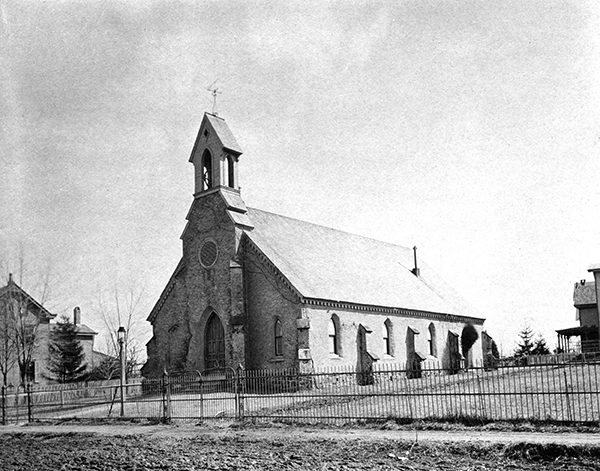
Trinity Presbyterian Church. Id TPC6, photo by Julius Sasche
The Civil war stirred the community as it never had been stirred before. The churches, which had almost without exception advocated anti-slavery, now reaped what they had sown for all loyal citizens were called upon to sustain the cause by vote and taxation if not by force of arms. The Republicans quite generally supported Lincoln’s war measures. The Democratic voters split; many of them soon became known as War Democrats; while a minority bitterly opposed to coersion were known as Copperheads. The primary motive to oppose all innovations is ingrained in the character of some people; with others it is, no doubt, coupled with a sense of loss of political prestige or the passing away of some long established privileges.
John D. Evans, owner of the Paoli inn, was a Southern sympathizer. It is said that he swore that he would not cut his beard until the South triumphed, and in consequence he wore his long whiskers buttoned under his waistcoat until his death. The Lincoln administration removed the Paoli post office to Green Tree, where it remained although still known as “Paoli”, until Johnson came into power. Thus the one time powerful Evans regime lost its last prop and Howellville became the political center of Tredyffrin.
Twenty-five or thirty years before the opening of the Civil war, the community had sent two of its brightest young men to be educated at West Point, and they were still in the Regular Army and with their military training, at the disposal of the government. One was Samuel B. Hayman of Easttown, who graduated at West Point and received his commission as Second Lieutenant of the 1st Infantry, July I, 1842; Captain March 3, 1855; Colonel New York Volunteers September 22, 1861; Brevet Lieutenant Colonel regular service, May 3, 1863, for gallant and meritorious services in the battle of Chancellorsville; mustered out of volunteer service, June 22, 1863; Brevet Colonel May 6, 1864, for gallant and meritorious services in the battle of the Wilderness; Brevet Brigadier General of Volunteers, March 13, 1865, for gallant and meritorious services in the battle of Fair Oaks, Virginia; Lieutenant Colonel 17th Infantry September 15, 1867. He retired July 1, 1872 and died May 1, 1895 in Missouri.
At the beginning of the war there was plenty of raw material. The second floors of the Leopard and Howellville schoolhouses were requisitioned for armories to accom-modate the “Home Guards.” Apparently no effort has ever been made locally to record the names of our enlisted men, a most difficult proposition at this late date, since the boys most eager to go joined singly and in small groups various regiments as opportunity permitted, and drafted men were assigned different organizations also. In fact, there was not a single company composed entirely of Easttown or Tredyffrin recruits. Natives of these two townships joined at West Chester, Phoenixville, Norristown, Philadelphia, Chester and even Harrisburg, the regiments of their choice.
A resident of Howellville, John Eyre Webster, had the honor to be one of the First Defenders. Leaving a wife and six young children in the care of his father-in-law at Reeseville, he joined the Allentown Greys mustered in the U.S. service April 18, 1861; he later served as quartermaster sergeant and died at Baton Rouge, Louisiana, June 21, 1864, from fever contracted in the Red River expedition.
Doubtless more local volunteers appear on the muster rolls of the 97th Infantry, commanded by Col. Henry R. Guss of West Chester, than of any other. The Rev. W. M. Whitehead of the Baptist Church in the Great Valley was its first Chaplain. Three members of his church, Henry Kauffman jr., Isaac A. Cleaver and James J. Dewees, enlisted in Company C, which was known as the Paoli Guards, because the first recruits were raised at Leopard near Paoli. The Baptist boys tented together until the first was promoted to a lieutenancy; the second, wounded in the heel at Cold Harbor, became a sergeant; and the last as corporal on one occasion commanded the Company while going into action, received a scalp wound from a spent ball, and later was invalided home after receiving a flesh wound through both knees while advancing on the skirmish line. Each member of this trio subsequently became deacons in the Baptist Church.
Company K, the Wayne Guards, was commanded by Captain William Wayne, who later became Major of the 82nd Volunteers, but soon left the service on account of his health. Company F, in which Lewis P. Malin went out as Lieutenant and later was promoted to Captain, contained some local men.
John, brother of Henry Kauffman, enlisted as a musician, and Henry, a brother of James Dewees, was in the three months service. Joseph Dewees was so enraged at his boys for enlisting that he exclaimed: “I hope the Rebels gobble up all of you!” The hired man said, “Why Joe, if the Rebels gobble them up, they will come on and take all you got, cattle, grain and all!” “I would drive the cattle into some thicket and hide them,” answered he in some doubt. “But they would find them and give you nothing.”
Henry C. Burns, farmer, of Reeseville, was rejected at West Chester recruiting office on account of his teeth. He went to Harrisburg and there enlisted in Company H, 7th Pennsylvania Cavalry (Wynkoop’s Troop) which was transferred at once to the Army of the West. Early in 1864 he returned home on a furlough and conducted some new recruits to the camp when the regiment was recruited up to 1800 strong for the final drive. Burns was struck with a musket ball in the leg at the battle of Gaylesville, Alabama on October 21. He died in the hospital at Chattanooga on November 19, 1864 and is buried in the National Cemetery near there.
Preston Lobb enlisted on August 9, 1861, in Battery F, 5th United States Artillery (Ayres’ Battery). The artillery held attraction for a recruit; generally artillerymen got to ride in wagons, avoiding long marches that infantrymen made, and they were not assigned to dangerous picket duty. Nonetheless, Lobb saw action in some of the fiercest fighting of the war, at Ball’s Bluff, the Peninsula campaign, Antietam, and Gettysburg. At the end of his three-year enlistment in the summer of 1864, he came home (the Lobb family owned a large farm located along both sides of Sugartown road south of Reeseville), one of only five men in Battery F who was not a war casualty; the unit had numbered 295 men.
Ethelbert and Clayton Lobb, two of Preston’s brothers, entered the service in 1864 before he arrived home. Ethelbert was a recruit who returned to camp with Henry Burns to serve with Company H, 7th Pennsylvania Cavalry, during the last year of the war. Clayton served with Company N, 192nd Pennsylvania Infantry, one of the “100 day” units called up in July when Confederate General Jubal Early again threatened invasion of Pennsylvania.
Samuel H. Tompkins, born in the original log house in Lewis’ hollow, enlisted in Birney’s “Fire Zouaves” of Philadelphia. He had been associated with Good Will Fire Company and grown tough. Before their departure they had marched to the church, heard a sermon on patriotism and received pocket testaments. Early in Sam’s army life, on one occasion he drank heavily and broke all restraint. He said that when the Captain ordered him gagged with a frosty bayonet, balled and chained, and placed standing on the head of a barrel, he beat in the head, fell through and rolled down the hill. The Colonel came up and reprimanded the Captain with the remark, “I know they are bad, but I will not have their mouths ruined so they are not fit to fight. If I hear of you doing this again I will have you served the same way!” With the aid of a comrade, he learned to write while in the army and came out an industrious and trustworthy man.
When Lee’s Army of Virginia crossed over the border of Pennsylvania to Gettysburg, it was thought that they outstripped and outgeneraled the Army of the Potomac and that nothing would stop them from marching down the Lancaster pike to Philadelphia. Robert Glenn, farmer and drover on the old Blue Ball farm at Mt. Airy and reputed Copperhead, became alarmed and rode out to the neighboring farms of J. W. Sharp and William Wayne, with the oft repeated query, “What are you going to do? They will slaughter all our cattle!” Wayne replied that he was going to send his family to Philadelphia and himself remain on the farm.
As Early’s scouts appeared above Wrightsville on the western banks of the Susquehanna, the Union troops, including the City troop, retreated across the Columbia bridge which was the longest covered bridge in the world, being over a mile long. Union troops first tried to blow up the bridge, but when this did not work they set it on fire to stop the advance of the Confederates. On the return march, some tarried at the house of the widow Gamble at Glassley to partake of a peace offering of doughnuts and cakes meant for the dreaded Rebel cavalry.
Confederate prisoners taken at Gettysburg were quartered at the Paoli parade grounds and helped gather the harvest. One “Cracker” veteran remarked that in Pickett’s charge he found himself standing alone, “like a fool,” so he threw up his hands and surrendered.
The outrageous treatment of prisoners of war by the Confederate authorities was the occasion of the “waving of the bloody shirt” in after years. As a local member of McCall Grand Army Post remarked to a reconstructed ‘Greyback’ at a reunion of the Blue and Grey at Gettysburg. “I can forgive you for everything except the way you treated your prisoners” “Friend!” replied the ’Cracker, “We-uns would not have treated you-uns that-away. It was shirkers at home, who never saw a battlefield.”
Among the prisoners released from that awful slaughter pen at Andersonville, Georgia, there was one who returned to the little tenant house of John Rees on the Old Lancaster road, to die in a few weeks. He was reported to have been in the most pitiful condition, a mere skeleton from vermin, disease, and starvation. Another was Jonathan Smiley, Company A, 8th Pennsylvania Cavalry, of Howellville, prisoner for almost a year, he lived to be almost the last survivor.
James A. Cornett, Company F, 5th Pennsylvania Cavalry, captured when he had almost served his entitlement, was confined at Andersonville, Georgia , and Florence, South Carolina for several months. He was exchanged, brought home to die April 29, 1865, and buried at St Peter’s.
During Lincoln’s second campaign for the Presidency, Easttown has marching clubs, or “Wideawakes” as they were called. The ranks were filled with returning soldiers whose perfect alignment was the pride of their partisians, and they carried with the stars and stripes at the head of the line a beautiful banner presented by the patriotic ladies of the township.
When Benjamin Harrison, a few years later, conducted his successsful presidential campaign, Easttown had probably the largest and best drilled club of the times, and in the midst of the campaign, the leaders, mostly men who were ignorant of local tradition, suggested that the name of the club be changed to Berwyn, since few people outside of the county knew where Easttown was situated. D. Bernard Stout, an old soldier and resident of Waterloo Mills, arose in meeting and made an impassioned speech against this, he pointed to the old banner on the platform, still borne at the head of the line, inscribed with the name of Easttown, and recited its history with rough eloquence. When he sat down there was an impressive silence for the space of a few minutes and nothing further was said of changing the name of the club.
Area farmers in Colonial times returned more than a score of Negro slaves in local tax rolls, the descendants of these and of some acquired probably via the “underground” route as cheap farm labor, had squatted mostly in wooded folds in the hills, and up to the Civil was formed a very small percentage of the population.
With freedom came a hegira northward of Negro families fresh from the towns and plantations of the south, bearing all the humility of a long subdued race. Being inoffensive and somewhat irresponsible they gave no cause for personal violence from the irreconcilables and even had the latter been disposed to interfere, the new comers had the protection of the so-called “Black Republicans.”
Among the local arrivals was a deep-chested old man, Tommy Ross. His sons came with him. Ben had belonged to a black regiment and had been wounded in the leg in the assault at Petersburg, under Burnside. When the surgeon decided to amputate, Ben was so scared that he crawled out of the hospital where he saw arms and legs piled up like cord wood, and hid in the woods. When they found him the next day his leg was so much better they decided to save it, in consequence it served him well for nearly half a century more. He later deserted to join another regiment, and it was under the name Isaacs that he received a pension. He worked in Reeseville, later Berwyn, for 16 years as a mason tender, gradually learning the trade which he followed in after years.
At The Same Time
Unification of Italy, except for Rome and Venice, under Victor Emmanuel, King of Piedmont
Otto von Bismark, Prussian prime minister; later defeats France in Franco-Prussian War
Russia sells Alaska to United States
The Suez Canal is opened
Trade Unions legalized in Britain