Chapter 6: Beginning of the Local Industrial and Educational Period
1834 - 1859
The Philadelphia and Columbia railroad, an undertaking of the state “Main Line of Public Works,” was crooked, uneven, and full of high grades. Its light rails were laid in slotted iron chairs which in turn were bolted to stone sills about 22 x 14 x 12 inches or less. This proved unsatisfactory and eventually gave way to wood ties. The first cars were horse drawn and, as horseflesh is ever unequal in speed, a schedule could not be maintained.
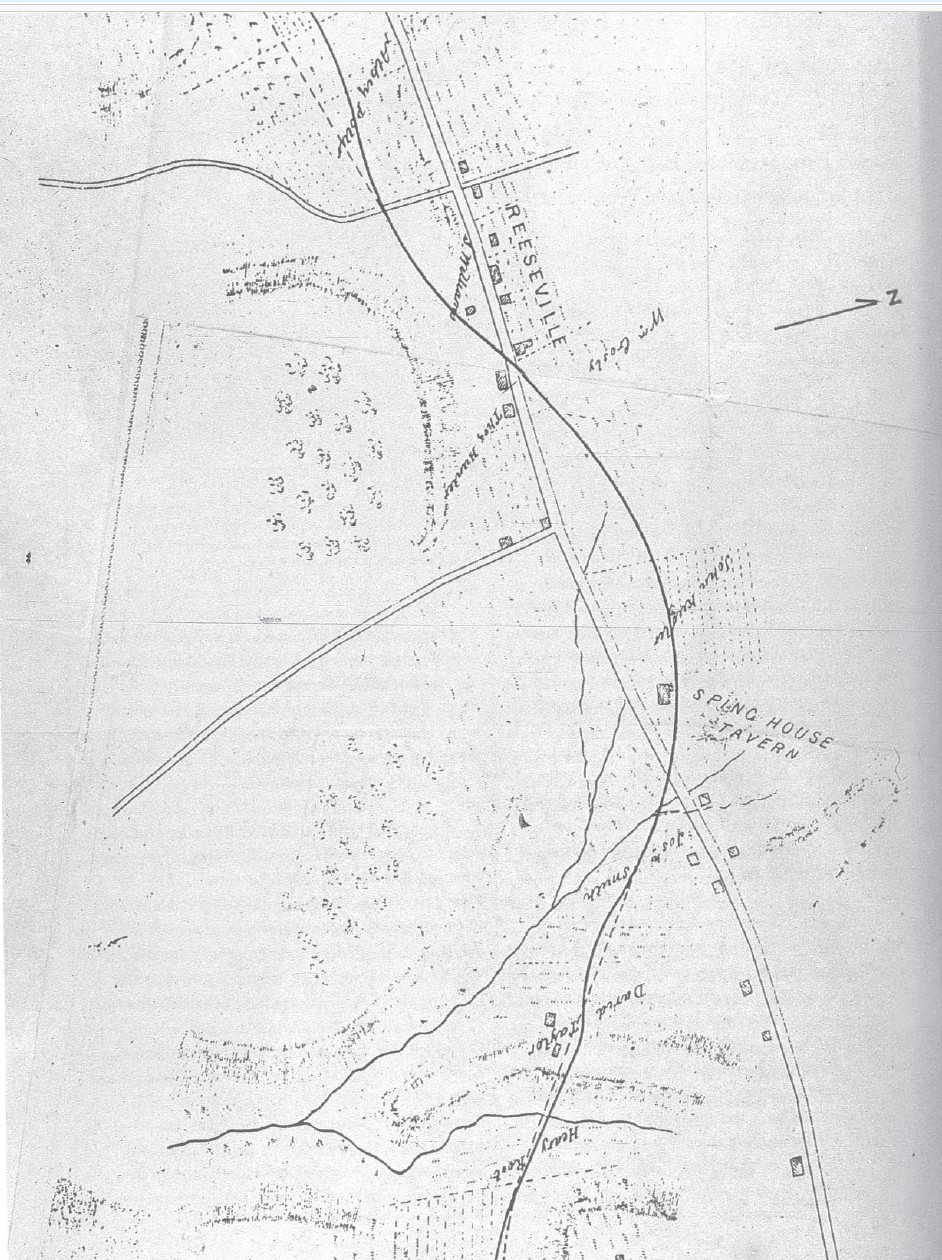
Easttown portion of map showing Philadelphia and Columbia Railway with Proposed Improvements, published by E. F. Gay in 1851.
The first light engines had comparatively high smoke-stacks which were hinged to lower while going under the low overhead bridges, and a man had to go along the track after every train to drive in wedges loosened by vibration of the engine.
When a locomotive ran off of the track, the train crew and perhaps some of the passengers would pry it on again with a couple of fence rails. The first passenger injured met with an accident which occurred through carelessness. The man stood up in his seat to pick an apple hanging from a tree over the right of way and struck his head against a limb; he fell under the car and had a leg severed. For a long time the engines burned wood, which gave the sawyers much employment. Hugh J. Steen had a contract to furnish wood by the cord, and he often joked about certain crooked logs rejected by the sawyers which formed the base for new stacks and were measured again and again!
The Columbia railroad was commenced previous to 1828 and completed in 1833. The first train hauled by the famous “Black Hawk” locomotive passed over the road on the last day of February, 1834. The Pennsylvania Railroad, incorporated April 13, 1846, built a road from Harrisburg to Pittsburgh and took over the old Columbia road on August 1, 1857. The railroad was originally surveyed in 1826, on a line in the Great Valley near the northern slope of the South Valley hills from Warren tavern to the gap opposite Spread Eagle, where it was planned to enter the hills. This would leave Paoli inn, which had so long been enriched by social, political, and military preferment, high and dry. Joshua Evans jr. was a man of energy and of influence, however, and he pulled every wire to have the railroad pass his door.
The story is told that a gang employed in some preliminary work was quartered at the Davis tavern, Howellville, which was on the proposed railroad. Something had gone wrong at the hotel; the landlord was inclined to be grouchy, and the men complained that they were not getting good service. The hostler, doubtless an emissary of Evans, intimated that if they would go to the Paoli inn they would be treated right. It appears that they went to Paoli and were kept dead drunk for five days during which time the officials were vainly searching for them and wild rumors spread of their capture by Indians.
It is possible that the valley was the ostensible route projected to obtain concessions from the owners along the turnpike, but at any rate Joshua Evans felt that he had obtained a victory, as indeed he had. The Paoli inn was admirably situated to cater to the increased trade that the trains brought to its doors. The bustle of the military muster and elections was succeeded by the rush of passengers to eat and “liquor up,” but after some years of prosperity the roadbed and equipment improved so much that the time to and from Philadelphia became all too brief to admit of lengthy stops; from this time on the Paoli inn gradually declined.
To the east, the community dwelling near the “Sixteenth Mile Stone” on the turnpike settled down to a long period of quiet, simple, rural life. A few buildings had sprung up between the Springhouse and Drove taverns, notably John Lewis’ (later Frank Matson’s) log house, William Sloanaker’s store on the corner of Newtown (later Waterloo) avenue. William Gamble's single and double stone houses, better known as the cigar factory because of the Spanish and half-Spanish cigars made there, and a few other buildings including a store-house for grain from the valley on the northwest corner of Howellville road and Lancaster pike across from the Drove (Jonathan Moore’s, formerly Dampman’s, a drover). The farmhouses of the Carters, Potters, Wetherbys and Smiths were close by. It formed a somewhat modernized duplicate of the ancient hamlet of Cockletown.
A small frame and plaster office had been erected early in the century for the use of Dr. John Wilson Rees until his death in 1840 in the 34th year of his age. This stood opposite the Drove, between the pike and railroad. Here the Rev. William Henry Rees, rector of Old St. David’s and St. Peter’s, established a Sunday school with 45 scholars and three teachers in 1837, and here Clara Davis kept a private school in 1865.
The indefatigable Rev. Rees also established a select school for boys in his residence at the Drove tavern until his removal to West Chester in 1839, to devote his whole time to his Mount Vernon Academy.
This easternmost building, sometimes called the Drove, was then occupied until 1850 by Noble Heath and his Reeseville Boarding school. In this connection it is well to mention that Noble Heath, in 1855, published “A Treatise on Arithmetic,” which was very superior and very complete.
The place was not of sufficient importance to justify even a flag stop on the railroad; the turnpike had become almost deserted and badly out of repair, yet it became apparent that the village needed a name. About 1835 a sign appeared on the little schoolhouse announcing “Reeseville” to all who passed. The Reese family was among the early Welsh settlers of the neighborhood and the name was the logical one for the place, though it created considerable criticism and some opposition.
The Sloanaker store had recently been leased by a man named Clarence, and after he renovated the buildings he put up a sign “Clarenceville”. Not to be outdone, Rev. Rees put up a board in his meadow opposite Clarence’s store, lettered “Mount Vernon,” apparently were never generally accepted, and the village settled into a comfortable familiarity with the name Reeseville for the next forty years.
Before the establishment of the public school system a few scholars attended private academies, but so called “pay” or subscription schools were the norm. Youths in Easttown usually attended at the Wayne school, on the border of Wayne’s plantation, along Bear road and a few hundred feet north of the Bear tavern, or at the Glassley school south of the Lancaster turnpike, in McClenachan’s Glassley development, where “reading, writing, spelling, and ciphering” were taught. In common with the parochial school at St. David’s church, they were all tiny, one-room affairs capable of accommodating an average, perhaps, of fifteen or twenty children. The masters often taught school in the winter when farm work was light and worked as a farm hand in the summer.
With the implementation of the Common School Act, in 1835 and later, the trustees managing each school were replaced by an elected board of township school directors. School tuition was eliminated in favor of tax support which came partly in the form of levied school taxes and partly in the form of a subsidy from the state. The St. David’s school was torn down by the church in 1844, but two new schools were added by Easttown township.
Foundations were dug for a school on Church road between the Smith and the Adam Siter farms. Adam Siter was the schoolmaster of the Old Eagle school - “Hop and Go Fetchit” the boys called him. However this site was not used, for John Ogden of Hickory Hill about 1850 offered a part of his ground and $500 to build on the site selected by him; this became known as the Ogden school which name it retained even after the old building and site were abandoned for the new one just below.
The Leopard school was built about 1852, on Leopard road behind the old inn. It was originally one story but a second was added in 1872 being designed for a town hall for elections, school entertainments, political meetings, the lyceum, religious services, etc. It replaced the Wayne school and became the most efficient school in Easttown.
The Public School Report for 1865 shows that Easttown had three schools, Glassley, Ogden, and Leopard; a nine-months term, 76 male and 82 female scholars; the male teacher receiving $35 and the female teacher $30 a month. The school and building tax was 4.5 mills, a total tax for the year of $1694. Tredyffrin seemed less forward to school provision though in the aggregate spent a larger sum. There were nine schools Howellville, Presbyterian, Tablet (Salem), Walker's (near Calder’s blacksmith shop), New Centerville (Fairfield), Carr’s, Eagle and Mt. Airy, with a seven-months term, 177 male and 145 female scholars; paying teachers $28 alike; the tax was 6.25 mills and amounted to the sum of $2554 for the year.
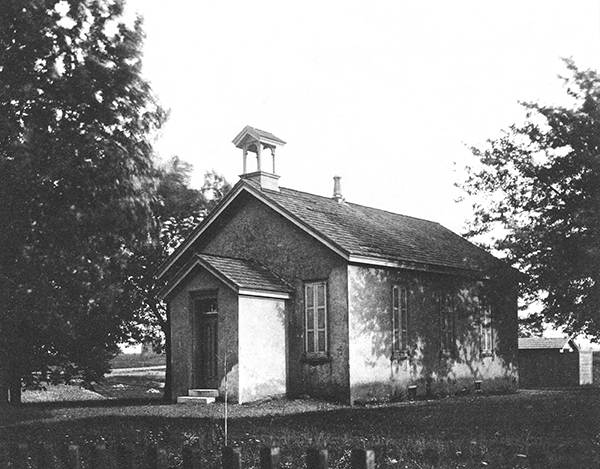
The second Glassley School, built in 1863, stood along the south side of the Turnpike. Id GLS3, photo by Julius Sachse.
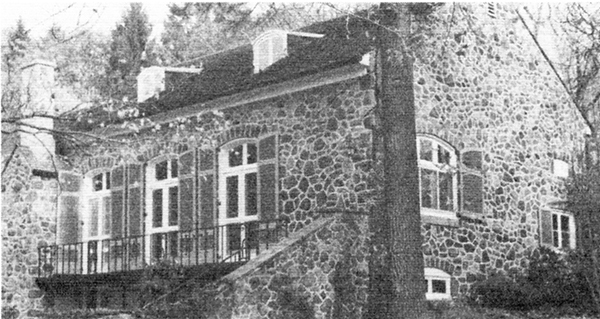
Ogden School served the children of Waterloo Mills. Located on Church road, it closed in 1922 and became a residence, shown here about 1950. Id SCH9
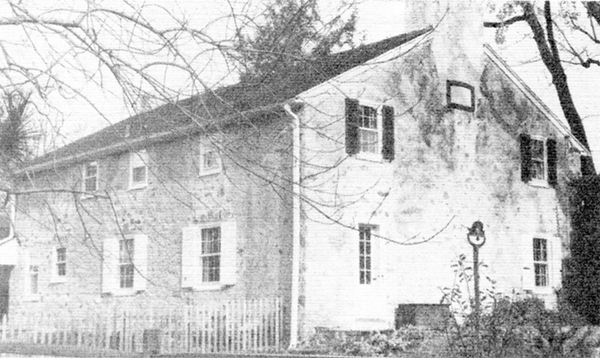
The Leopard school was used for about 70 years. After closing, it became the pictured residence known us “Recess.” Id SCH4
The Tredyffrin side of Reeseville attended the Mount Airy school along the turnpike on bleak Skelp Level (now Daylesford), sharing the single room of the stone building with the youths and maidens of Paoli. This school was adjacent to Prissy Robinson’s of Blue Ball notoriety, and now and then Prissy stormed the school door, ax in hand, in pursuit of some offending pupil.
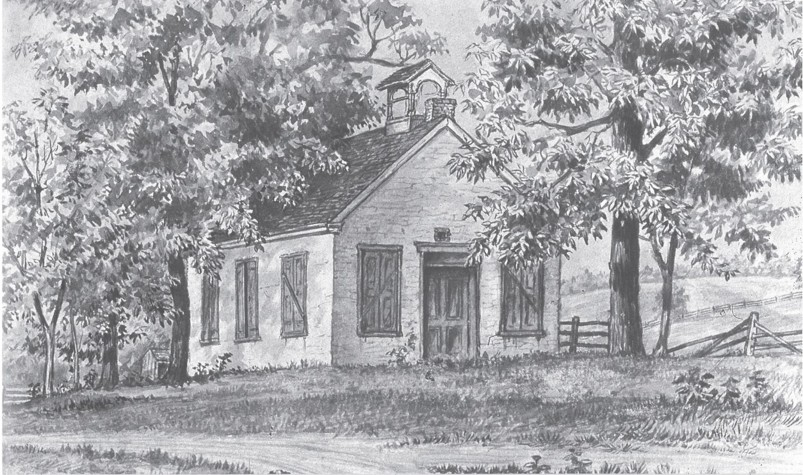
Mount Airy schoolhouse on Lancaster pike near Daylesford as it looked in June 1915. The image is taken from a pen and ink sketch by Louis Sartain Schofeld of Paoli.
She had a perpetual grudge against the railroad for destroying the tavern business. One day a locomotive killed her heifer which had wandered upon the track. Prissy rendered the tallow and greased the track. A late train tried all night to reach Paoli, and the ancient crone stood on her doorstep, shook her fist and swore she would give them tallow as long as the dead heifer held out! The next day an official came from Paoli and settled for the cow.
The decade of the 1840s appeared to be the time of reconstruction and replacement of many of the old log buildings with the more durable stone. Masons were in demand more or less steadily every season up to about 1851, at a daily wage of from $1.00 to $1.47 and ½ for masons and 50 cents a day for tenders.
During harvest time the weaver, mason, carpenter, and able-bodied men of various other trades quitted their normal occupations to help the farmer gather his crops. This condition of affairs was extremely advantageous to the farmer, for it gave him help close at hand just when he needed it, and at the same time it was beneficial to the artisan in the matter of cash and change of labor. Old timers enthused upon the sight of ten or a dozen expert reapers, cradles in hand, encircling a field of golden grain. The day began at 6 a.m. and ended at 7 p.m., with an hour for noon and short rests at 10 a.m. and 3 p.m. for lunch. Five meals a day found!
A farmer on what was later the Sharp farm paid in cash every evening after supper the day’s wage of sixty-two and a half cents. One afternoon at 5:30 o'clock a thunderstorm drove the harvesters to the house for an early supper, and their employer passed from one to another with the “cash upon the nail” reiterating, “Three-quarters and half a quarter” until he reached the last, who happened to be an Irishman, who refused to be docked an eighth of a day, exclaiming, “A whole day or nothing!” The mildly astonished farmer paid him in full, and, after another visit to his strong box, painstakingly refunded to every man in pennies and half pennies the amount for “half a quarter” day.
Squire Benjamin Wetherby, an old bachelor who owned much land south of Reeseville, was something of a character. Tradition states that he once collected a debt through the devious processes of law from Prissy Robinson and that she paid it with a barrel of large copper pennies and half pennies, remarking that, “The counting will give the old devil something to do!”
Wetherby took great delight in the parade of the militia, in fact he once commanded the 38th Regiment. One evening, sometime in the 1830s, a small barefoot boy on a nearby farm heard the sound of fifes and drums issuing from the front of the cigar factory where a newly married couple had settled. He ran as far as the railroad bridge and there halted, for it held the proud figure of Squire Wetherby who, with cane at shoulder, paraded back and forth all by himself, and the boy heard him exclaim in a voice pitched high with emotion, “Benjamin Wetherby! Justice of Peace! Major of Militia! My! How I love martial music!”
It must not be supposed that military science and leadership of this neighborhood had wholly degenerated into showy parade, a volley of blank cartridges and a rally around the bar of the tavern, for this section continued to produce leaders of the game of war. Israel Vodges of Paoli was admitted to West Point July 1, 1830, and commissioned 2nd Lieutenant, 1st Regular Artillery, July 1, 1837, and Samuel B. Hayman accredited to the same place was admitted July 1, 1838, and commissioned in the 1st Regular Infantry, July 1, 1842. Both these officers attained the grade of Brigadier General for meritorious conduct on the field of battle.
In the early days Easttown and Tredyffrin were more evenly divided between the Whig and Democrat, and elections were bitterly contested. The astute county politicians used to wait eagerly for these township returns, especially on account of the old saw, “As Easttown goes, so goes the county.” In 1840 the Easttown polls were removed from Paoli to the sign of the Leopard, kept by Philip Kirk, the political if not the geographical center of the township; and in 1843 Tredyffrin removed to the Ramrod, kept by Evans Kendall, at New Centerville.
Valley Forge continued to be a great rallying place for the Whigs. In 1840 many thousand persons were present at a Harrison meeting to hear the great Daniel Webster speak. Four years later the protective tariff was an issue and there was a long procession in which various industries were represented, including nails and other articles being manufactured, in the moving column. A rival company of Democrats followers of Polk were rushed by the Clay adherents, and the Polk stalks of their political enemies were strewn along the route.
In 1852, during the Scott-Pierce presidential campaign an ox roast was given to the many thousand people present in one of the clay pits. Protection of home industries resulted in the development of water power for the early Scots-Irish handlooms, and the English immigrants, deprived at a livelihood at home, found it profitable with limited capital, to run small independent mills on tiny but never-failing streams in more or less remote localities. Nearly all of the local textile mills were just beyond the bounds of our township, but nevertheless added to the wealth and industry of our inhabitants.William Crosley bought 178 acres of land on Darby creek below the Easttown line and in 1828 erected a woolen mill and conducted a large business for many years until the factory burnt down. It passed into the possession of Dr. Henry Pleasants in 1861 and from him in 1865 to Casper S. Garrett, who erected a paper mill. Unfortunately, some years later this mil too was destroyed by fire.
At Valley Forge, Brooke Evans of Sheffield, England, leased the property, converting the saw and rolling mills vacated by James Wood into a gun factory, and made 20,000 rifles of a beautiful pattern. The mill was later enlarged and converted into a cotton and woolen factory which prospered a long time.
The only woolen factory in Tredyffrin was located in Howellville on the swift little stream that comes down from Prissy’s hollow, known as Crabby Creek today. The original mill was leased from about 1835 to 1850 by Robert Webster and his two sons, John and Joseph. They were from Yorkshire, England and expert in the manufacture of woolen cloth, blankets, etc. The dam was an eighth of a mile above the village, the breast now part of a farmhouse lane, and the race is still traceable down the meadow.
There was a time, about 1845, when five or six men were employed in carding, spinning, and weaving flax in the old store shop on Howellville road on the property later known as Doyle’s Nursery.

William H. Doyle, who died in 1934, started a nursery business in Berwyn and is credited with planting the dogwood trees in Valley Forge Park. He also owned most of the land along Howellville road north of what was old Cockletown. His home is identified by the name “Prague” seen here on the gate posts at the street.
The old Hammer Hollow tiltmill owned by J. B. Newman was converted into a bobbin factory by William Cundy, an Englishman, and in some of the small tenant houses below the high dam breast of this remote hive of industry, a cigar factory was managed by the elderly Brown who employed several workmen. The cheap Spanish and half-Spanish cigars were rolled on the benches and tied up in bunches of a hundred each without boxes. Brown later became afflicted with a religious mania, climbed up on the great water wheel, jumped off, and killed himself one night.
The spools or bobbins were slender and perfect little articles made of dogwood, which Mrs. Cundy placed in bags, heaped into a cart drawn by “Fatty”, her horse, to the Eagle station, where they were shipped to various destinations. The bobbin factory stood just below the high dam buttressed by outstanding cliffs capable of withstanding enormous pressure. The remains of the lower dam, similarly positioned, can still be located, but the turning mill of pre-Revolutionary times, and the stone cottages have disappeared entirely.
The decline of the small operator began with the perfection of steam power, great improvements in machinery, and the introduction of large capital, which permitted the scrapping of equipment about once in every seven years to keep up with American labor-saving devices. Then, too, the English-born owners made so much money at the start that they fell into expensive habits. Gradually the little country factories, so far removed from the market and lacking cheap and quick transportation, became abandoned and soon fell into ruins.
Although Reeseville eventually became the generally accepted name of the place, it had not gained local popularity as late as 1847 when Lodge No. 290 of the Independent Order of Odd Fellows was instituted, for it was officially known as Paoli Lodge. It met in the little stone building at the head of the lane of the Old Drove (later the residence of H.B. Rumrill), on the Old Lancaster road opposite the Burns homestead. Two years later the institution of an encampment composed only of Scarlet Degree members was known as the Paoli Encampment, No. 89, in the new Odd Fellows hall built in 1848 at Howellville by Hugh J.Steen, who had a store on the first floor.
The Paoli Lodge became very prosperous with several hundred members drawn from a wide extent of territory. Mr. Ritner, father of Rev. Ritner, then living in the little log house about where Dr. Okie’s gate posts later stood on the Old road, served oyster stews below stairs, especially to members driving long distances. After a time some members succeeded in having the lodge removed to Holly Martin’s in Paoli, opposite the Bear tavern on the turnpike, and the large membership eventually split up into half a dozen lodges situated at Radnor, Newtown Square, Sugartown, Pickering, Valley Forge and Port Kennedy.
The parent lodge later returned to Howellville and met over Beitler’s store, and after some years it again removed to Paoli on Darby road where it erected the present hall.
“Paoli Grove” for a time was a popular Sunday resort about 1850. The railroad put in a switch at the Bear and ran excursions from Philadelphia until it became the resort of toughs and an unbearable nuisance to the neighborhood, when it was discontinued.
The road leading from the old Fox tavern to Wilson’s corner was opened about 1854 after a great deal of contention among the small landowners over the almost impossible grade, and the name, Contention lane, appears on later deeds.
Abel Lewis and his son Jonathan owned the small place by a spring below the Old road and between the Valley Baptist road and Contention lane. It was subsequently sold to their cousin Jackson. Jonathan kept a carpenter and coffin shop and was the father of Eugene Lewis and Mary McClure. George Lewis, uncle of Abel, resided near the head of another spring a few hundred yards west across Contention lane and was the father of Morris and Washington Lewis.
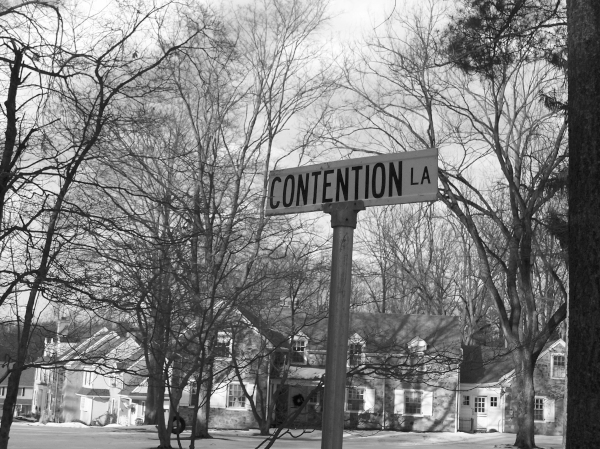
Contention Lane signpost. Photo by Marc J. Heppe.
Joseph Lewis, father of Lewis Lewis, plasterer, lived on the Old road. Westley Jones bought the double house, used as a cabinet-makers shop and dwelling, and carried on shoe-making until he sold to a family of Whites, one of whom married his son Robert many years later.
Bill Laws, a colored man, lived in the old log house on the hill back of Neeley’s after it was vacated by Philip Upright and worked at “tending” mason for Isaac Burns as early as 1848.
Mordecai Davis, son of Joseph Davis of Willistown, lived on a farm at Waterloo Mills from about 1800. The property belonged to his wife, who owned it with her sister. Mordecai bought the sister’s share. He and his wife are buried at Radnor Meetinghouse. The land passed to son, John W Davis, who continued to farm and enlarge the property. In 1850, through a sheriff’s sale, he purchased the parcel across the road containing the mill. For a short time the Davis family controlled the entire community of Waterloo Mills, including the only gristmill in Easttown township.
Through the influence of John W. Davis, it is said, Waterloo Mills on January 1, 1853 became the first post office in Easttown. Tenant miller William Steele, Davis’ brother-in-law, was postmaster. Stephen Stout, the mail carrier from the Spread Eagle, often carried the mail in his hat or pocket, and the chance patrons were apt to find the day's mail lying on a stump in the woods where the carrier was engaged in felling trees. This post office was discontinued September 25, 1867.
Old-fashioned people insisted on calling the place “Cabbagetown,” a name originating about 1830 when a greedy miller became unscrupulous in the amount of toll exacted from the grain delivered by nearby farmers; to “cabbage” in old English was to purloin or steal. The name stuck long after this miller had departed for lack of customers.
There were also half a dozen houses and a blacksmith and wheelwright shop. Charles Stout was here for fifteen years, and his son, D. Bernard Stout, established a general blacksmith and carriage business from about 1865 when he returned from the Civil War, to 1891, when the old shops were replaced by a more modern stone building. After that, he operated with the aid of his son Frank until the shop was abandoned. “Nard” Stout was a thorough mechanic of the old school, able to build and finish a carriage from wheel to top-wood and iron.
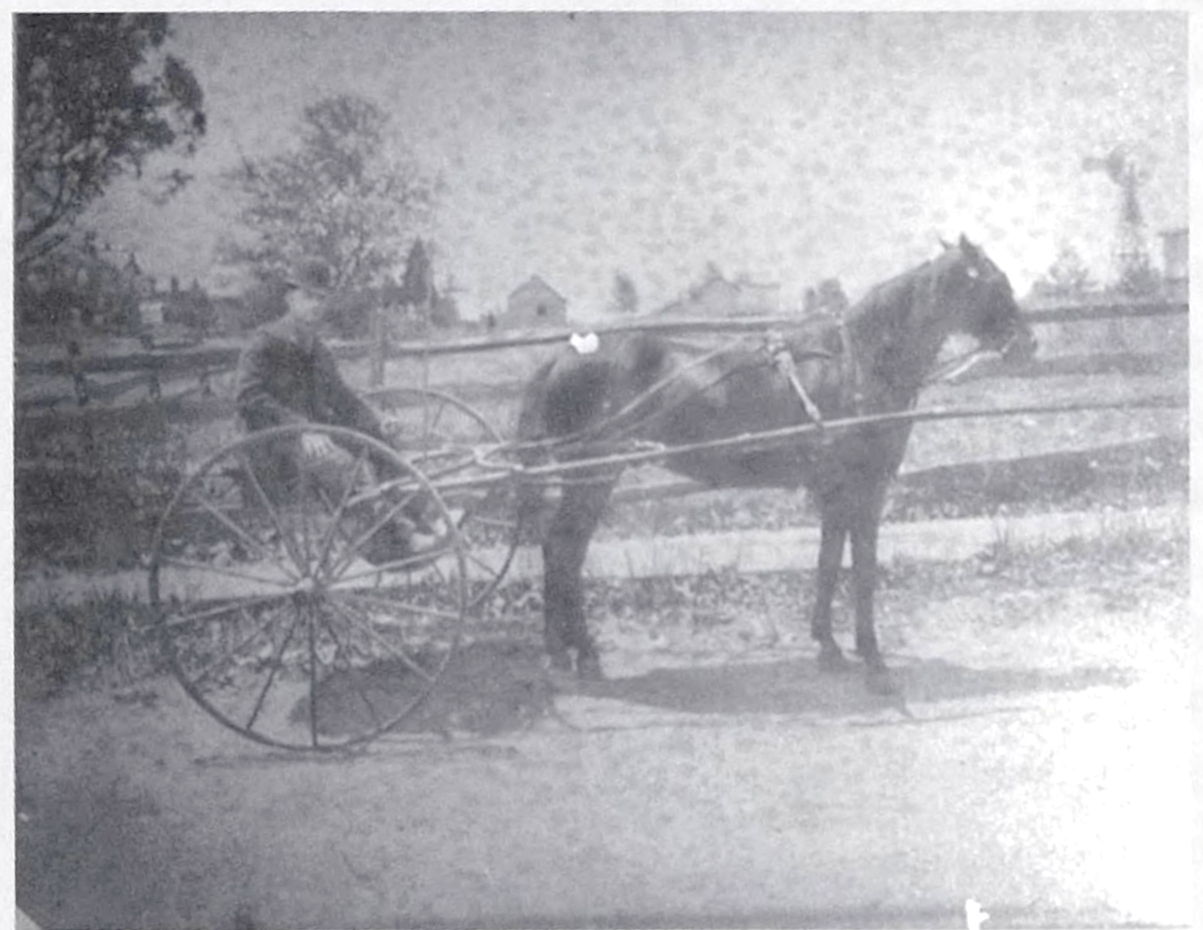
D. Bernard Stout, pictured seated in a sulky behind his horse, followed his father in conducting a blacksmith and carriage building business at Waterloo Mills from about 1865 to 1910.
A quarter of a mile above on the road leading out to the Newtown road above “Pinchtown” on Darby creek stood the old sawmill of Jonathan T. Morris, son of James and Honoria (Thomas) Morris, who was born in 1805 and operated the mill “up to 1843,” followed later by Eber Beaumont. Neal, Van Leer, and others with stout teams hauled great logs here to be converted into boards and timbers. The dam was a good one of several acres in extent, but finally it burst, carrying the Cabbagetown dam with it. The latter was repaired but the former was not. It is now a tussock swamp and maple thicket; the boulder-faced dam is filled with soil and the old left-sided race may still be traced to the site of the mill.
The only other saw mill in Easttown stood on the same stream at Judson Campbell’s place on the west side of Newtown road at South Leopard road, just north of the Darby creek bridge, where years ago the ruins of the old wheel and timbers could be detected midst the sycamore trees. This mill also at one time ground plaster.
A small but thriving village of about fifty inhabitants had grown up around the Leopard tavern on the Darby road a mile and a half south of Wayne’s manor house. The tavern operated for almost a hundred years and was licensed last in 1863.
The village was mapped as Evansville by John Kauffman, a rising young surveyor, about 1858, in honor of his wife’s family, owners of the tavern and some other property, but like some vaccinations it did not take. The Leopard comprised the tavern (later a store kept by John W. Hayman), blacksmith shop, Porteus’ store, and perhaps eight or ten dwellings with many more houses within a short distance, making it undoubtedly the only considerable hamlet in Easttown at this time.
William Porteus was the Justice of Peace and storekeeper (later Kelley residence), and Still’s little store on the road to Willistown contributed to its activities, though it did not become a post office, under John Hayman, until April 2, 1866. Samuel Buley carried the mail from Reeseville at a yearly recompense of $100, and he was followed by George Stanley at a $50 increase.
The Darby road became for a time the Plank road in the early 1850s but soon wore out. Squire Porteus’ son was killed by the stumbling of his horse in a hole on this road.
“Sawmill Woods” on the Yerkes place between Leopard road to Newtown and Waterloo road to the same place, about three- quarters of a mile east of Leopard, is so called because a steam sawmill operated there for some years to supply timber for the Plank road. The planks were two inches thick and laid upon sleepers. The project was abandoned about 1857, however, when the tolls collected were not sufficient to maintain the road and replace worn or rotted timbers. The remaining planks were sold to the highest bidder.
The temperance wave that swept over the country about this time resulted in numerous lodges of the Sons of Temperance being organized and their halls erected. A “Sonny’s” hall was built on the road to the Leopard, half a mile south of Reeseville, and undoubtedly it did some good even if some of its members would occasionally blackslide. The activities of this laudable secret order were apparently short lived, since the hall was vacant in the early 1870s and remodeled for a dwelling about 1875. Eventually it was torn down.
The winter of 1856 - 1857 was remarkable for a great snowstorm which buried the railroads for a week or more. Evans boarded the stranded passengers at the Paoli inn until the trains could be shoveled out. This winter was long remembered for the thirteen weeks of sleighing.
R. E. Lewis kept a general store at Lewis’ corner. now known as Wyola, and his trace extended throughout Easttown. His daybook of 1856 shows the prevailing prices of the staples of the period. Flour $7.50, corn meal .75 - $1.20, and potatoes 0.28 a bu., sugar .07 - .10, coffee .16, tea $1,00, rice .10, cheese .12, butter .25, crackers .08, and soap .05 - .06 a lb., vinegar .10 - .16; and molasses .65 a gal., salt .16 a bag; eggs .12 - .16 a doz., tobacco .12 - .37 a lb.; meat shoulders and hams .10 - .14, veal .10, and pork .06 - .16a lb.; boots .88 - 3.50, shoes .45 - $1.31 a pr.; hats .12 - $1., shirts .75 - .88, coats or pants $1.25, muslin, print, drill, anf gingham .10 - .13 a yd.
St. David’s Church: The Rev. Willie Peck, 1838 -1845, should not bring up visions of an effeminate youth for he is said to have been six feet four inches tall and to have fought under General Pike at Toronto and General Jackson at New Orleans. He was the first resident rector of St. David’s, for the original rectory was built during his term of office.
The Rev. Breed Batcheller, 1845 - 1847, and the Rev. John A. Childs, 1848 - 1850, had very short tenure, the latter “at a salary of $350 or more if it can be raised” explains the reason Rev. Rees devoted his latter days to school teaching. An infant child of Rev. Batcheller is buried in the churchyard. The Rev. Henry G. Brown, 1851 - 1855, and the Rev. Richardson Graham, 1851 - 1861 followed.
Baptist Church in the Great Valley: The pastors were the Rev. Charles B. Keys, 1841 - 1845; the Rev. James F. Brown, 1846 - 1854; the Rev. George Spratt, 1854 - 1858, and the Rev. William M. Whitehead, 1856 - 1861. The Church was noted for the large number of ministerial and missionary candidates raised from membership during this period.
Many of the Baptists had long been abolitionists and some of the Radnor members are known to have maintained stations on the “underground railroad.” The Clingers reserved a room on the ground floor for runaway slaves, and many a black man sat down at their breakfast table who had not been present the evening before. John Milton Campbell of Easttown’s Willowdale farm also was interested in abolitionist activities.
At Great Valley Presbyterian Church, the Rev. William R. Brigham, a native of York County, Pennsylvania followed the long ministry of the Rev. Latta and served from 1848 to 1859. A split in the Presbyterian church occurred in 1835 between the conservative old school and the more liberal new school which was more pronounced against slavery. The two constituencies reunited after the Civil War.
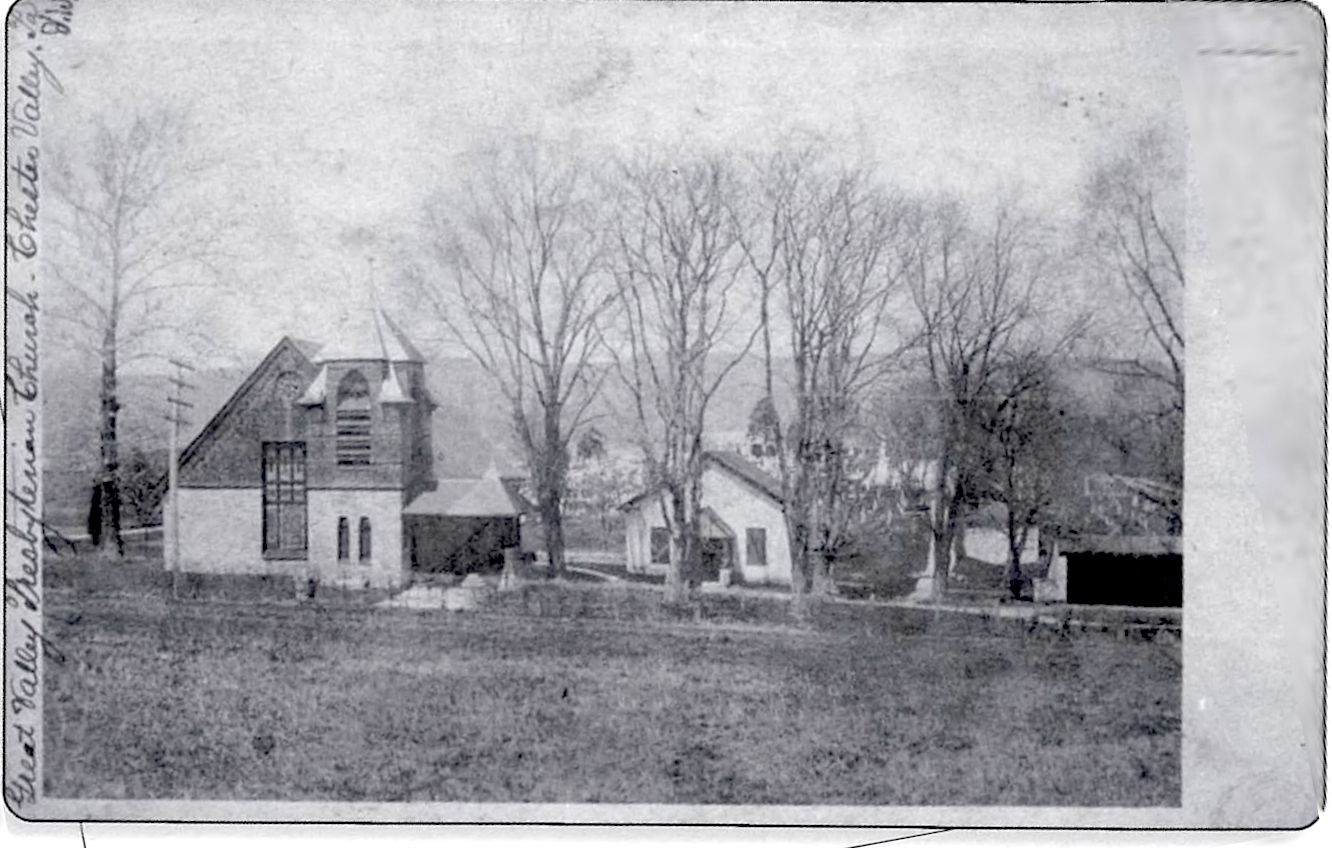
Great Valley Presbyterian Church as it appeared about 1906 in a Lucy Sampson photograph.
At The Same Time
Texas wins independence from Mexico; battles of the Alamo and San Jacinto
Queen Victoria, aged 18, ascends throne in Britain; reigns for 64 years
Samuel F. B. Morse patents his invention of electromagnetic telegraph and code which bears his name
Potato famine reaches height in Ireland; large scale emigration to America begins
Karl Marx and Friedrich Engels write The Communist Manifesto
California Gold Rush