Chapter 5: Turnpike Period
1798 - 1833
All but the eastern end of Cockletown, on the Old Lancaster road, was in Tredyffrin, but upon completion of the Philadelphia and Lancaster turnpike in 1798 by a company of progressive business men, nearly all of the transient traffic moved to a parallel line south of old Cockletown and mostly in Easttown.
This was the first toll road constructed in the country. The more direct route with graded and stone-paved roadbed, at once justified the expenditure by the increased stream of travelers requiring “entertainment for man and beast,” hence the numerous taverns that appeared along the road. There were drove, wagon, and stage stands, the latter being by far the best conducted.
All of the pre-Revolutionary stands left stranded on the back road were speedily put out of existence and their owners compelled to rebuild on the pike in order to hold their custom, but wherever the turnpike happened to occupy the old roadbed, the fortunate landlord opposite reaped an increased trade. Of the more fortunate were the Black Bear and the General Paoli.
The General Paoli, named in honor of Pasquale Paoli the Corsican patriot, came to be the Democratic headquarters, the polling place of Easttown and several other townships, and by the addition of several wings, offered an imposing front. It was owned by the Evans family for over a hundred years; Joshua Evans 1769-1814, Joshua Evans jr. 1814-1846, and John D. Evans 1846 until 1873. The Evanses, however, did not keep tavern continuously, for there were several early landlords, including Richard Robinson in 1799 and for some years after.
Joshua Evans jr. was the political and military leader of the district. Paoli was crowded on election day, the voters sometimes lined up for a quarter of a mile, and as every district had its bully, fights were numerous and often became general. The landlord on important election days disposed of two or three barrels of whiskey, besides quantities of cider, cherry bounce, and other liquors. In 1812 a regiment was mustered at the Paoli and neighboring taverns.
Isaac Wayne was also a political leader. He frequently got in difficulty at the Paoli inn when it was filled with an election or military muster crowd, and his trusted son-in-law, William Hayman, usually came to his rescue. “Isaac Wayne! Are you in trouble again?” “Yes Billy, come here!” and Billy would plunge through the packed mass, pushing men to the right and left, until he reached the side of Isaac and took his part in the fracas.
The Springhouse, the successor of the Fox tavern on the Old road, was located in what is today the east end of Berwyn. It was built by William Torbert for John Llewellyn, a brother of David Llewellyn of the Fox, and in 1814 bought by the Kuglers. From 1825-1830 it was leased by John Dane, later by his widow, when it became known as “Peggy Dane’s” tavern, the rendezvous of many a rustic beau, for the landlady had a bevy of dark-eyed daughters. Later it was occupied by the owner as a residence, a member of the family that made Kugler’s restaurant famous in Philadelphia.
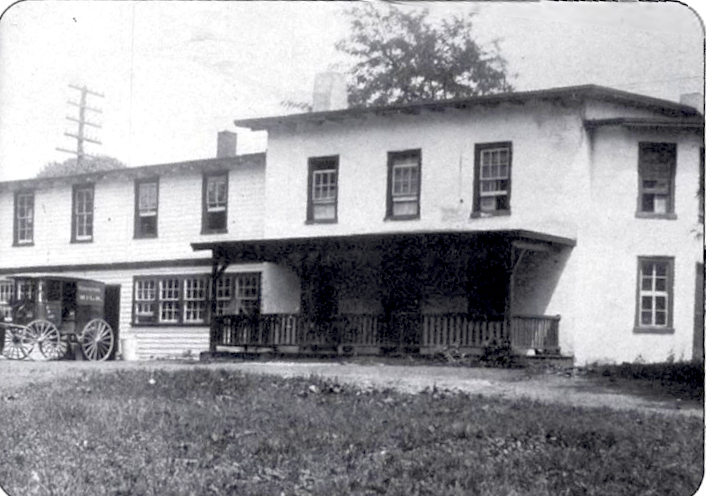
The Springhouse Tavern, pictured here around 1916, occupied a favored location along the Lancaster roadside in the nineteenth century. Later the building was used as a depot for local milk delivery routes. Expansion of the adjoining Bronze factory led to its use in manufacturing.
This tavern was situated at the head of the Darby creek, with ample yard room and an abundance of spring water. It became known as the Big tavern. Samuel White who had sold his Valley Forge farm, moved there in 1855, but after he had occupied the building a single day it caught fire from locomotive sparks and burned down. It was rebuilt on part of the old walls by the Rev. John McLeod, who purchased the farm from the Kuglers in 1861. It is said that in time past its ample porches witnessed many a country vendue. Later the building stood at the rear of the plant of the Berwyn Ice Company.
About a quarter of a mile west of the Springhouse on the Lancaster pike stood the new Drove, or rather two buildings about a hundred yards apart, owned by the Reese family. The east building was probably the oldest and reputed to have had an underground connection with the original Drove tavern on the Old road.
The new Drove bore an evil reputation for drunken brawls and gambling. It catered to a rough class, the drovers. It was popularly believed that unknown patrons were robbed and perhaps murdered in their beds, through a system of easy entry to the bedrooms by means of trap doors from cellar to garret in superimposed closets. Here, also, scandal whispers, a sporting member of the Reese family staked a farm on the throw of the dice and lost!
The older building was demolished by Henry Fritz in 1869 to make room for his residence. Curious neighbors wished to dig in the old cellar for traces of bodies but the owner filled it up with the remark that as he expected to live there, the less he knew of former trouble the better.
The Reeses appear to have been a kindly people, fond of sport of all kinds, and they naturally attracted the noisy, sporting class. They imported the first thoroughbred stallion for breeding purposes, in all this neighborhood, and the Old Lancaster road through Cockletown provided an excellent half mile dirt track upon which the improved type of horseflesh was exercised by their owners. The turnpike had drawn off most of the traffic, and the Sunday impromptu races down the Old road lined the fences and filled the trees with spectators, some of whom bet freely upon the result. Later, the Reeses built a track in a field west of the Howellville road (later occupied by the nursery of W.H.Doyle) and altogether spent a great deal of time and money on race horses.
The new Drove stood on the northeast corner of the turnpike and the Howellville road, built against the bank so that the occupant could step from the second story rear door to his backyard, and the rear rooms of the ground floor were dark and damp to the extreme. The singularly graveyard repellent odor of the Judas tree, the enormous boxwood bushes, and the greenish unhealthy-looking fruit lying crushed under the large Osage orange, heightened the evil effect.
It is certain that John Reese, a reputable farmer on the Old road, was the proprietor in the early 1830s and that the Rev. William Henry Rees occupied one of the buildings while preaching at St. David’s and St. Peter’s churches. Abel Reese may have been the last landlord.
Of the new hostelries, the Lamb (now Roughwood, a private residence), corner of the Turnpike and Line (Great or Baptist) road, Devon, was built about 1805 by George Rees who was later Sheriff of Philadelphia county, and a country store was kept there by Jonathan Jones, 1805-1812. John Lewis was first tavern landlord in 1813, followed by Jacob Clinger, 1815-1830.
The Stage Coach (later part of the lawn of George D. Woodside’s mansion, Devon) was owned by John Havard Davis, 1810; John Lewis, 1810-1812,-Alexander E. Finley, 1813-1830, perhaps later, and was followed by a German by the name of Shenaman, who was the last landlord. Finley was a Scots-Irishman of some political influence and a “colonel” of the militia. The Stage was often called the “Militia house” since the Glassley commons where it was located was scene of many a military muster of Easttown.
The signs of both the Lamb and Stage were the work of a self-taught artistic genius, James McGuigan, of Glassley commons. All inns in that day had signboards with pictures on them. This was necessary, for many of the teamsters along the road could not read.
The old Blue Ball of Mt. Airy (now known as Daylesford), had been left out of the line of travel and a new tavern was erected close to the new pike. It was also known as the Blue Ball, though oftener called “Prissy’s” tavern after the notorious Prissy Robinson who kept it for many years and died, at the age of one hundred years and six months, after outliving three husbands. The estate, except a few acres, was in woods, and Prissy was for many years before her death under the necessity of selling ginger cakes and molasses candy to the children at nearby Mt. Airy school for the few pennies she could make.
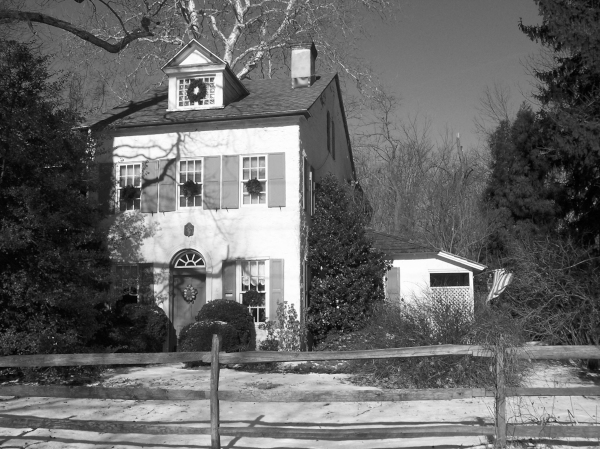
The Blue Ball, was the second inn to bear the name. It is located along the north side of what we today call “Old Lancaster” road in Daylesford. Photo by Marc J. Heppe.
The Black Bear was the only tavern in this vicinity on the south side of the pike. It stood near where today’s Route 252 crosses Lancaster avenue and served wagoners and drovers.
The General Jackson built by Randall Evans, brother and bitter rival of the landlord of the Paoli, was headquarters for the Farmers’ Lodge of Freemasons, No. 183, from September 12, 1822 to about 1830 when it was constrained to forfeit its charter during the anti-Mason craze. Evans was succeeded by Evenson, who called it the Franklin, and it was later known as the Hinkson house. Much later it was the headquarters of the local branch of the Red Cross, during World War I.
It was the custom of the times to abbreviate the names to Stage, Ball, Bear, etc. There were 62 taverns or inns located along the 62 miles of the turnpike between Philadelphia and Lancaster.
The Paoli was a stage stand of excellent reputation. Many of the others were frequented principally by the wagoners and drovers who were usually content if they could find a spot on the barroom floor for their blankets, and sometimes while they lay in a drunken sleep, the crafty landlady would extract produce from their wagons to serve up for breakfast!
Robert McClenachan, late of Ireland, styled a Philadelphia merchant, married Amelia Harrison, who had inherited a large tract of Easttown land. In 1800, shortly after completion of the turnpike through a part of this property, McClenachan laid out on paper the new town of Glassley with wide streets, squares, and lots, on a tract about equidistant between the Lamb and Springhouse taverns.
Beginning on the north at Old Lancaster road running east and west there were in succession: “North”, “Turnpike,” “South,” and “Pearl” streets; beginning on the west running north and south there were “Green”. “Harrison,” “Franklin,” “Washington,” “Thompson (now Fairfield),” “Wayne,” and “McClenachan (now Valley Forge)” streets. But beautiful Glassley never became a town. It looked good on paper, but it had no industry to attract prospective residents.
McClenachan donated a piece of ground in his model town “on the side of the hill near a spring of water” for a school. At that time there was a schoolhouse in Howellville, one near Strafford, and one near the edge of Newtown, but all were too far away to accommodate the children of Easttown. With the ground having been provided, people gave either money or work as best they could, and in 1808 Glassley School House was completed and opened to children who could attend.
After selling some lots, the disgusted founder returned to England and there died. For many years this fenceless tract was known as the “Glassley commons.”
Here Major Wetherby, Captain Rowan, and Ensign Hampton proudly exhibited and exercised their gaudily clad militia, which later degenerated in ever more of a farce. Every male over 16 years of age was supposed to turn out once a month for military drill, according to the law. The military spirit was at low ebb and there were no active leaders and the men and boys tramped about at random, often armed with cornstalks, to fulfill the letter of the law.
Later they persuaded landlord Finley of the Stage to assume charge, dubbing him “Colonel” though he knew nothing of military matters. However, he was not loath to lead them to the field and exclaim, “Line up b’ys, line up with your backs to the turnpike and your faces to the gum tree and stand still until I gov’ the word halt!”
General Anthony Wayne was buried at Fort Erie where he died in 1796, and years later his son Isaac disinterred his bones and brought them home packed in the body of his sulky. On June 6, 1811, the local military companies assembled at Evans’ (Jackson) tavern, Paoli, and moved out the Lancaster road to meet the Norristown cavalry and the funeral cortege, which they conducted to Old St. David’s church.
Samuel Smiley, an old soldier under Wayne, insisted upon marching on foot in front of the hearse the whole distance. Chaplain David Jones was present and upon the solicitations of the assembled neighborhood, mounted the platform to relate once more the horrible details of that awful night when under the command of the cold-blooded Grey, the British surprised Wayne at Paoli.
Wayne’s war horse survived him many years and was often ridden by his son on the muster days of the militia. Col. Isaac Wayne inherited from his distinguished father a taste for military matters which he often exercised on the old Valley Forge parade grounds.
In the second war with Great Britain, or War of 1812 as it was called, local men took a prominent part. Cromwell Pearce, was appointed Major General of the Third Division, Pennsylvania Militia. Isaac Wayne was offered a colonelcy in the infantry, but refused, preferring to enlist as a private in a local cavalry troop. Benjamin Wetherby was Captain of the Fourth company in the 65th Regiment, Pennsylvania Militia. The local companies did not see a great deal of action, but the officers in higher command were in several hot engagements. In 1812 Cromwell Pearce resigned his empty title of Major General of Militia to become Colonel of the 16th U.S. Regulars, and while second in command under General Pike, captured York (now Toronto), Canada. In the battle of Chrystler’s Field near Williamsburg, Canada, November 11, 1813, in which the Americans were victorious, the command devolved to him after General Covington was mortally wounded.
It was announced during 1816 that Wetherby’s company would be paid off at the Paoli tavern on a certain date. Doubtless Joshua Evans had extra heavy receipts on the appointed day when “the ghost walked.”
On September 20, 1817, the Republican Artillerists, headed by Col. Cromwell Pearce, and with the local military companies, dedicated the first monument to the dead at Paoli. Five years later, Col. Pearce and his wife conveyed about 23 acres adjacent to the graves as a place of parade forever. The Paoli Battle had taken place next to the Pearce family farm when the Colonel was five years old.
The intrusion of government into the lives of Easttown residents was very slight. County officials (commissioners, judges, etc.) were situated in West Chester. Justices of the peace represented the county judges locally, but most served districts comprising three or four townships. Easttown was paired with Willistown and East Whiteland. The first Easttown appointee as Justice of the Peace was Whitehead Wetherby in 1800, followed by Benjamin Wetherby in 1817.
The Fiftieth Anniversary of the evacuation of the Continental army at Valley Forge was celebrated on July 26, 1828. That late date was to accommodate the farmers who were busy with cultivation on June 20th, and harvesting crops on July 4th. It was ostensibly a Harvest Home but actually a Whig political gathering of the local admirers of the grand old sage, John Quincy Adams.
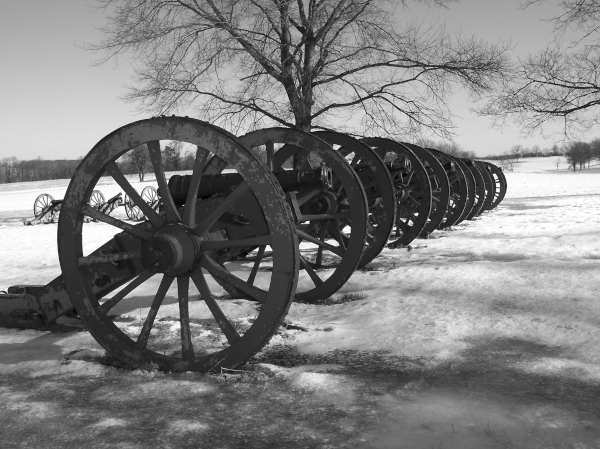
The cannons at Valley Forge National Historic Park. Photo by Marc. J. Heppe.
We are told that the morning was ushered in by a salute of cannon and that some venerable survivors of the Revolution were seated upon the stand with the orator of the day, Col. J.C. Watmough. Abisha T. Woodman contracted to provide lunch for the entire company on thirteen tables, each 164 feet long, and seating 1600; about 3000 were fed here and many others dined elsewhere.
Jonathan Roberts presided over the dinner at which thirteen toasts were scheduled: George Washington, John Quincy Adams, Henry Clay, Richard Rush and Anthony Wayne were extrolled, and Andrew Jackson, Timothy Pickering, Livingston of Louisiana, Eaton of Tennessee, Giles of Virginia and other Democrats, condemned.
Except for commerce transacted at the taverns and inns along the pike, nearly all of Easttown’s 600 inhabitants were involved in day to day subsistence agriculture for their livelihood. Some small amount of grain crops and meat produced were considered surplus and sold at market, but the greatest portion of what the farm produced was used on the farm itself.
Most farms were fifty or more acres in size and generally stood at a distance from each other. A traveler, some years earlier, with perhaps some exaggeration, noted that between Philadelphia and Lancaster he found “not any two buildings standing together except at Downingtown.”
Opposite the fifteenth mile stone on the turnpike (Glassley) Samuel Stirk, wheelwright, and Patrick McGuigan, blacksmith, were established. Blacksmiths, and often wheelwrights, flourished also near the inns at the Paoli, Leopard, and elsewhere.
The little community that served Easttown was of scarcely any importance, known at this time as the “Sixteenth mile stone,” advertised as late as 1832 by Van Leer and Channel, who had moved their stand from Tredyffrin to the “spacious store house on the Lancaster pike’ at Newtown road where they sold dry goods, groceries, and liquors; or as “Peggy Dane’s” or the “Drove.”
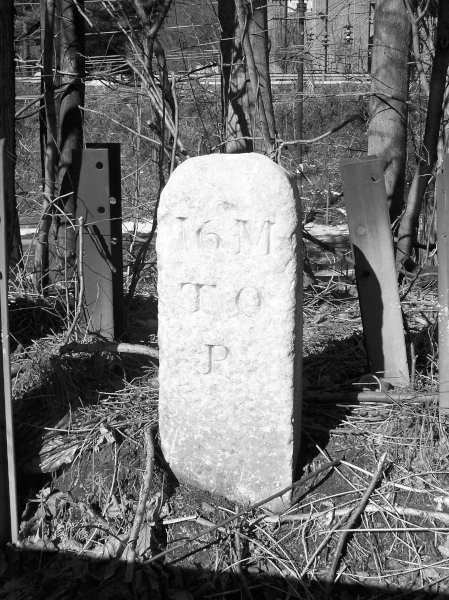
Philadelphia and Lancaster turnpike milestone 16. Photo by Marc. J. Heppe.
The coming of the railroad was soon to displace pike traffic. The road, not an engineering wonder, was as crooked as a meadow brook and was at first operated by horse power, but on April 1, 1834 the first locomotive, the “Black Hawk,” ran in eight and one-half hours from Philadelphia to Lancaster. By 1836 steam had displaced horse power. Abel Reese viewed the first steam-drawn cars with tears running down his face, and he exclaimed to his neighbor, Peter Burns sr., “Our farms are ruined!” Burns sacrificed a valuable colt racing the returning engine into Philadelphia.
The stage and freighting business on the turnpike was indeed soon ruined, and although the decline of the tavern was gradual it was more or less complete, and it was high time for the common tap-room was demoralizing the people. The barroom had become the social life of a certain proportion of the male inhabitants and swearing, quarreling, habitual drunkards infested every neighborhood.
Of the taverns before mentioned, the Lamb, Blue Ball, and Jackson became, for a time at least, private residences; the Stage, Springhouse, and Paoli were destroyed by fire; and the Drove and Black Bear were demolished.
Dr. John P. Lewis, local Quaker physician, had a wide practice. He and Dr. Thomas B. Evans, a cousin of Anthony Wayne, are said to be the first physicians to practice in Easttown. Lewis’ daybook of 1827 shows that he charged $1 for a single visit including medicine, though often no greater sum for two or three visits. He charged 25 cents for extracting a tooth or for bleeding. Vaccination came high at $1.50 to $2 and the reduction of fractured members, from thumb to leg, ran from 75 cents to $5.
Easttown residents continued to make their way on Sunday to the three old meeting houses, St. David’s, Valley Baptist, and Valley Presbyterian.
For nearly a score of years St. David’s Church was without a regular rector. Little had been done at Radnor to arouse the congregation from the spiritual apathy caused by the Revolution and the hierarchical split with the Church of England. Its pulpit was at last filled by the Rev. Samuel C. Brinckle 1818-1832, in whose term was inaugurated the first Sunday school with the venerable John Hunter as superintendant.
Then followed the Rev. William Henry Rees, 1833-1838, who was a native of Cockletown as was his father before him. The Rev. Rees, late of the Diocese of Maryland, had been called from the Church of St. James the Greater, Bristol, and left this vicinity for Mt. Vernon Institute, an Episcopal Church school at West Chester.
Dr. Henry Yates Carter was the first secretary of the St. David’s vestry of this time. He was born in London, 1750, and died at his home opposite the Drove tavern, 1849. He had been assistant surgeon on board Lord Nelson’s flagship at Trafalgar.
The Rev. David Jones was again the pastor of the Baptist Church in the Great Valley from 1792 to 1820 with frequent leaves of absence. In February, 1799, the Church was incorporated, and in 1805 a new stone meeting house was built. The oak logs of the original building were sold for $55 and dragged up Valley Forge road to be used as an addition to the Lamb tavern on the turnpike. The parsonage was built in 1816 and the barn in 1823. The little creek, Nant yr Ewig, which flows through the meadow, was dammed and here the converts were baptized at all seasons of the year until a pool was provided in the new chapel at Berwyn. It was popularly believed that no one had ever taken cold from baptism as practiced by this denomination.
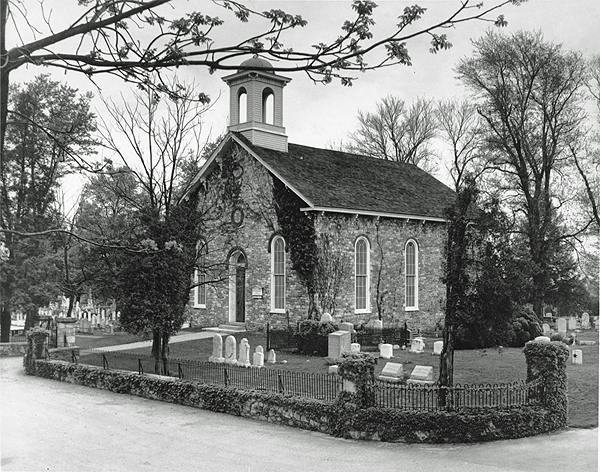
The Great Valley Baptist Church, founded in 1711, was the church home of the Easttown Baptists, even though its meetinghouse was sited on the north slope of the South Valley hill below the Easttown line. The graceful limestone building shown here is pictured on the occasion of the congregation’s 250th anniversary in 1961.
In August, 1821, the Rev. Thomas and Elizabeth Roberts, Evan and Elizabeth Jones, Isaac and Rachel Cleaver, and John Farrier were dismissed to form a mission to the Cherokees in Tennessee, the first fruits of the Missionary Society organized in 1816.
It is noteworthy that after this little band of zealous Baptists had labored long to reduce the tribal dialect to a written form, they found that an illiterate half-breed Cherokee, Sequoyah, or George Guess, with nothing but a split shingle and a piece of charcoal, had devised in 1826 a syllabic alphabet by which he rendered the language completely expressive. The missionaries discarded their own attempts, although they had already printed a spelling book, and were pleased to adapt Sequoyah’s arrangement. A son of Evan Jones, the Rev. John B. Jones, born on the mission field, translated the Scriptures into Cherokee many years later.
The closing days of the Turnpike era marked a season of great religious activity under the Rev. Leonard Fletcher. It is said that during his pastorate 447 converts were baptized and 26 admitted by letter, and at this time and for more than a score of years later, especially under the leadership of the Kauffman family, the choir enjoyed an excellent reputation for music.
The Baptist Church in the Great Valley became the parent through missions of the following Church organizations: Lower Merion, 1808; Phoenixville, 1830; Norristown, 1832; Willistown, 1833; West Chester, 1834; Radnor, 1841. This last, it is true, was secession from the Great Valley church, when 79 communicants in sympathy with Rev. Fletcher’s antislavery views, asked for and received their letters to form a church in Radnor.
Great Valley Presbyterian Church had but one pastor during all of this period, the Rev. William Latta, 1799-1847. He was born in 1768 and died in 1847. He made a memorable prayer at the West Chester reception for General Lafayette in July, 1825. He was a son of the Rev. Dr. James Latta and a brother of the Rev. Francis A. Latta.
At The Same Time
“Louisiana Purchase”; France sells Louisiana to the United States
Battle of Waterloo; Napoleon defeated by Duke of Wellington
First passenger steam railways open
Reform Act passed in Britain extends vote to middle class