Chapter 2: Colonial Period
1705 - 1760
The rich limestone land of the nearby Great valley was greatly esteemed for agriculture from the start, and the settler thought himself fortunate enough indeed if his allotment fell short of a slice of the North or South Valley hills, which were considered worse than waste ground, the lurking places of the destructive “varmints,” yet, about 1700 certain Welshmen came into possession of land lying contiguous to the old Indian trail, later known variously as the King’s, Great, Provincial, Lancaster or Conestoga road, on the South Valley hills, as wood lots.
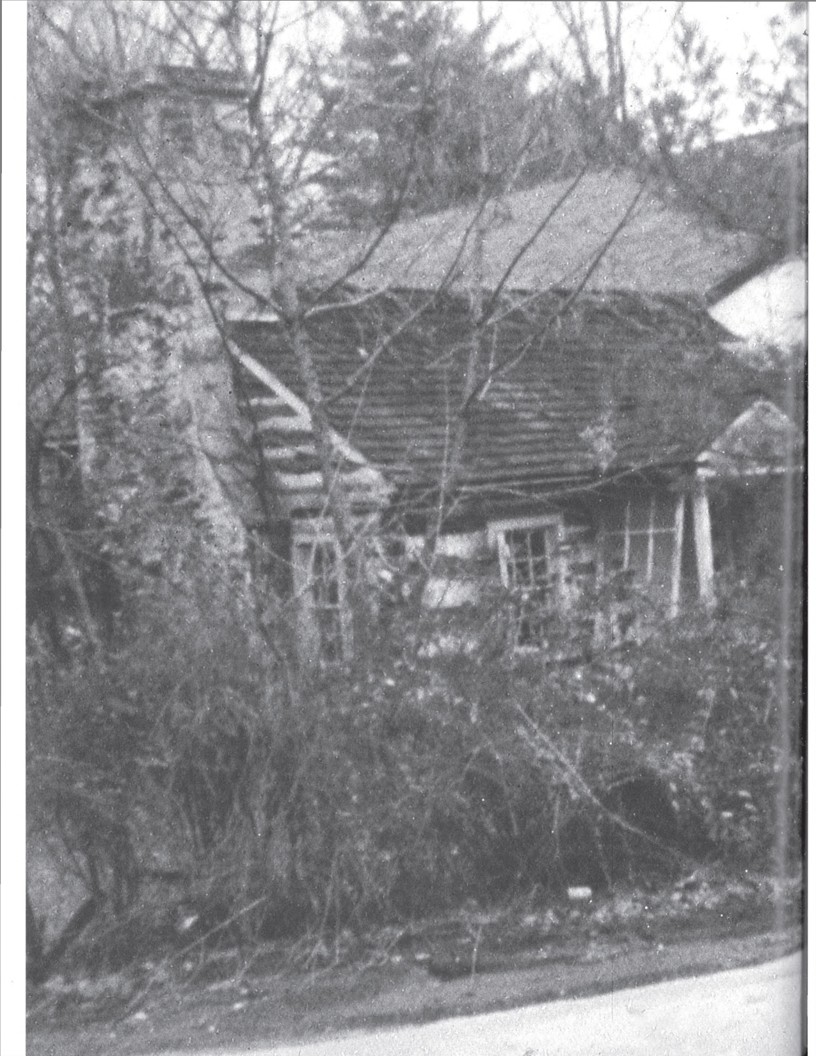
The Devon log cabin, still standing on the north side of Old Lancaster road, is said to date to 1734. In the early twentieth century it was known as the “Devon Tea Room.” This 1973 photo is by Dorthoy Read. Wallace Nutting’s book “Pennsylvania Beautiful” shows the cabin on page 129. The id of the image is DLC05.
Nearly all of the early settlers, except the Germans, were wasteful of the timber. Grand old forests of oak, ash, walnut, maple, birch, hickory, chestnut, pine, cedar, hemlock etc., were felled and rolled in huge piles to be burned to clear the ground. A fine red walnut found near the banks of the Schuylkill was soon gone from this region after it became popular for Colonial furniture.
Doubtless many of the original dwellings were of logs, but as the Welsh were accustomed to stone houses in the old country and had many clever stone masons, they lost little time in building permanently of limestone. Few examples of log houses exist today. The more or less temporary log hut had large flat stones for corner foundations, stick chimneys daubed with clay, beaten earth floors, moss and clay chinked-log sides, and thatched or split slab roofs.
Few tools were necessary in the construction of a primitive log hut, an accomplished woodsman could build it with no other tool but an ax. The logs were pushed up into place by means of stout pole skids until the walls were about six feet high, when door and window openings were made usually with a crosscut saw and the walls continued upward to the desired height. The door latch and hinges were ingeniously fashioned of wood, and in place of glass there were fastened to the windows the oiled hides of some thin skinned wild animal from which the fur has been removed. The windows were both small and few for the settler, so constantly in the open, liked to feel the difference when he entered the house.
The Welsh were liberal providers. Before attempting work of any moment, great quantities of eatables and a liberal supply of alcoholic drinks were provided. Some few also learned to provide a hot weather drink compounded of vinegar, ginger and sweetened water, but no harvest seemed complete without strong drink in abundance and it was thought that no foundatiom could be laid, stone wall built, or barn timbers raised without the assistance of alcohol.
The masons constructed their scaffolds of heavy poles fresh from the woods and the put logs were bound to the scaffold poles by hickory withes, no nails being used. For a permanent building the shingles were if possible of pin oak, the kind that split in thin slabs sometimes four feet long, overlapped both ways and fastened with wooden pegs.
The floor was of wide mill-sawn oak plank, ripsawed edges to key, plowed and wedged with loose tongue sometimes when an extra tight floor was desired, and fastened by square pegs in round holes. All of this was done by hand. The plastering was generally done right on the bare stone wall, with the joists and floor boards of ceiling exposed. The partitions were made of wide boards, doubled with wide and overlapped joints, and the whole whitewashed every spring.
When lath were used they were of split oak. Mouldings were planed out by hand and when a carpenter arrived he brought a wagon load of tools and prepared to stay some time. The nails, hinges, locks and other hardware, if not duplicated in wood, were hand wrought by the local blacksmith.
For weeks or perhaps for months before a barn raising, the carpenter and his assistants cut, squared, mortised and bored the heavy timbers, until every piece was ready to hoist in place and the wooden pins driven home - the work of the assembled neighborhood. A cedar bush lashed to the ridgepole, a relic of still earlier times when a bush on a cottage gable was the sign of ale brew sold within, reminded the owner that a treat was due, and if tradition may be relied upon, the old settlers were no less formidable as trenchermen and drinkers than at heavy labor. An old saw intimates that the Welsh were racially opposed to hard “bone” labor of any kind if a living might be obtained without, but the original colonists of this section were good honest workmen, skilled led in husbandry or craftsmenship and inured to hard labor. A settler might be forgiven almost any sin but the crime of laziness, which was a mortal offense to the whole colony.
Probably the Scots-Irish pioneer of the hills found the local stone more difficult to quarry or more refractory to use, or perhaps they found the log house more satisfactory. At any rate many of them built substantially of oaken logs, squared and notched, chinked with a mixture of lime mortar and chopped straw. Such buildings had cellars with stout stone walls, and large stone chimneys, with floors and roofs of split oak, pine or cedar. It was the custom, whenever possible, to select the southern exposure of a hillslope, face the sun and bury the rear first story wall below frost level. Many of these buildings have endured for two hundred years and were accounted warmer than stone buildings in the winter.
The reclaimation of the virgin soil required almost super-human effort under a sun many degrees warmer than that to which the Welsh pioneer had been accustomed, and it is said that many of the more mature laborers succumbed soon after the turning of the soil. The young buried their elders in places long since forgotten and busied with the lush crops and the endless distractions incident to frontier life, recorded little of passing events.
Mowers and reapers for a long time encased their lower extremities in rags as a protection against the rattlers, copperheads and the greatly dreaded “wamper” or “horned” snake (the fabulous “hoop” snake of our grand-daddies) and many believed that this reptile could put its tail in its mouth and roll about like an animated hoop.
We have no records of the dates of the extermination of the various wild animals. However, the “catamounts” (panthers or bobcats) were traced to their dens at Diamond rock, Prissy’s hollow, Mount Misery, the rocks below Leopard and other forgotten harbors and killed with the timber wolves and other stock destroying animals, the scalps of which early commanded a bounty.
The black bear and Virginia deer endured in the hill forests until some time after the beginning of the 19th century, for the Welsh were too busy to become great hunters. A great hollow chestnut tree nearly opposite the old “Black Swan” distillery below Neilley’s log cabin (north side of Old State road, almost within sight of Tredyffrin/Easttown Middle School) was the site of the killing of the last bear found in this vicinity; and an old chronicle states that about 1800, during a mild spell in midwinter, the deer came out of the North Valley hills to feed in the valley. (The deer now come out of Valley Forge Park.) Our National bird, the bald eagle, had its eyrie near Mount Joy until about 1845.
The extermination of carnivorous animals disturbed the balance of Nature and the crow, blackbird, squirrel, and other animals became so numerous as to become a nuisance, and it was found necessary to offer bounties for their scalps. In the aggregate a great sum was paid out for their suppression in Colonial times. As early as 1700 a bounty of three pence a dozen was paid for blackbirds and a like sum per head for crows. In 1749, Kalm, the Swedish traveler, stated that 64,000 black and gray squirrels were killed in the Province on a bounty of three pence each.
The Welsh, though less superstitious than the average emigrant, had a firm belief in the supernatural. Many planted, harvested, butchered, built fences, etc., according to the signs of the moon. They believed that to set out on a journey or begin any new work on Friday would bring bad luck. Quasi-religious belief in miraculous intervention of the Deity, in ghosts and supernatural warning of impending disaster, and that sudden death might outstrip the will of God, were not uncommon.
Perhaps some Welsh farmers believed that if Candlemas day was fair, one could look for six weeks more of winter; yet the quaint rhymester libeled him outrageously when he made him say that he:
Would rather see his wife on her bier
Than a fair second of Februeer.
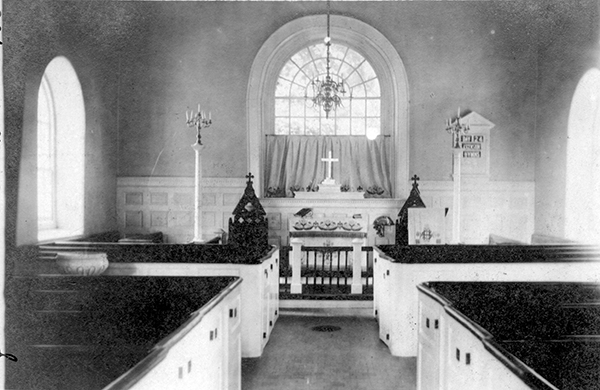
Interior view of Old St. David’s Church, Radnor, as it appeared near the time of its bicentennial celebration in 1915. The church was founded by Church of England Welshmen living in Easttown, Newtown, and Radnor townshipsshortly after 1700. In 1876 during a temporary stay at Rosemont, Henry W. Longfellow visited Radnor Church and composed a poem which conveys the deep impression the old place left on the mind of the famous American laureate. Photo by Lucy Sampson. The id of the image is SDC7.
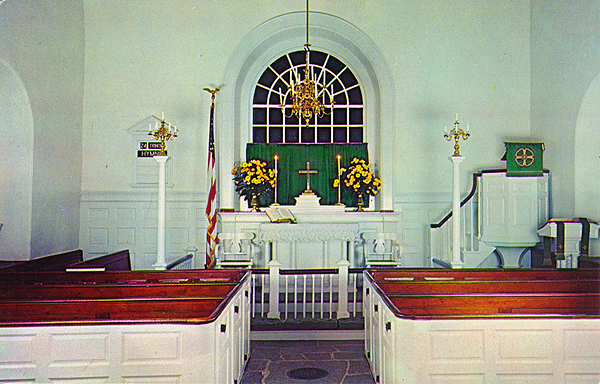
St. David’s
Church today, same view, shown in a postcard issued about 1969. The id of the image is SDC27.
They had plenty of horses and hogs, but the largest farms seldom kept many cows or sheep, for the reason that there was no
local market for fresh meat or dairy products. Wheat was the staple or money
crop; rye, flax, potatoes and hay were grown chiefly for
home consumption. There was no apology for rye bread but there might be for pie when it appeared:
Here is a dried apple pie, it’s crust is made of rye;
It’s pretty tough, I hope it will be enough.
Although the soil and climatic conditions were best adapted to the Indian maise or corn, very little was raised at first since the settlers had not learned to esteem it. Still it gradually came into favor after they learned from the Indians that seed corn should be planted “when the oak leaf is as big as a squirrel’s ear,” or about the middle of May. The first grist mill in Tredyffrin was built along the Valley creek by Thomas Jarman in 1710; the same year Wm. Davie owned another on the Darby creek a mile below the Easttown border; Nathaniel Grubb had another (late Worrilow’s mill) on Crum creek. Therefore, the local farmer had less than a day’s journey to haul his grain.
The sugar maple does not seem to have been abundant here and the wild honey bee was unknown in America until brought over by the white settlers; “the Whiteman’s flies” as the Indians called them. Cane sugar, molasses and rum were early imported from the West Indies to Philadelphia.
A backwoods settlement is scarcely the place for all the refinements of civilization. There were crude customs and the people were habituated to many things that would now be considered real hardship. Many of the farmers attended meeting in homespun and cowhide boots. The younger generation went barefoot until well into cold weather; the soles of their feet in some instances became so hard and horny that they could crack open a chestnut burr with the bare heel, and, indeed, they felt very uncomfortable when obliged to encase their feet in leather.
In the “good old times” underclothing was not known; abundance of hard work and plain food took its place. Bathing was seldom indulged in during the winter season; an outdoor life made this less imperative and, even during the warmest weather, it was held to be very weakening to the system and opened the pores to disease, to wash too frequently.
The year 1741 is recorded to have had an exceptionally severe winter, deep snows; many cattle and deer perished for want of forage. Colds were frequent and the patient dosed with home remedies. An epidemic during the fall of 1748 is said to have carried off many people, as the doctors were entirely helpless. It had all the symptoms ol pleurisy and usually carried off the victim in two or three days. In 1764 there was an epidemic of smallpox.
Crops were abundant in 1751-52, but the years 1753-55 are said to have been a season of want in the country at large, probably because of the Indian ravages all along the western border.
The use of alcoholic drink was universal. Wine, gin, rum, whiskey, were found in almost every house as specific for fatigue, exposure, snake bite and “chills and ague.” Soon, however, its increased use and abuse moved the elders of the Society of Friends to caution the members against permitting excessive drinking in their houses, especially at funerals and that they should have a care in supplying their friends “more than was good for them.” Soon certain medicinal herbs, native and introduced, made into tea by the good old Quaker mothers, were thought to have all the beneficial and none of the harmful properties of alcohol.
Of play there was little, unless log rolling, house and barn raising, “varmint” hunting, etc., could be so-called, as they were sometimes the occasion for the gathering of neighbors.
An old Welsh game called “Duck on Davy” is played now and then to this day. The “Davy” is a large flat stone and each player provides himself with a small round stone of a pound or so weight and stands back of an imaginary line some ten paces from the “Davy.” The player who is “it”, places his “Duck” on the “Davy” and the other players try to knock it off. If a player misses, he cannot touch his “duck” without danger of being tagged and made “it”, until someone knocks the “Duck” from the “Davy,” when all may grab up their small boulders and run for the line while the player is replacing it. It is a game of quick throwing, running and dodging, and can be rough, especially when someone is hit on the head while bending over his “Duck.”
Doubtless there were many “bedtime” tales and legends of Wales told at the fireside, but few are preserved.
Ghost stories were accepted with great credulity and terror. We are all familiar with the old Welsh-American nursery jingle:
Taffy was a Welshman, 'Taffy was a thief!
Taffy came to my house and stole a piece of Beef;
I went to Taffy’s house and Taffy was not home
Taffy came to my house and stole a marrow bone;
I went to Taffy’s house and Taffy was in Bed,
I picked up the marrow bone and threw it at his head.
The early Welsh members of the Society of Friends, settled in the eastern part of Easttown and southeastern Tredyffrin, attended the Radnor Meeting, Radnortown (now Ithan), held at the homes of John Jerman, a noted Quaker preacher, and John Evans as early as 1686, although the meetinghouse was not erected until 1693. This was the oldest religious organization in the vicinity and in its more prosperous days it was largely attended from all the country around. The older part of the present building was erected in 1718, but now all records of a long and profitable existence are deposited in the vaults of the Hicksite Friends library, 16th and Race Streets, Philadelphia. In 1882, Radnor Meeting fell into disrepair and disuse for nearly fifty years.

“Historic Waynesborough,” seat of the Wayne family for eight generations, is now owned by Easttown township and leased to the Philadelphia Society for the Preservation of Landmarks. Photo by Marc J. Heppe. The id of the image is WAY31.
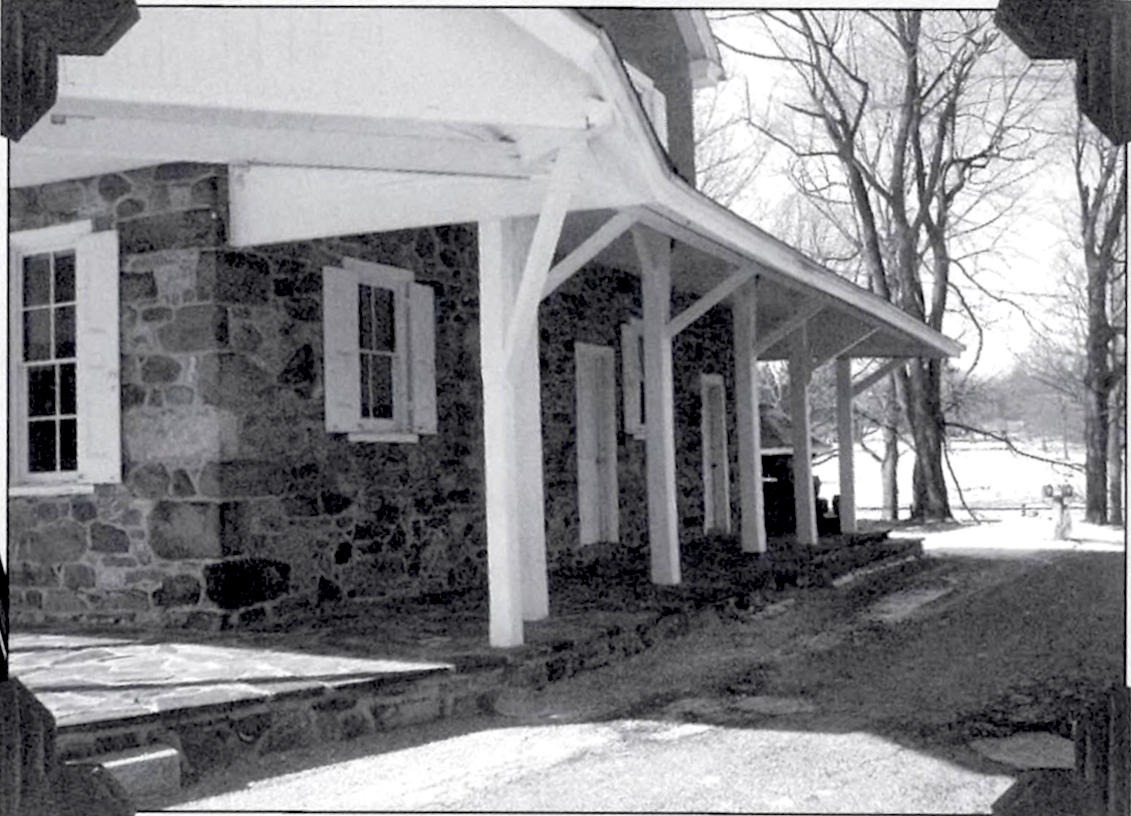
Newtown Square Friends Meetinghouse, founded in 1696. A building was constructed in 1711 and redesigned and enlarged in 1791. It still stands today although it no longer houses an active membership. Photo by Marc J. Heppe. The id of the image is FMH54.
There were at later dates, prosperous meetinghouses at Newtown Square, 1696, Goshen, 1722, and East Whiteland, 1726 or earlier; all of which were conveniently near the borders of Easttown.
The Old Welsh Church of St. David’s, Radnor, had its beginnings when the adherents of the Church of England, living at what was then the very edge of the Welsh settlement, came together to worship as they had done at home. The Rev. Evan Evans, rector of Christ Church, Philadelphia, is said to have preached at Radnor every other week from about 1700 until 1718, except for two short absences to return to London. He, too, was a Welshman, a missionary sent out by the Society for the Propagation of the Gospel in Foreign Parts. The events leading to the location of this congregation of Church of England faithful at Radnor Church have not been documented. Only tradition informs us of meetings in a log cabin near Darby creek, in the vicinity of Signal Hill, Easttown, and a short distance from a nearby burial ground. The meeting place then burned.
Tradition continues that some time later a church site was selected to the southeast where the Radnor, Newtown and Easttown boundaries join. It is said that Easttown and Newtown then had more parishioners and that Radnor had very few. A church building was erected there in 1715 during the short period when Rev. John Clubb, another Welshman, was missionary pastor. The oldest gravestone in the burying ground is that of Edward Hughes (1716).
In the construction of this historic building at St. David’s, it is regrettable that no authentic record has been kept of the personnel and methods of the doubtless skilled volunteer workmen, or the name of the master mason, but the result was that of modest architectural beauty, which leads one to suspect it to be a replica of a church building nestling in some vale in Wales, the home of the Welsh master mason.
The Rev. William Currie, 1737-1775, 1784--1785; was a Scotsman and the last missionary, as the early rectors were called; also the first to preach regularly in English. He was obliged to divide his services between St. David’s, Radnor, St. James’, Perkiomen, and St. Peter’s, East Whiteland. He founded his farm on the southern slope of the North Valley hills in Tredyffrin above the Valley Forge, convenient to all his parishes, convenience at that period being only a relative term. He was situated in the parish of St. Peter’s, about five miles from St. David’s and more than a mile from the Fatland ford which he was obliged to travel on his way to St. James’.
The passing of the Welsh rectors marked the passing of the original Cymric stock and the increase of the English, Scots, Scots-Irish, German, Dutch and Swedish emigrants. The English people had felt the competition of the English and Scots Protestant farmers and manufacturers transplanted in Ireland and the Parliament had closed the home markets to them by arbitrary acts. The result was ruinous to the Irish Protestants and marked the beginning of the ancient grudge that lead to the loss of America to the British crown, for the hegira to the colonies continued until Ireland was drained of most of its enterprising citizens, whose descendants filled the ranks of the Continental army.
During all this period the successive rectors were dependent in a manner upon the bounty of the London society for their small incomes, while the Independent churches had to be self supporting. There seems to have been a day school conducted by Rowland Jones somewhere in the vicinity of St. David’s church sometime between 1720 and 1730. It is clearly established that a school house was built upon the church grounds about 1749, perhaps the successor to an older one, and it endured until 1844.
There can be no question that the majority of the population were poor and uneducated, especially in the third generation; a condition inevitable in a new and thinly settled neighborhood, where there were mere clearings surrounded by woods and connected by cart roads often impassable for the greater part of the year.
Some of the Easttown settlers affiliated with another early Welsh church organization situated near Wyola, Newtown township, known as Seventh Day Baptists (also Baptist Quakers or Keithians). They appear to have been former members of the Society of Friends who had come under the influence of George Keith, a contentious Scots Quaker holding extreme views regarding the doctrine of non-resistance, and his disciple Abel Noble.
Keith, holding that members of the Society of Friends could not consistently participate in the administration of the government because of their views, was disowned and later became an Episcopal missionary. In 1717, Thomas Thomas conveyed a small plot on the “Newtown street” as a burial place for the members.
As a commentary upon the supposed intolerance of sects of this period, consider two instances of mixed marriages where husband and wife continued as members of their own peculiar faith without more than personal inconvenience. Two of old Anthony Wayne’s sons, Humphrey and Isaac, were married to women who were Seventh Day Baptists.
A daughter (died 1738, 14th year) and a son (died 1752, 4th year) of Humphrey and Priscilla Wayne; also four children and Elizabeth, wife of Isaac Wayne, are buried here. Both Humphrey (the carpenter) and Isaac (the tanner) were members of St. David’s Episcopal Church.
Elizabeth Wayne, daughter of Richard and Margaret Iddings, died May, 1793, aged 84 years. The inscription on her gravestone reads, “She was a woman of distinguished piety and benevolence.” She was also the mother of Anthony Wayne of Revolutionary and Indian war fame. Some distance below St. David’s church, the site of the house in which Elizabeth Wayne, was born is still pointed out, also the pool in Darby creek on the Radnor line where she was baptized.
Tradition describes Elizabeth Wayne as small in personal appearance but exceedingly competent, as indeed she must have been to manage a household and large estate in the new settlement while her husband drilled the local militia during the French and Indian wars. “Mad Anthony” Wayne, her son, was of course, half Welsh, a fact his biographers have, for the most part, ignored, and his mother, whose religious convictions were wholly against war, lived to see her son the foremost warrior of America.
For a period of one hundred and fifty years the nearest meetinghouse for Easttown Baptists, most of whom were Welsh, was the Baptist Church in the Great Valley. Its history in many respects is peculiarly interwoven with that of our township, as well as with that of the denomination in Delaware and Pennsylvania.
The church was organized in 1711, and in 1722 erected a meetinghouse of logs, 28 feet square, situated on what we today call Devon State road. The Rev. Hugh David, a Welshman, was the first minister 1711 - 1753.
Great Valley Presbyterian Church, while inconveniently situated three miles up the valley on the Swedesford road, merits more than a passing notice, since it has many more communicants and continues to be the burial ground of those of the Presbyterian faith of our community. The congregation, mainly Welsh, assembled as early as 1710 and regularly organized on October 10, 1714 with the Rev. Malachi Jones as minister 1714 - 1720. During the incumbency of the Rev. David Evans, in 1720, the first building was erected.
In order to vote in 1739, electors were required to own at least 50 acres, with 12 acres cleared and improved, or 50 pounds in money. Easttown was included in the Crum Creek district with Radnor, Newtown, Upper and Lower Providence. Isaac Wayne, son of the immigrant and father of General Anthony Wayne, repeatedly represented his district in the Provincial Assembly.
John Rees was a lieutenant and Benjamin Weatherby sr. was an ensign in the local company of “Associators” formed about 1748 for protection against the French and Indians. Isaac Wayne is also mentioned as bearing a distinguished part as captain of a local company in the provincial service after Braddock’s defeat, and Cromwell Pearce was a lieutenant in a battalion of foot.
It is probable that the Blue Ball tavern (now Daylesford still standing as a residence near Jimmy Duffy’s) was their headquarters and rendezvous, where they fought their battles over again in front of the bar, tradition of which led historian Dr. Sachse to surmise that it was the mustering place of part of Braddock’s ill-fated expedition of 1755 and the more fortunate Forbes army.
Some of the British soldiers under Dunbar may have stopped there in their long and cowardly retreat to Philadelphia after Braddock’s defeat, but the general opinion is that they are running yet.
Easttown farmers were compelled to furnish some heavy farm wagons for the campaign. According to Government specifications, they were to be furnished with tar and grease pots, drag chains, ax, spade, grasscutter etc., well as extra harness, horse shoes, nails, four horses and an able bodied driver to haul army baggage into the Indian country beyond the Alleghanies. The recompense, however, was not attractive in view of the risk of scalp and property. Even Captain Wayne’s team had to be pressed into service and it never returned.
The taverns along the old Lancaster road (today Conestoga road) catered mostly to the transient trade. The better known in this vicinity were the Fox in Easttown, and the Drove, Blue Ball, Black Bear, and General Paoli in Tredyffrin. The old time inn of the better class was the home of good fellowship and true democracy, managed by an inn keeper of wide acquaintanceship, broad sympathy for his fellow man and giving him the best of home comforts at a moderate compensation. The host welcomed the stranger at his door personally conducted him to his room, introduced him to his fellow travelers and was ever solicitous of his comfort, in short, made him his intimate and life-long friend.
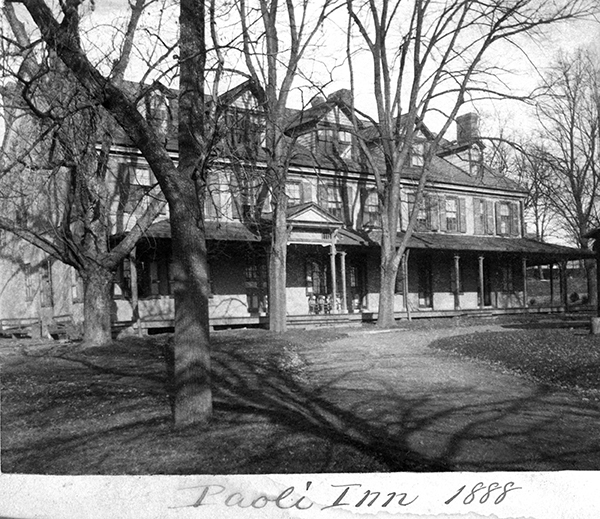
The General Paoli tavern, first licensed by Joshua Evans in 1769, was one o fthe earliest inns along the old road to Lancaster. Photo by Julius Sachse. The id of the image is GPI03.
The Blue Ball tavern is said to have been a popular house in early times and was sometimes called the “Half-way House” because it was equidistant from the Schuylkill and the Brandywine by way of the old Lancaster road. Abandoned as a road house when the Lancaster turnpike was built, in 1863 Robert Glenn demolished all but the rear wing and rebuilt it for a farm house.
Easttown’s local tavern was at the sign of the Leopard on the Darby road. It is said to have been built by Adam Roads in 1716. Little is known of its early history beyond the fact that Samuel Wetherby, 1768; Whitehead Wetherby, 1769; Caleb Parry, about 1770-1774; Elisha Worrell, during the Revolution; probably followed by George Steible or Joseph Morgan operated as “ye tavern keeper.” The red frame house, long demolished, at Sharp’s corner on the southeast angle of Sugartown and Leopard roads, was also a tavern at some period. .
The Black Bear (Bull’s Head at one time) at the southwest corner of the Lancaster and Bear roads, was a famous Colonial tavern midway between the Blue Ball and the Paoli. The locality still retains the name of “the Bear,” but unfortunately its history has not been preserved. The building was pulled down by Hugh Steen in 1877.
The Paoli inn appears to have been built by Joshua Evans, the carpenter and the proprietor, 1769-1814, and it is said to have been run by the Davis family for some years, later by the owner with some intervals: Thomas Search, 1779-1780, and Richard Robinson certainly kept it in 1781 and 1797, doubtless many more years.
According to the ingenious tax collector, Easttown landowners in 1753, were Chas. Calling, Nathaniel Claypole (Claypoole), Thos. Crass, Jennie Davis, Ann and Humphrey Ellis, Peter Eliot, Thos. Hingham, Elizabeth Howel, Benj. and Isaac Hugh, Griffith James, David, Nicholas, and Thomas John; Benj. Junkin, Richard McCadden, Thos. McCain (McKean), John McCorkle, Patrick McCarty, Andrew Meguier (McGuire), John Marran, Morris Matson, Isaac Minshall, Mark Morris,
Elick-sander (Alexander) Nuckle, Hugh Reed, John Steel, Adam Trehorn, Francis, Humphrey, and Isaac Wayn (Wayne); Hugh Win (Wynne), Edw. William, and Isaac Worrell.
It will be noted that the exclusively Welsh settlements soon exhibited a strong tinge of Scots-Irish. During the reign of Charles II, the British Parliament placed an embargo upon Irish cattle; the people then turned their attention to sheep, but the English soon felt the competition in wool and woolen goods and closed their markets to them. Many Scots-Irish Protestants were than reduced to want and the steady emigration to America in 1700 became a succession of waves from about 1717 to just before the Revolution, when there were difficulties in renewing leases in Ireland.
The Scots-Irish often came with little or no money, but they had a hunger for land, and the Quaker government shrewdly shoved as many as possible out upon the ever- moving frontier, as a living wall between the Indians and the peaceful settlements. As they came on each settlement retained a share, until their number was legion. They proved natural frontiersmen, nor did they stop until the entire West was conquered and there was no longer a frontier to defend. There were also some of their kinsmen, the Scots. Doubtless numbers were sold into servitude for a specified time, usually four or more years, to pay for their passage according to agreement with shipping masters. It was no disgrace to have been a redemptioner. One had to pay his passage at all events and it was far easier to earn the money in the New than the Old World. Servants were regarded as property and taxed as such. Masters had the right to punish them and the system was capable of great abuse. “White Christian slavery” ceased in 1785.
Thomas Jarman, miller, of upper Tredyffrin, went to town to buy a sleigh about 1715, just when a shipload of redemptioners came in. He bought James Anderson, a bright Scots boy. Later this boy married Jarman’s daughter, Elizabeth, and ran away to the “wilds of Charlestown.” Still later the parents received a visit from their daughter, bringing her boy Patrick, born in 1719, who later became a captain in the Continental line and a man of property and influence in Charlestown.
There was another and much smaller group forced out of the southern part of Ireland. They depended almost entirely upon farming and grazing, while North Ireland was largely industrial, i.e., manufacturers. This group were originally from the north of England, Episcopalian, and some of them fought with William of Orange in the battle of the Boyne. The Burns’, Hill’s, Hunter’s, Pearce’s, Penrose’s, and Wayne’s were of this class and arrived in this vicinity between 1717 and 1737, feeling that England had not played fair with them in Wicklow, Ireland, but nevertheless associating in the settlements with the English emigrants of Episcopal and Quaker pretentions.
The Welsh came seeking a homeland and the promise of advancement in Penn’s new land. Their hopes of a Welsh “barony” were foreclosed, perhaps, but advance they did. They were joined by the English, emigres from Ireland, and others who labored beside them, but it was a large, beautiful country with much yet to be done.

The Intersection of Sugartown and Leopard roads, known as Sharp’s corner in deference deference to the long-time land owner there, presents an unusual challenge to motorists unfamiliar with the local terrain. Leopard road does not line up to make a square intersection. It is said that a house which once stood on the southeast quadrant of the corner was a tavern. Today construction proceeds on a field of new homes across the street. Photo by Mark J. Heppe. The id of the image is EST05.
At The Same Time
England and Scotland united under the name Great Britain
William Penn dies near London
Composer Johann Sebastian Bach choirmaster at St. Thomas’ Church, Leipzig
Seven Years War (French and Indian War in North America); British capture Quebec